



snap crackle and pop 1845862017
<p>If you bought shares in Snap during last week’s biggest IPO of the year so far, then you may be wondering why, if you held […]</p>
Share this:

If you bought shares in Snap during last week’s biggest IPO of the year so far, then you may be wondering why, if you held onto those shares, you are sitting on a loss. After a positive start to trading last Thursday, they have tumbled more than 10% at the start of this week, and there could be further losses to come.
The problem for Snap lies with its decision to refuse to sell shares with voting rights. It says its wants to remain founder-led, without the pressures from outside influences. This has ignited the ire of large asset managers who if they plough millions of dollars into a company, want to have a say on its future.
Snap: shooting itself in the foot?
In a recent development, some large asset managers are asking the big US indices – the S&P 500 and the Dow Jones Industrial Average – to ban Snap from listing with them, arguing that Snap’s strategy goes against the spirit of a public company. The S&P 500 and the Dow have 6-months to decide if Snap will list on their markets’, it is certainty big enough to do so, with a market capitalisation of $27.5 billion, which is larger than Twitter. If it is not included on one of these indices then asset managers who track the indices won’t be forced to buy Snap’s shares, which could have ramifications for its share price.
Being included on a stock index is attractive for a company because it can boost interest in the shares and volume in trading, all of which can push the price up. When you are not listed it can be tough to drum up enough interest to grow your market capitalisation. Snap’s share price hasn’t been helped by a decidedly negative tone to investment bank analyst views on the company either. No major investment house has a “buy” recommendation on Snap, with many having shifted to a “sell” recommendation at this early stage of the company’s listed life.
So what can Snap do to stem the decline in its share price?
The easiest way in the short-term would be for Snap to shift its stance on voting rights and it could re-designate existing shares to give them voting rights. This would be unconventional, but it could increase the chance that investment bank analysts’ will change their recommendations to a “buy”, which may boost Snap’s share price. However, there are no signs that Evan Speigal or Bobby Murphy are willing to do this yet.
This could also help Snap’s share price performance in the long-term. If Snap allows experienced outside investors have a say in how it operates then investors may be more confident that it can thrive in a very competitive social media space.
Could Alphabet’s model work for Snap?
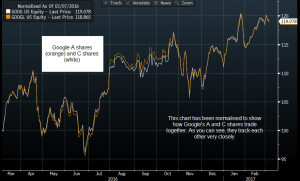
Overall, if Snap fails to change its strategy then it is hard to see how the shares can rally with all of this negative attention, particularly if they don’t make it onto the indices. However, if Snap follows Alphabet’s strategy (the holding company of Google), and divides shares into different classes according to voting rights then it could placate the asset managers. Alphabet’s A shares have voting rights, while its C-class shares do not. Although the C shares trade at an approx. $20 per share discount to the A shares, both A and C class shares have been moving in the same direction, suggesting that there is demand out there for shares without voting rights (see figure 1 below).
Of course, Google is a very different company to Snap, with a track record of strong profits. Snap does not have this pedigree, which means that Alphabet is not a like-for-like comparison with Snap, so treat it with caution.
Social media IPOs: a mixed bag
Overall, social media companies have had mixed success with listing on the stock market, with Twitter and Linkedin struggling, while Facebook and Google have thrived. The one thing these companies have in common is that they are all listed on a US equity index. If Snap cannot get listed on an index, it is hard to see a positive future for this company’s share price, especially since it is not expected to make profits until at least 2020 and is unlikely to pay a dividend to shareholders for many years. The first obvious downside target is IPO price of $17, with some analysts looking for further declines towards $10 per share in the medium-term.
Figure 1:
Source: City Index and Bloomberg
Related tags:




Open an account in minutes
Experience award-winning platforms with fast and secure execution, and enjoy tight spreads from 0.5 pts on FX and 0.3 pts on indices.
Economic calendar
Web Trader platform
Our sophisticated web-based platform is packed with features.
Related articles
This report is intended for general circulation only. It should not be construed as a recommendation, or an offer (or solicitation of an offer) to buy or sell any financial products. The information provided does not take into account your specific investment objectives, financial situation or particular needs. Before you act on any recommendation that may be contained in this report, independent advice ought to be sought from a financial adviser regarding the suitability of the investment product, taking into account your specific investment objectives, financial situation or particular needs.
StoneX Financial Pte. Ltd., may distribute reports produced by its respective foreign entities or affiliates within the StoneX group of companies or third parties pursuant to an arrangement under Regulation 32C of the Financial Advisers Regulations. Where the report is distributed to a person in Singapore who is not an accredited investor, expert investor or an institutional investor (as defined in the Securities Futures Act), StoneX Financial Pte. Ltd. accepts legal responsibility to such persons for the contents of the report only to the extent required by law. Singapore recipients should contact StoneX Financial Pte. Ltd. at 6826 9988 for matters arising from, or in connection with the report.
In the case of all other recipients of this report, to the extent permitted by applicable laws and regulations neither StoneX Financial Pte. Ltd. nor its associated companies will be responsible or liable for any loss or damage incurred arising out of, or in connection with, any use of the information contained in this report and all such liability is hereby expressly disclaimed. No representation or warranty is made, express or implied, that the content of this report is complete or accurate.
StoneX Financial Pte. Ltd. is not under any obligation to update this report.
Trading CFDs carries a high level of risk that may not be suitable for some investors. Consider your investment objectives, level of experience, financial resources, risk appetite and other relevant circumstances carefully. The possibility exists that you could lose some or all of your investments, including your initial deposits. If in doubt, please seek independent expert advice. Visit www.forex.com/en-sg/terms-and-policies for the complete Risk Disclosure Statement.