

Throughout the week, oil prices have continued to climb, and WTI has accumulated gains of more than 19% over the last four trading sessions. The barrel has even reached the $80 per barrel area, a level not seen in several months.
For now, as geopolitical tensions continue to impact markets, concerns are centered around a potential supply disruption that could threaten international crude trade. This concern has allowed buying pressure to remain consistent in the short term. If tensions in the Middle East continue to escalate, the bullish bias may remain relevant in the coming sessions.
Uncertainty Persists
Several sessions have passed since military attacks began between Israel, Iran, and the United States, and the conflict has escalated to a point where activity in the Strait of Hormuz remains compromised. More than 20% of global oil production transits through this maritime route.
So far, no consistent agreements point toward a rapid de-escalation. In fact, Iran has stated that it plans to intensify its response to recent attacks, while China has reportedly asked its main refineries to suspend diesel and gasoline exports in recent days.
This situation has heightened concerns over potential disruptions in global crude production and distribution. With more than 20% of global supply dynamics at risk, expectations regarding available barrels in circulation have been reduced, increasing the risk of a temporary supply deficit.
In this context, oil prices have maintained a preventive bullish bias. As long as the possibility of further disruptions remains—such as attacks on refineries or strategic infrastructure—the market may continue pricing in a restricted supply scenario.
For now, the market anticipates that volatility will remain elevated in the coming sessions. The OVX index, which measures implied volatility in oil ETF options and serves as a 30-day expectations benchmark, remains at its highest levels in the past six months, reaching the 75-point area. This reflects a consistent increase in expected volatility over the last four trading sessions.
The rise in OVX indicates that the market is pricing in larger price swings in WTI, suggesting a higher geopolitical risk premium and increased demand for hedging among institutional participants.

Source: MacroMicro
In this environment, the combination of persistent tensions and rising expected volatility reinforces the possibility of aggressive price movements in the short term. If a new escalation occurs, additional gains could accumulate, sustaining meaningful buying pressure. However, if signs of de-escalation or diplomatic agreements emerge, a significant corrective move in WTI prices could also develop.
Technical Outlook for WTI
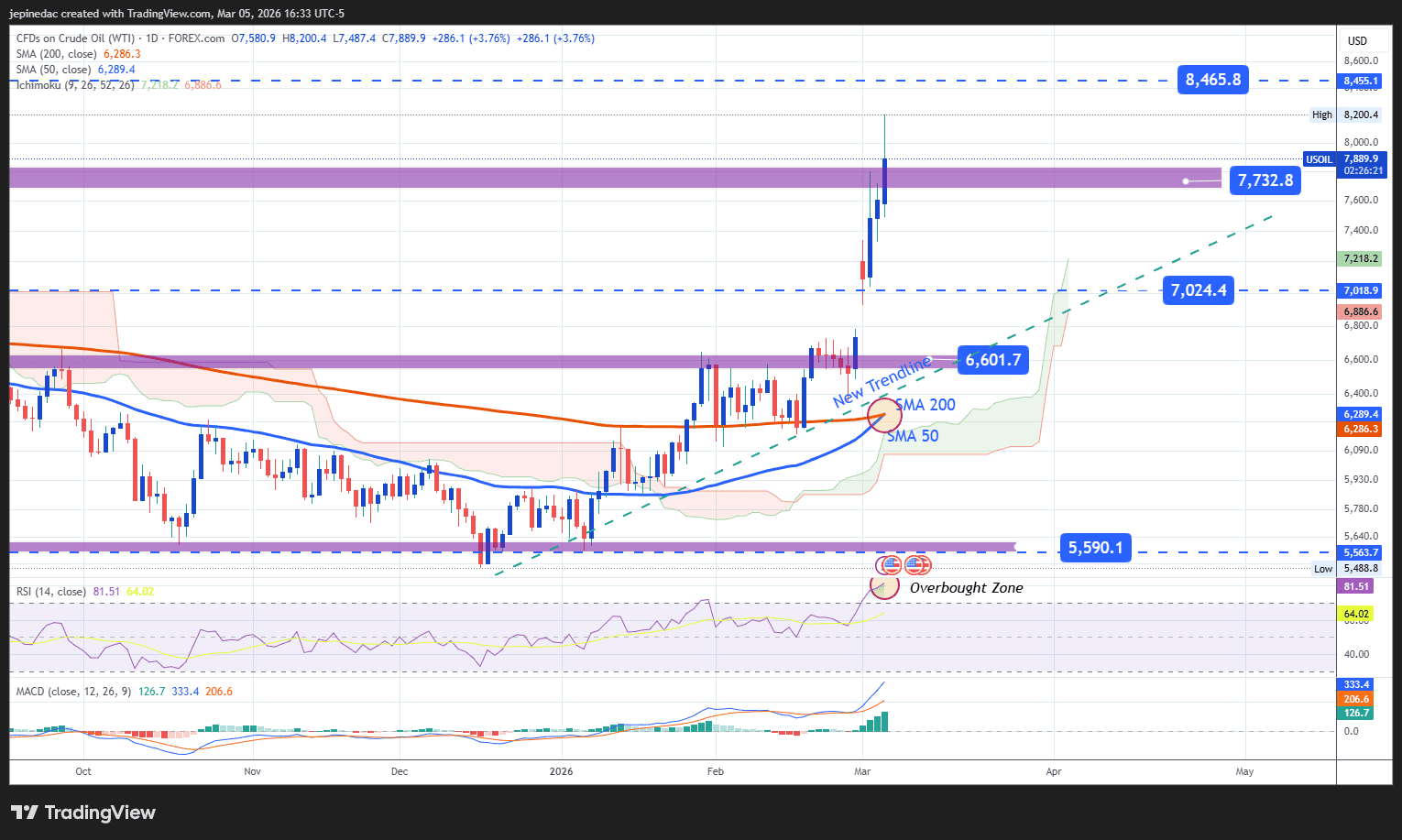
Source: StoneX, Tradingview
- Uptrend Begins to Dominate the Market: Since late December 2025, WTI has been forming a new upward trendline on the daily chart. Recent buying pressure has reaffirmed this technical structure, which now stands as the dominant formation and maintains a bullish short-term bias. Additionally, the 50-period moving average is approaching a crossover above the 200-period moving average, which could further reinforce medium-term strength. However, the rapid pace of recent gains may also be creating a scenario of overextended buying pressure, leaving room for potential technical corrections in the coming sessions.
- RSI: The RSI shows dominance of bullish momentum but currently remains above the 70 level, indicating overbought conditions. This suggests that recent upward pressure may be overextended, opening the door to potential short-term corrective pullbacks.
- MACD: The MACD displays a positive histogram above the zero line, confirming that short-term moving average momentum remains tilted to the upside. Despite the possibility of corrections, the broader technical structure continues to favor a bullish bias.
Key Levels:
- $84 – Key resistance: Level corresponding to highs not seen since 2024 and the most relevant bullish barrier at this stage. Sustained moves above this area could trigger a more aggressive extension of the uptrend.
- $77 – Near-term barrier: Recent neutrality zone that may serve as a reference level in the event of pullbacks. It could function as intermediate support during corrections.
- $70 – Key support: Major psychological level aligned with the prevailing upward trendline. A break below this zone could threaten the current bullish structure and restore dominance to the bearish bias in the medium term.
Written by Julian Pineda, CFA, CMT – Market Analyst
Follow him on: @julianpineda25