



EUR/USD Forecast: Euro Faces Levels Not Seen Since April 2025
Trading conditions continue to be quite challenging for the euro in the short term. The European currency remains under considerable pressure against the U.S. dollar, a dynamic that can be clearly seen in the behavior of EUR/USD, which has started the week down nearly 0.7%.
Share this:

Trading conditions continue to be quite challenging for the euro in the short term. The European currency remains under considerable pressure against the U.S. dollar, a dynamic that can be clearly seen in the behavior of EUR/USD, which has started the week down nearly 0.7%. This continues to highlight that the selling pressure observed over recent weeks remains relevant and that market participants are still favoring the U.S. dollar for the time being.
The bearish pressure around the pair continues to be driven mainly by the divergence in expectations surrounding the central banks of both regions. Now, markets continue to view the Federal Reserve as potentially more aggressive than the European Central Bank, a situation that keeps favoring dollar strength. At the same time, the U.S. currency continues to benefit from its role as a short-term liquidity haven. If this dynamic remains in place, the selling pressure observed around EUR/USD could continue to be a relevant feature during the coming trading sessions.

Are Changing Central Bank Expectations Becoming More Evident?
When looking at the recent performance of both the euro and the U.S. dollar, it is important to keep in mind that much of the current dynamic is driven by what markets expect from central banks over the coming months. Interest rate expectations remain one of the most important drivers of a currency's relative attractiveness and, at the moment, a meaningful divergence between the Federal Reserve and the European Central Bank is becoming increasingly evident.
On one side, recent comments from the ECB continue to reflect a relatively cautious and moderate tone. On the other hand, the Federal Reserve has continued emphasizing that inflationary pressures remain relevant, leaving the door open to a higher interest rate environment in the months ahead. As a result, markets have started to consider that there is room for the U.S. central bank to maintain a more aggressive stance than its European counterpart.
This difference in expectations can be seen in current market pricing. In Europe, the deposit rate remains around 2.50%, with more than a 90% probability of moving toward 2.75% during the December 17 meeting. However, when looking at expectations for the February 2027 meeting, markets currently expect rates to remain relatively unchanged. This suggests that investors still see room for one final rate hike before year-end, but do not expect a prolonged tightening cycle afterward, highlighting a relatively neutral outlook for the European Central Bank.
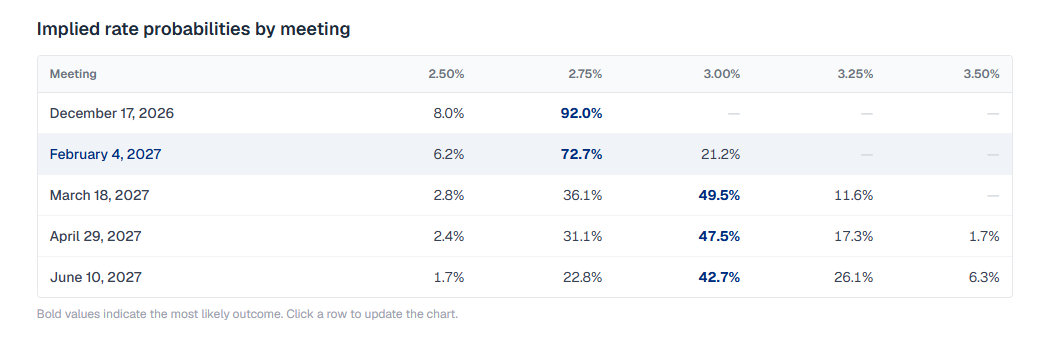
Source: ECBWATCH
The outlook surrounding the Federal Reserve, however, is considerably different. While, just as in Europe, more than a 95% probability is currently assigned to a December rate hike that would move the benchmark rate from 4.00% toward 4.25%, what stands out is what comes next. For the January 27, 2027 meeting, markets are currently pricing in nearly a 70% probability of another rate increase, which would take the benchmark rate toward the 4.50% area during the first months of next year.
This expectation creates a meaningful divergence compared to the European Central Bank because, while Europe is expected to move toward a relatively stable monetary policy environment, the United States is increasingly being viewed as entering another phase of rate increases. As a result, expectations for a more aggressive Fed continue to gain traction.
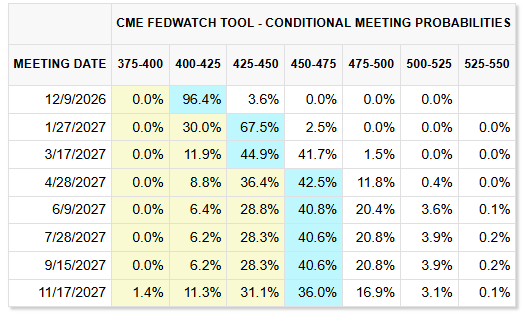
Source: CMEGROUP
What is important to keep in mind is that an environment of increasingly higher interest rates in the United States may continue favoring demand for dollar-denominated investments. At the same time, the uncertainty observed across several markets in recent weeks has also helped the dollar regain importance as a short-term liquidity safe haven.
Beyond expectations for higher rates, it is also important to remember that the U.S. dollar remains the world's primary reserve and funding currency. The combination of both factors has helped generate relatively consistent demand for the currency. This dynamic can be clearly observed in the behavior of the DXY Index, which measures the strength of the dollar against its major peers and continues to trade at 2026 highs above the 104-point area while maintaining a relatively consistent upward slope. Altogether, this suggests that demand for the U.S. dollar remains relevant in the short term.
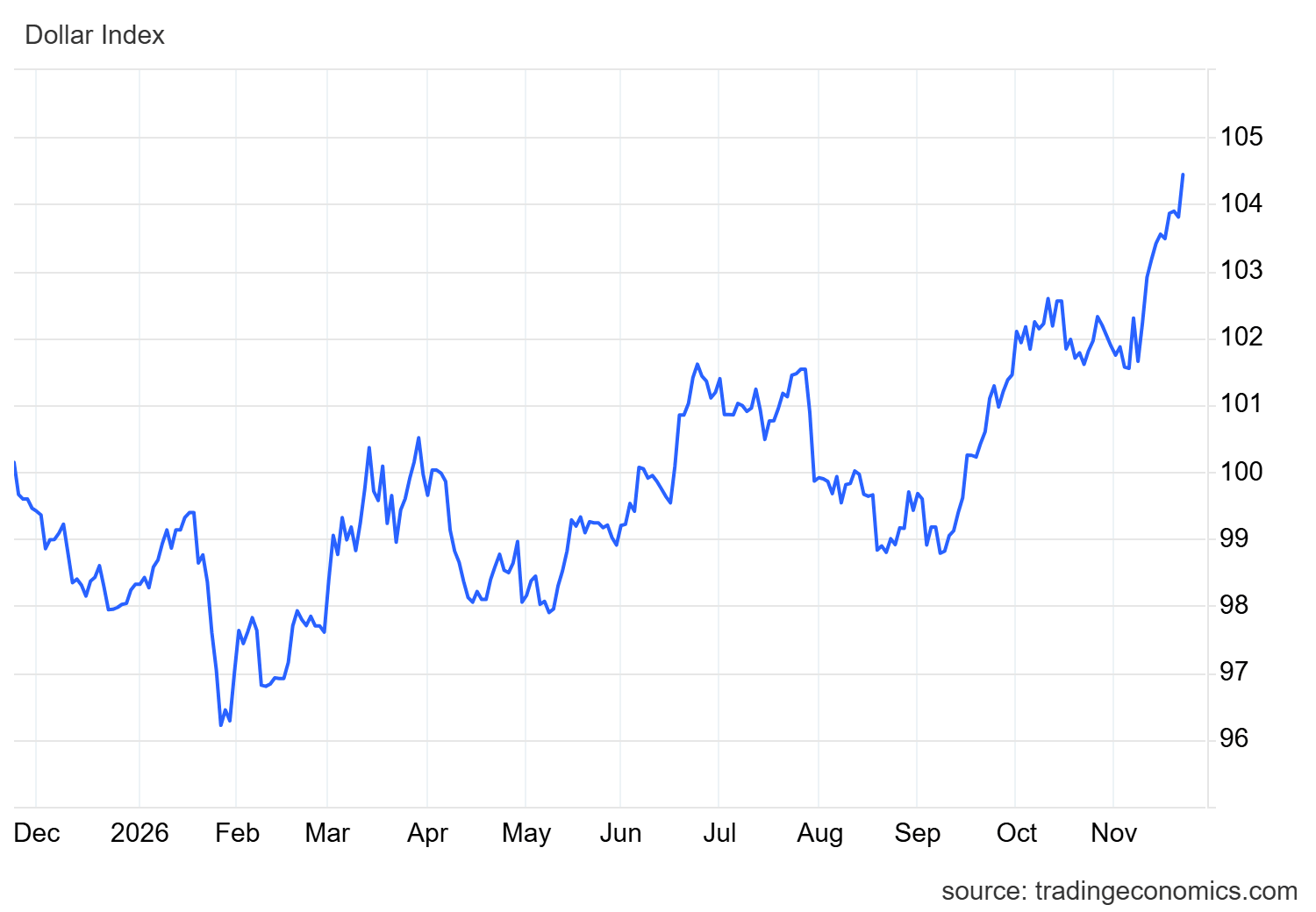
Source: TradingEconomics
The euro appears to be facing a difficult environment in the near term. As long as markets continue pricing in a European central bank that is perceived as less aggressive than the Fed, the interest rate differential could continue favoring the United States. This may keep the relative attractiveness of euro-denominated investments under pressure. In addition, the dollar continues to benefit from its role as a liquidity safe haven and, unless there are developments capable of significantly changing these fundamentals, the selling pressure observed in recent weeks could continue to be relevant around EUR/USD.
EUR/USD Technical Forecast
Source: StoneX, Tradingview
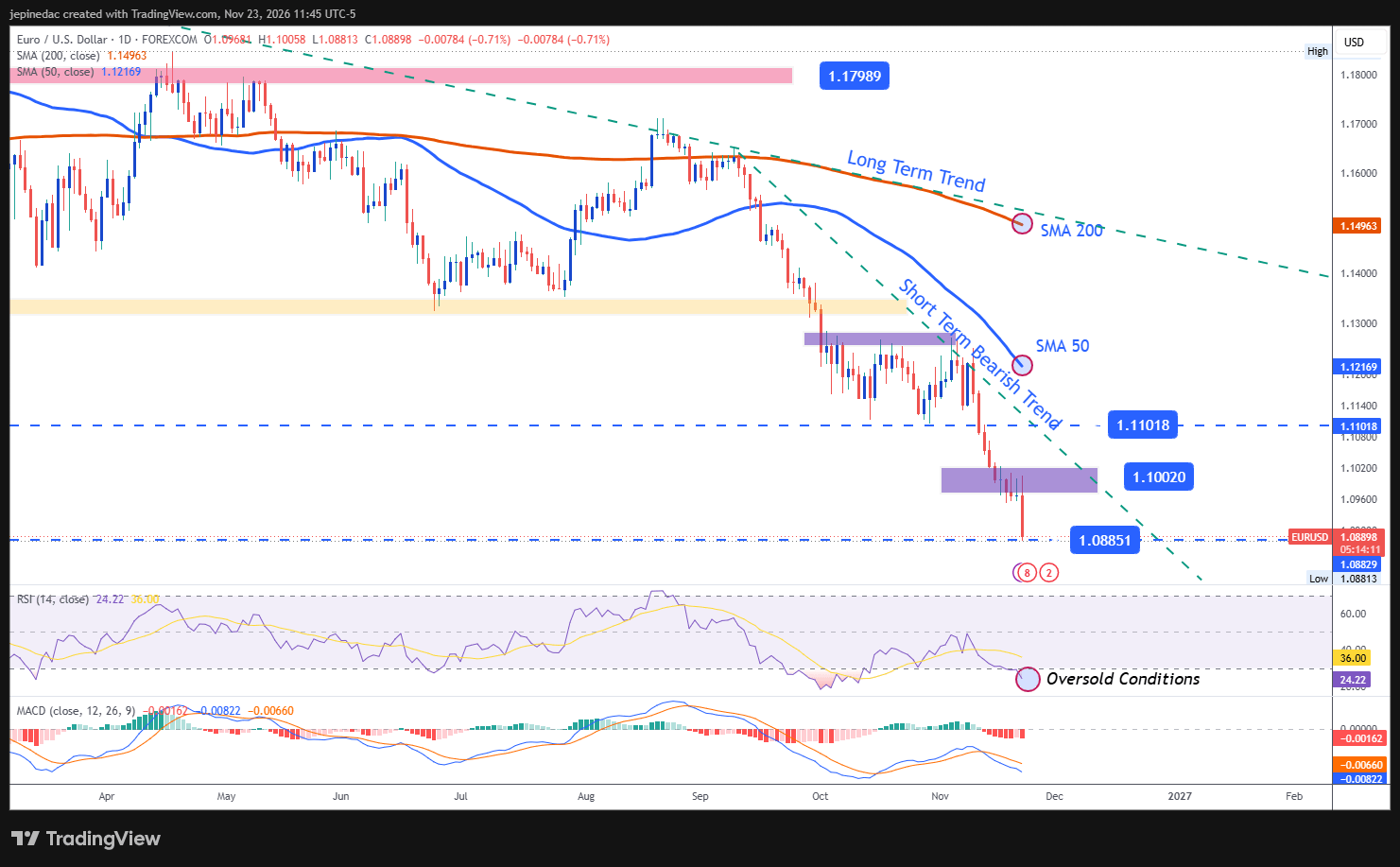
• A more aggressive bearish trend is becoming relevant: While the primary structure in EUR/USD has remained a long-term bearish trendline for several months, a more accelerated bearish phase has started to develop in recent weeks, giving shape to a potential short-term downward trendline. As selling pressure continues breaking through important downside barriers, this newer technical structure could continue gaining relevance over the coming weeks. However, it is also important to keep in mind that the recent decline has been relatively aggressive and could eventually create room for short-term bullish corrections.
• MACD: The MACD histogram remains below the indicator's neutral 0 level, reflecting continued selling pressure in short-term moving averages. As long as this reading remains intact, the current bearish bias could continue to be relevant in the weeks ahead.
• RSI: The RSI shows a similar picture as it continues to trade below its neutral level. However, it is also important to note that the indicator has started moving closer to the 30 oversold area, a situation that could be warning of excessive recent selling pressure and may eventually create room for short-term bullish corrections.
Key Levels:
• 1.11018 – Key Resistance: This level corresponds to an important retracement area seen several weeks ago and currently represents the most important upside barrier to monitor. Price action returning to this level could begin highlighting a more consistent lack of direction and may even open the door to a broader period of sideways trading over the coming weeks.
• 1.10020 – Nearby Barrier: A retracement area observed in recent sessions that also coincides with an important psychological reference around a key round number. It could become the main level to monitor if short-term bullish corrections begin to develop.
• 1.08851 – Critical Support: A level not seen since April 2025 that currently represents the most important downside barrier on the chart. Price action that continues to maintain selling pressure around this area could keep highlighting the dominance of the current bearish bias and may continue extending the short-term bearish trendline as the dominant technical structure during the coming sessions.
Written by Julian Pineda, CFA, CMT – Market Analyst
Follow him on: @julianpineda25
Latest market news




Open an account today
Experience award-winning platforms with fast and secure execution.
Economic calendar
Web Trader platform
Our sophisticated web-based platform is packed with features.
Related articles
US Dollar Price Action Setups into PCE: EUR/USD, GBP/USD, USD/JPY, USD/CAD
USD/JPY has continued to hold below the 160.00 level but it’s the EUR/USD sell-off below 1.1000 that’s been most attention grabbing around the USD complex.
Canadian Dollar Forecast: USD/CAD Rally Stalls at Yearly High—Correction Risk Builds 11 24 2026
USD/CAD’s November rebound faces its first meaningful setback, with buyers defending trend support as momentum divergence warns of fatigue.

EUR/USD outlook: Fed hawkishness priced in as Ifo hits 3-year high
The euro is bouncing from the 61.8% Fibonacci retracement as the dollar takes a breather after Monday's surge. With Fed hawkishness largely priced in and Germany's Ifo at a three-year high, a close above 1.1000 would signal a near-term low.

From time to time, StoneX Financial Pty Ltd (“we”, “our”) website may contain links to other sites and/or resources provided by third parties. These links and/or resources are provided for your information only and we have no control over the contents of those materials, and in no way endorse their content. Any analysis, opinion, commentary or research-based material on our website is for information and educational purposes only and is not, in any circumstances, intended to be an offer, recommendation or solicitation to buy or sell. You should always seek independent advice as to your suitability to speculate in any related markets and your ability to assume the associated risks, if you are at all unsure. No representation or warranty is made, express or implied, that the materials on our website are complete or accurate. We are not under any obligation to update any such material.
As such, we (and/or our associated companies) will not be responsible or liable for any loss or damage incurred by you or any third party arising out of, or in connection with, any use of the information on our website (other than with regards to any duty or liability that we are unable to limit or exclude by law or under the applicable regulatory system) and any such liability is hereby expressly disclaimed.