



EUR/USD Forecast Weighed by Crude Oil, Dollar Upsurge - Currency Pair of The Week
Energy prices are once again setting the tone for currency markets, with the renewed tensions in the Middle East reinforcing the dollar’s appeal while weighing on low-yielding and energy-importing currencies. As oil and natural gas prices climb, investors are becoming increasingly reluctant to price out further Fed tightening, providing the greenback with another tailwind.
Share this:

Energy prices are once again setting the tone for currency markets, with the renewed tensions in the Middle East reinforcing the dollar’s appeal while weighing on low-yielding and energy-importing currencies. As oil and natural gas prices climb, investors are becoming increasingly reluctant to price out further Fed tightening, providing the greenback with another tailwind. This is keeping the near-term EUR/USD forecast tilted to the downside.
Dollar remains bid as oil climbs on fresh escalation
At the weekend, the US launched fresh strikes on dozens of Iranian military targets after Iran attacked commercial shipping in the Strait of Hormuz. Targets reportedly included air-defense systems, radar installations, missile and drone capabilities, and naval assets. In retaliation, Iran said it targeted US military bases in Jordan, Bahrain, and Kuwait, as well as radar systems in Oman.
The latest exchanges mark a significant intensification of tensions between Washington and Tehran. Last week, US President Donald Trump declared that the US-Iran ceasefire was “over” and sharply criticized Iran’s leadership. What it means for the markets is that the re-escalation has disrupted maritime traffic through the Strait of Hormuz. No commercial vessels have transited the waterway since Sunday evening, according to reports tracking shipping data. In turn, oil prices have surged higher again.
With crude oil rising once again, the obvious question is: what does this mean for the US dollar?
Given that the Fed’s new chairman has made it clear that he wants to keep inflation under control, another spike in oil prices is likely to reinforce expectations that US interest rates will stay higher for longer. Even if some of the near-term economic data softens, persistently high energy prices would make it difficult for the Fed to adopt a more dovish stance.
That is one of the reasons why we’re seeing the US dollar regain momentum, particularly against currencies whose economies are heavily reliant on imported energy, such as the euro and the Japanese yen.
Should Iran succeed in disrupting shipping through the Strait of Hormuz for al lengthy period of time once again, the US is likely to be viewed as relatively insulated thanks to its energy independence. At the same time, higher oil prices would add to inflationary pressures, making it harder for the Fed not to signal intentions of policy tightening.
US CPI and Warsh testimony in focus
The focus now turns to a busy week for US economic data and Federal Reserve officials. Tuesday’s inflation report will be closely watched, with headline CPI expected to ease 0.1% on a monthly basis, lowering the year-over-year rate to 3.8% from 4.2%. However, firmer energy prices and sticky core inflation, still hovering around 2.9% year-on-year, suggest it remains premature to rule out at least one rate increase before the end of the year.
Markets will also hear from Fed Chair Kevin Warsh as he begins two days of testimony before Congress. Investors will be looking for any clues on the policy outlook. With energy prices firming and little evidence that the US economy is slowing enough to offset inflation risks, Warsh is unlikely to sound dovish at all. So, the fundamental backdrop continues to favour the dollar.
That leaves low-yielding, energy-dependent currencies such as the euro and the yen particularly vulnerable, meaning that the EUR/USD forecast is tilted to the downside. Of particular concern for Europe is the renewed strength in natural gas prices, especially with inventories still relatively low and demand rising (for air cooling systems) amid elevated summer temperatures.
Technical EUR/USD forecast and key levels to watch
That combination leaves the euro exposed. In the near term, the EUR/USD could drift back towards the 1.1350 region, with a follow-up move into the 1.1300 area looking increasingly plausible over the coming days and weeks.
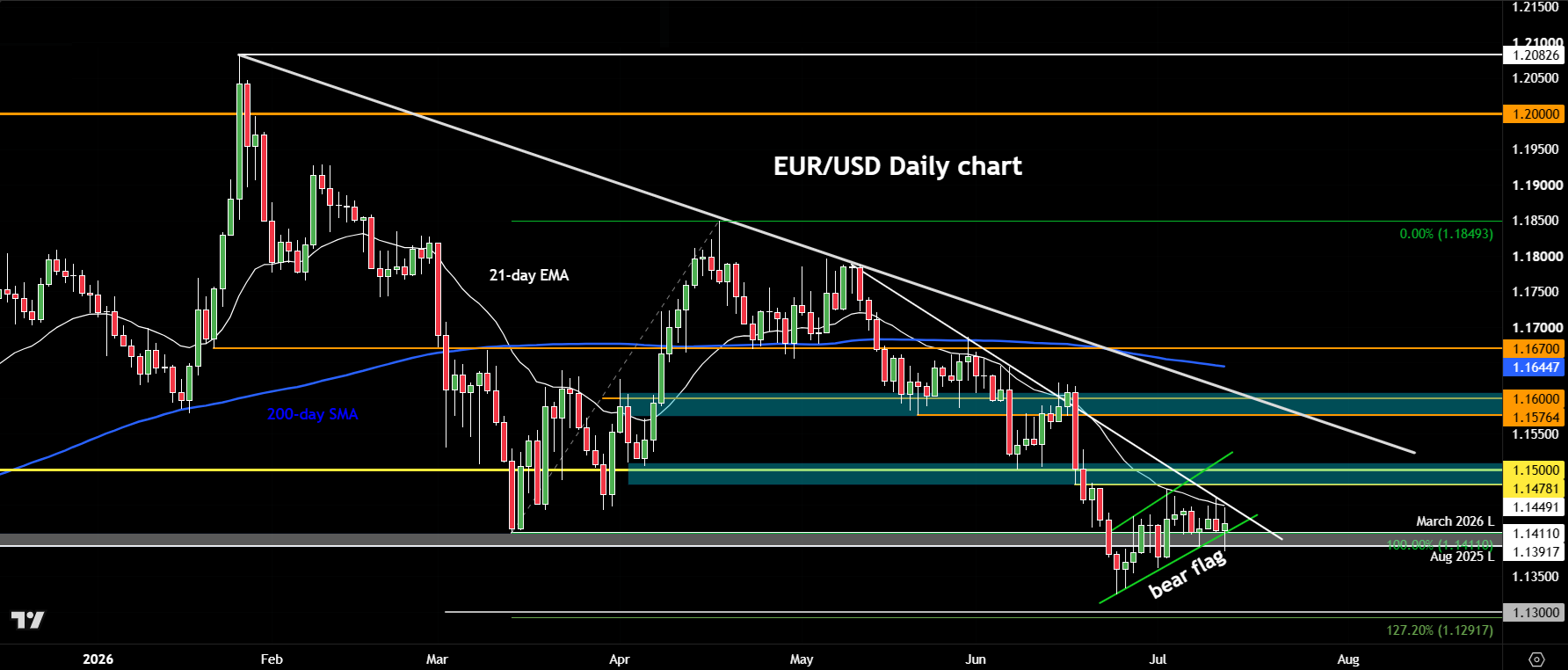
There is also a bearish flag pattern to consider, too. If there EUR/USD breaks below the support trend of the pattern, which is what I expect, then at the very least I’d anticipate a retest of the recent lows around 1.1324.
Below that the 1.1300 area would come into focus. This level also lines up with the 127.2% Fibonacci extension of the major advance we saw between March and April. Given what’s happening in the oil market, together with the prospect of a more hawkish Fed, the path of least resistance for EUR/USD still appears to be to the downside.
Resistance is seen around 1.1450, followed by the 1.1480-1.1500 region.
Meanwhile, the European data calendar is relatively quiet this week, meaning short-term moves in the euro are likely to be driven more by developments in energy markets and shifts in US rate expectations than by domestic fundamentals.

-- Written by Fawad Razaqzada, Market Analyst
Follow Fawad on Twitter @Trader_F_R
Latest market news




Open an account today
Experience award-winning platforms with fast and secure execution.
Economic calendar
Web Trader platform
Our sophisticated web-based platform is packed with features.
Related articles
S&P 500 forecast: tech rally loses momentum as Nvidia doubts linger
The Nvidia-led relief rally has faded quickly, with Anthropic below its IPO price and chip curbs still weighing on sentiment. The S&P 500 needs to reclaim its old support zone before a bottom can be confirmed.
US Dollar Technical Outlook: DXY Hits 2026 High—Major Trend Resistance Puts Rally to the Test 11 24 2026
Despite the Dollar’s persistent strength, a pullback from key resistance raises the risk of near-term exhaustion as DXY approaches support.

Currencies, Commodities, and Indices Test Key Confluence Zones
The U.S. dollar index sits near its 2026 high as Fed rate hike risk and U.S.-Iran tensions push gold, stocks and Bitcoin onto key support levels.

From time to time, StoneX Financial Pty Ltd (“we”, “our”) website may contain links to other sites and/or resources provided by third parties. These links and/or resources are provided for your information only and we have no control over the contents of those materials, and in no way endorse their content. Any analysis, opinion, commentary or research-based material on our website is for information and educational purposes only and is not, in any circumstances, intended to be an offer, recommendation or solicitation to buy or sell. You should always seek independent advice as to your suitability to speculate in any related markets and your ability to assume the associated risks, if you are at all unsure. No representation or warranty is made, express or implied, that the materials on our website are complete or accurate. We are not under any obligation to update any such material.
As such, we (and/or our associated companies) will not be responsible or liable for any loss or damage incurred by you or any third party arising out of, or in connection with, any use of the information on our website (other than with regards to any duty or liability that we are unable to limit or exclude by law or under the applicable regulatory system) and any such liability is hereby expressly disclaimed.