



Inflation fears hitting Emerging Markets Currencies
If the US Dollar remains strong, emerging markets may continue to feel the pinch
Share this:

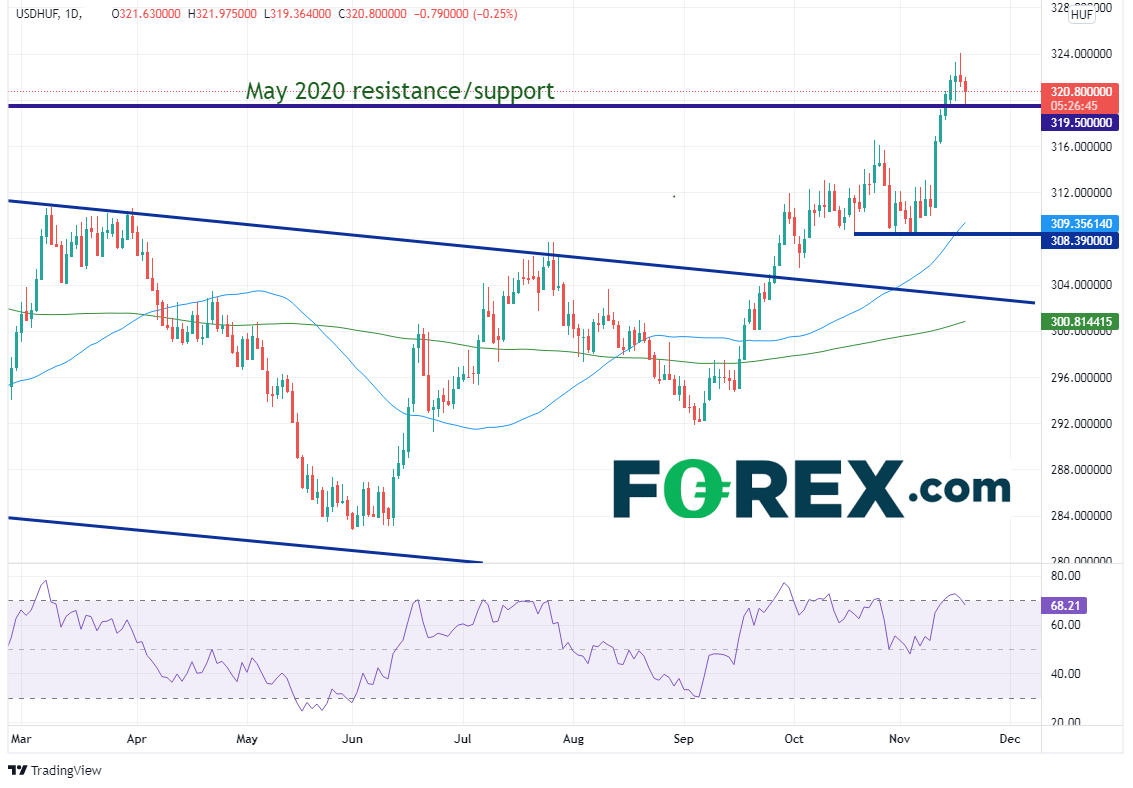
Earlier this week. the National Bank of Hungary raised interest rates 30bps to 2.1%, the highest level since February 2015. This was the 6th rate hike in a row. On Tuesday, USD/HUF reached its highest level since May 2020 near 324.00 as traders feared more hikes are necessary. The CPI reading for October was 6.5%. Wednesday’s candlestick was a shooting star, however so far today, there hasn’t been any follow through.
Source: Tradingview, Stone X
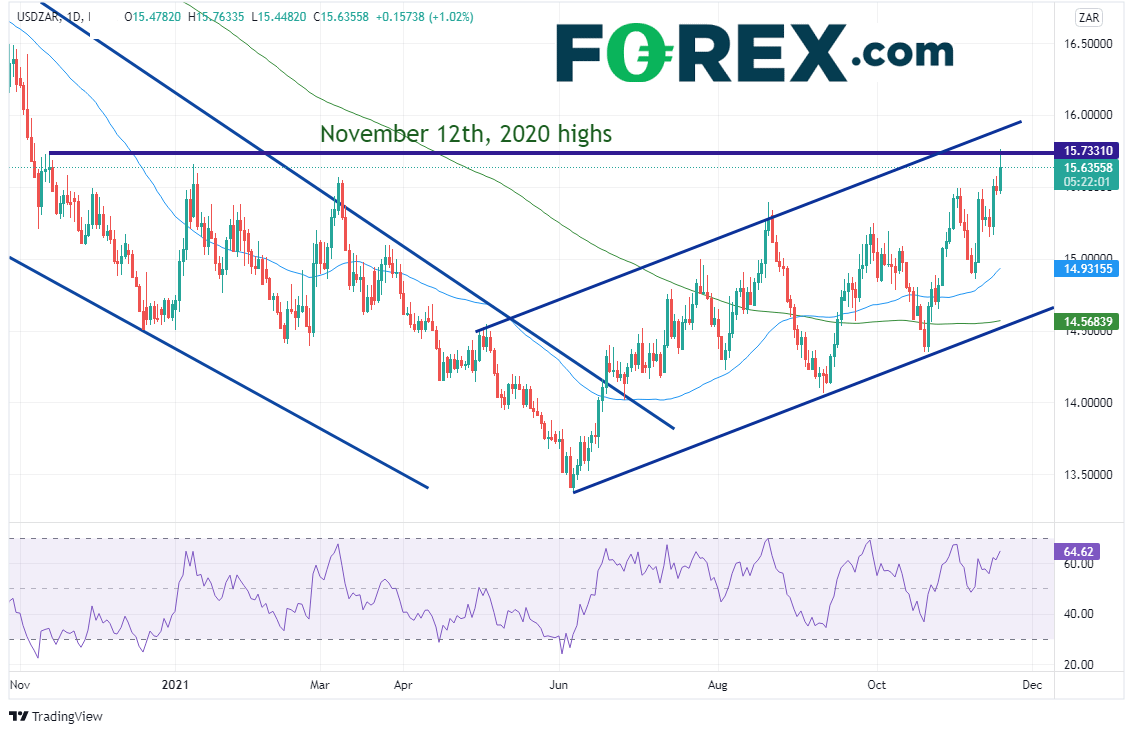
Today, the South African Reserve Bank (SARB) raised interest rates by 25bps to 3.75%. The expectation was for unchanged at 3.5%. This was the first hike in 3 years. The Central Bank cited inflation risks as the primary reason for the hike. USD/ZAR rose to its highest levels since early November 2020 near 15.76.
Source: Tradingview, Stone X
Trade Emerging Market currencies now: Login or open a new account!
As we have wrote about earlier this week, the Central Bank of Turkey met today and cut rates by 100bps from 16% to 15%, as expected, despite inflation readings of near 20%. The target inflation is 5%. Note that this is unconventional. The reason they cut is that President Erdogan does not like high interest rates! The committee said the inflation is transitory and will that they will access ending the rate cuts in December (that would be if President Erdogan says its ok). USD/TRY rose to its highest level ever, up nearly 12.5% this week as markets expect more rate cuts to come!

Source: Tradingview, Stone X
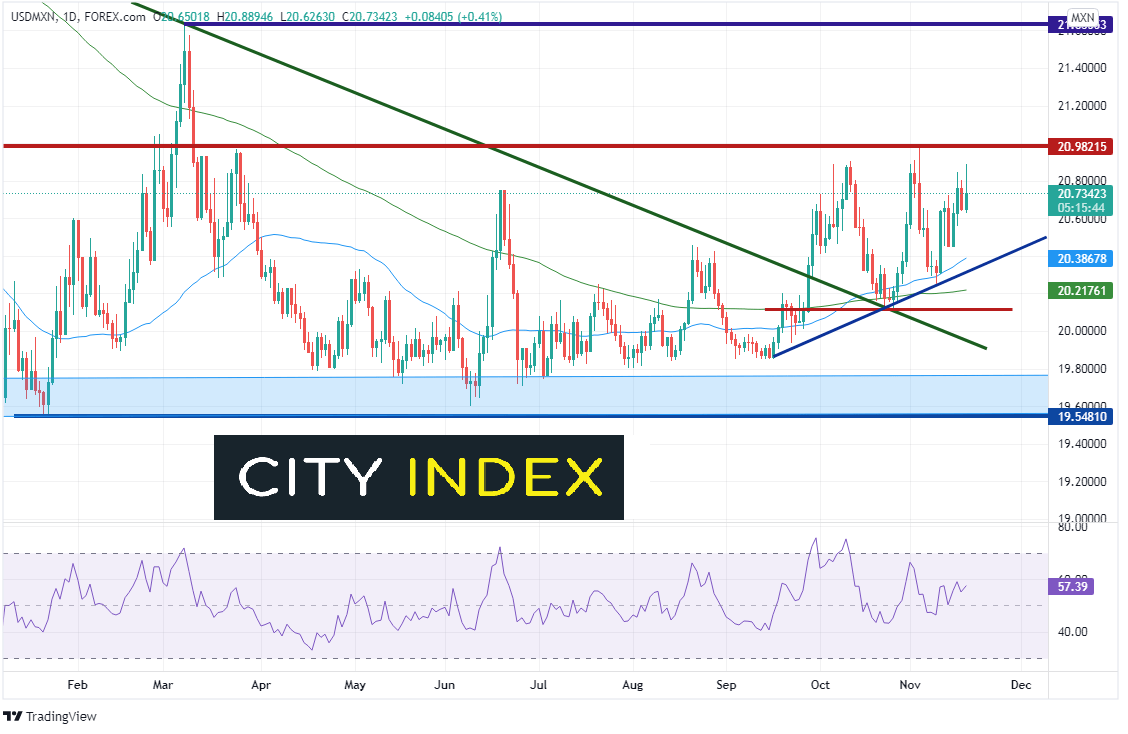
Last week, the Central Bank of Mexico hiked rates by 25bps to 5% as inflation rose to 6.24%, its highest level since December 2017. On November 3rd, USD/MXN tested horizontal resistance at 20.9821, but failed. Price is creeping back up towards that level again today as the pair currently trades near 20.7385 (and is making higher highs and higher lows).

Source: Tradingview, Stone X
The strong US Dollar as of late isn’t helping the situation in Emerging Markets. This weakens the value of the counter currency; thus, foreign goods are more expensive. If the US Dollar remains strong (due to higher inflation rate expectations and higher interest rate expectations), emerging markets may continue to feel the pinch. However, if expectations rise for central banks (non-US) to raise rates, it may ease the burden a little, all other things considered.
Learn more about forex trading opportunities.
Earlier this week. the National Bank of Hungary raised interest rates 30bps to 2.1%, the highest level since February 2015. This was the 6th rate hike in a row. On Tuesday, USD/HUF reached its highest level since May 2020 near 324.00 as traders feared more hikes are necessary. The CPI reading for October was 6.5%. Wednesday’s candlestick was a shooting star, however so far today, there hasn’t been any follow through.

Source: Tradingview, Stone X
Today, the South African Reserve Bank (SARB) raised interest rates by 25bps to 3.75%. The expectation was for unchanged at 3.5%. This was the first hike in 3 years. The Central Bank cited inflation risks as the primary reason for the hike. USD/ZAR rose to its highest levels since early November 2020 near 15.76.

Source: Tradingview, Stone X
Trade Emerging Market currencies now: Login or Open a new account!
• Open an account in the UK
• Open an account in Australia
• Open an account in Singapore
As we have wrote about earlier this week, the Central Bank of Turkey met today and cut rates by 100bps from 16% to 15%, as expected, despite inflation readings of near 20%. The target inflation is 5%. Note that this is unconventional. The reason they cut is that President Erdogan does not like high interest rates! The committee said the inflation is transitory and will that they will access ending the rate cuts in December (that would be if President Erdogan says its ok). USD/TRY rose to its highest level ever, up nearly 12.5% this week as markets expect more rate cuts to come!

Source: Tradingview, Stone X
Last week, the Central Bank of Mexico hiked rates by 25bps to 5% as inflation rose to 6.24%, its highest level since December 2017. On November 3rd, USD/MXN tested horizontal resistance at 20.9821, but failed. Price is creeping back up towards that level again today as the pair currently trades near 20.7385 (and is making higher highs and higher lows).
Source: Tradingview, Stone X
The strong US Dollar as of late isn’t helping the situation in Emerging Markets. This weakens the value of the counter currency; thus, foreign goods are more expensive. If the US Dollar remains strong (due to higher inflation rate expectations and higher interest rate expectations), emerging markets may continue to feel the pinch. However, if expectations rise for central banks (non-US) to raise rates, it may ease the burden a little, all other things considered.
Learn more about forex trading opportunities.
Related tags:


Open an account today
Experience award-winning platforms with fast and secure execution.
Economic calendar
Web Trader platform
Our sophisticated web-based platform is packed with features.
Related articles

NZD/USD Outlook: Reversal Signals Emerge as AI Trade Falters
Kiwi prints a reversal signal comes as cracks appear in the US economic exceptionalism story. An orderly rotation away from AI could provide favourable conditions for a rebound, but another brutal risk-off episode may have the opposite effect.


AUD/USD: Bullish Signals Emerge Ahead of Inflation Showdown
AUD/USD is showing early signs of a bullish reversal near key support as Australian CPI, US GDP and PCE inflation threaten to shake up interest-rate expectations.

Canadian Dollar Forecast: USD/CAD Rally Stalls at Yearly High—Correction Risk Builds 11 24 2026
USD/CAD’s November rebound faces its first meaningful setback, with buyers defending trend support as momentum divergence warns of fatigue.

From time to time, StoneX Financial Pty Ltd (“we”, “our”) website may contain links to other sites and/or resources provided by third parties. These links and/or resources are provided for your information only and we have no control over the contents of those materials, and in no way endorse their content. Any analysis, opinion, commentary or research-based material on our website is for information and educational purposes only and is not, in any circumstances, intended to be an offer, recommendation or solicitation to buy or sell. You should always seek independent advice as to your suitability to speculate in any related markets and your ability to assume the associated risks, if you are at all unsure. No representation or warranty is made, express or implied, that the materials on our website are complete or accurate. We are not under any obligation to update any such material.
As such, we (and/or our associated companies) will not be responsible or liable for any loss or damage incurred by you or any third party arising out of, or in connection with, any use of the information on our website (other than with regards to any duty or liability that we are unable to limit or exclude by law or under the applicable regulatory system) and any such liability is hereby expressly disclaimed.