



Market Brief Approaching the eye of the storm
Currency markets have been dominated by the latest Brexit dramas
Share this:


Stock market snapshot as of [3/9/2019 7:54 PM] 
- Currency markets have been dominated by the latest Brexit dramas which saw the pound plunge to its lowest since early January 2017 against the dollar. Parliament is set to have an emergency debate this evening on whether MPs should be granted control of House of Commons business. This is the first stage of a plan sponsored by the Labour Party to pass a Bill that would prevent Prime Minister Boris Johnson from taking Britain out of the European Union without a deal by 31st October if none has been agreed by then. Johnson has hinted that if such a Bill is passed, he could trigger a general election . A race against time is underway in any case, because Parliament is set to be suspended from early next week, and won’t return before 14th October
- Some queasy sentiment from UK affairs may have seeped into broader proceedings in Europe and perhaps beyond. Key Continental markets failed to make headway. Still, investors were keeping their feet off the gas following reports of the day before suggesting U.S. and China officials are struggling to agree on a date in September for substantive talks. Suspicions questioning optimism about such talks began to be aired last week
- As such, key U.S. stock markets, including futures have barely come up for air for the entire global session. The S&P 500 and Nasdaq 100 trade close to their day lows; down 1% a piece at last look
Stocks/sectors on the move
- Apple leads the U.S. benchmark losers with a near 2% drop, even as the group prepares to launch new products next week, including a new Watch. The best-selling smartwatch became the first Apple product to be hit by U.S. tariffs after Washington’s latest round of hiked duties kicked in over the weekend. Apple is now more sensitised to trade impact due to its huge dependence on the Chinese market, where it manufactures, sources supplies and retails
- Whilst precise U.S. landfall remains uncertain, there’s no sense Hurricane Dorian will hit major oil production installations as it moves north west after wreaking devastation on parts of the Bahamas; therefore there’s been little pause in the renewed deflation of energy prices in the wake of global economic and trade fears. Heavyweight energy shares continue to anchor the overall market
- It’s a broad downdraft though, with all but 3 of SPX’s 11 industrial segments trading lower, just now. Industrials, technology and Materials are worse off. Chip shares lead the increasingly beleaguered, trade-sensitive IT sectors. Among semis, groups with the closest ties to China, through supply chains and/or manufacturing bases, fall the most. Broadcom was down 4% a short while ago. Rival game processor makers NVIDIA and AMD lost 2% each. Intel fell 1.3%
FX snapshot as of [3/9/2019 7:49 PM]
FX markets and gold
- FX is mostly about Brexit, keeping sterling under pressure and threatening to cap the euro’s attempts to break sustainably over $1.10 too
- The single currency was assisted somewhat by an ISM manufacturing print that dollar buyers appeared to find deeply dissatisfying
- Elsewhere, the RBA’s surprisingly indecisive turn of phrase when it kept rates on hold overnight was taken as a de facto hawkish signal, enabling the Aussie to advance to a one-week high several hours later
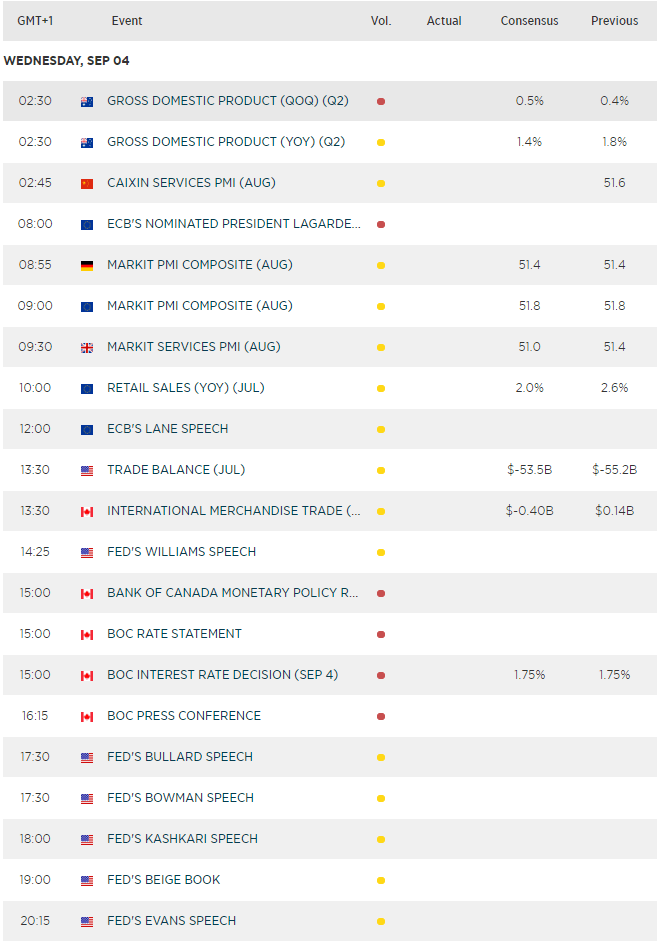
- A full roster of Federal Reserve speakers ahead of the central bank’s pre-decision quiet period are among key points to watch over the coming days. Bank of England Governor Mark Carney, will also make an appearance on Wednesday, when a Treasury Select Committee hearing might become the venue at which his anticipated policy ahead of Britain’s fevered EU exit becomes a cause célèbre again
Upcoming economic highlights

Stock market snapshot as of [3/9/2019 7:54 PM] 
- Currency markets have been dominated by the latest Brexit dramas which saw the pound plunge to its lowest since early January 2017 against the dollar. Parliament is set to have an emergency debate this evening on whether MPs should be granted control of House of Commons business. This is the first stage of a plan sponsored by the Labour Party to pass a Bill that would prevent Prime Minister Boris Johnson from taking Britain out of the European Union without a deal by 31st October if none has been agreed by then. Johnson has hinted that if such a Bill is passed, he could trigger a general election . A race against time is underway in any case, because Parliament is set to be suspended from early next week, and won’t return before 14th October
- Some queasy sentiment from UK affairs may have seeped into broader proceedings in Europe and perhaps beyond. Key Continental markets failed to make headway. Still, investors were keeping their feet off the gas following reports of the day before suggesting U.S. and China officials are struggling to agree on a date in September for substantive talks. Suspicions questioning optimism about such talks began to be aired last week
- As such, key U.S. stock markets, including futures have barely come up for air for the entire global session. The S&P 500 and Nasdaq 100 trade close to their day lows; down 1% a piece at last look
Stocks/sectors on the move
- Apple leads the U.S. benchmark losers with a near 2% drop, even as the group prepares to launch new products next week, including a new Watch. The best-selling smartwatch became the first Apple product to be hit by U.S. tariffs after Washington’s latest round of hiked duties kicked in over the weekend. Apple is now more sensitised to trade impact due to its huge dependence on the Chinese market, where it manufactures, sources supplies and retails
- Whilst precise U.S. landfall remains uncertain, there’s no sense Hurricane Dorian will hit major oil production installations as it moves north west after wreaking devastation on parts of the Bahamas; therefore there’s been little pause in the renewed deflation of energy prices in the wake of global economic and trade fears. Heavyweight energy shares continue to anchor the overall market
- It’s a broad downdraft though, with all but 3 of SPX’s 11 industrial segments trading lower, just now. Industrials, technology and Materials are worse off. Chip shares lead the increasingly beleaguered, trade-sensitive IT sectors. Among semis, groups with the closest ties to China, through supply chains and/or manufacturing bases, fall the most. Broadcom was down 4% a short while ago. Rival game processor makers NVIDIA and AMD lost 2% each. Intel fell 1.3%
FX snapshot as of [3/9/2019 7:49 PM]
FX markets and gold
- FX is mostly about Brexit, keeping sterling under pressure and threatening to cap the euro’s attempts to break sustainably over $1.10 too
- The single currency was assisted somewhat by an ISM manufacturing print that dollar buyers appeared to find deeply dissatisfying
- Elsewhere, the RBA’s surprisingly indecisive turn of phrase when it kept rates on hold overnight was taken as a de facto hawkish signal, enabling the Aussie to advance to a one-week high several hours later
- A full roster of Federal Reserve speakers ahead of the central bank’s pre-decision quiet period are among key points to watch over the coming days. Bank of England Governor Mark Carney, will also make an appearance on Wednesday, when a Treasury Select Committee hearing might become the venue at which his anticipated policy ahead of Britain’s fevered EU exit becomes a cause célèbre again
Upcoming economic highlights
Latest market news




Open an account today
Experience award-winning platforms with fast and secure execution.
Economic calendar
Web Trader platform
Our sophisticated web-based platform is packed with features.
Related articles
Euro Short-term Outlook: EUR/USD Plunges to 19-Month Low—Bears Face Critical Test 11 18 2026
The Euro selloff is now approaching pivotal support, raising the prospect of downside exhaustion as the November decline extends.


Japanese Yen Technical Outlook: USD/JPY Rally Stalls Near 160—Breakout Support in Focus 11 18 2026
USD/JPY has set its weekly range just above former resistance, with a range break likely to determine whether November’s rally has further to run.

US dollar forecast: is NZD/USD ready to form a bottom near its 2020 low?
NZD/USD is testing the 0.5450 to 0.5500 zone that marked its 2020 COVID low. With a hawkish Fed, weaker metals and risk aversion weighing on the Kiwi, is a bottom forming, and what would confirm it?

From time to time, StoneX Financial Pty Ltd (“we”, “our”) website may contain links to other sites and/or resources provided by third parties. These links and/or resources are provided for your information only and we have no control over the contents of those materials, and in no way endorse their content. Any analysis, opinion, commentary or research-based material on our website is for information and educational purposes only and is not, in any circumstances, intended to be an offer, recommendation or solicitation to buy or sell. You should always seek independent advice as to your suitability to speculate in any related markets and your ability to assume the associated risks, if you are at all unsure. No representation or warranty is made, express or implied, that the materials on our website are complete or accurate. We are not under any obligation to update any such material.
As such, we (and/or our associated companies) will not be responsible or liable for any loss or damage incurred by you or any third party arising out of, or in connection with, any use of the information on our website (other than with regards to any duty or liability that we are unable to limit or exclude by law or under the applicable regulatory system) and any such liability is hereby expressly disclaimed.