



Oil surge buoys stocks as yields give
Something had to give, either rising Treasury yields or rising global stocks - stocks were winning on Thursday morning.
Share this:

- Something had to give. A day after global stocks and other ‘risky assets’ rallied in the face of U.S.-Iran geopolitical escalation and the U.S. benchmark Treasury yield creeping back to the psychologically potent 3%, either investors would soon retreat or borrowing costs would. There was a clue in Wall Street’s solid close. The failure of the 10-year yield to sustain gains just 1 tick above 3% for long helped confirm a pause in Treasury selling. Of course, this cross-asset status is inherently unstable. The market’s reaction to ratcheting global risks combined with overbought oil looks out of kilter with sentiment just a week ago. Once giant oil shares are no longer doing the heavy lifting for equities, things could look much different. On Thursday though, markets on both sides of the Atlantic were still rising in unison, if cautiously, following a similar tone among Asian counterparts, where the MSCI’s broadest Asia-Pacific gauge excluding Japan edged up 0.4% despite a shock election result in Malaysia.
- There were also signs that the market expected a tightening crude oil demand/supply balance to support prices, regardless of the ultimate outcome of the U.S.’s exit from Iran nuclear deal. In the futures market, widening premium on nearer-dated contracts compared to those dated further forward, is generally a sign of concern that supply is falling. The ‘December/December’ spread – the difference between contracts expiring at the end of the current year and those expiring in December a year ahead – was at the widest in five years on Thursday. The measure echoed the last time Iran was forced to cut oil exports. At that time, Iranian oil output fell 40% to about 1.3 million barrels a day by late 2013, half Iran’s current output. It’s too early to predict what prices will do this time.
- Either way, the rhetoric out Iran was defiant. Comments by top Tehran officials continued to corral the remaining four signatories to the original Iran deal, aiming to isolate the United States. Meanwhile, OPEC sources said Saudi Arabia was not prepared to act alone to fill any oil shortfall. Elsewhere in OPEC, Venezuela’s cash-strapped funding situation took its own toll on supply. Additionally, whilst Brent futures forward curve continues to show the market expects prices to drift to as low as $67/bbl. in two years the curve is rallying in May next year. It projects prices well above $70/bbl. With Wednesday news that U.S. inventories fell last week, oil has delayed its inflection point for the near term. Brent remained supported on the $77 handle on Thursday, having set its latest 3½-year high at $78/bbl. earlier.
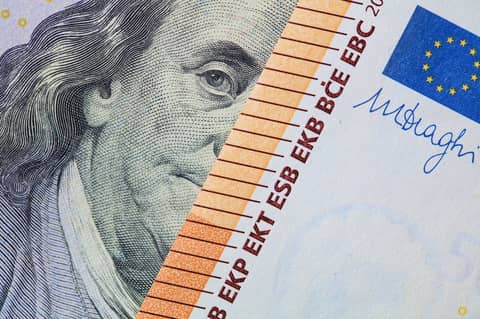
- Consolidation rather than retracement was the word for the dollar. The Dollar Index was perched topside of a significant long-term price of 92.95, a former support before the severe correction beginning in September 2017 and resistance in January. Global news flow supported the greenback. EM currency and yield disruption continued with the introduction of another potential source of instability in Malaysia. Moody’s saw the country in “unchartered waters” after the surprise return of controversial former prime minister Mahathir Mohamad to power via an opposition alliance. Forward contracts on Malaysia's Ringgit tumbled 2% whilst debt insurance costs soared. However, there was little sign that domestic market stress was spreading into nearby regions. In Europe though, the single currency was subtly undermined at the periphery as the spread between the yield of Italian BTPs to bunds widened the most in six weeks. It followed progressing talks between leaders of the anti-immigration Northern League and anti-establishment Five Star. Neither party has the same Eurosceptic edge they used to, but if they succeed in sealing a deal, Italy’s 10-year debt yield could draw the euro towards December’s $1.1718 low from $1.1873 at last check, after the euro scraped a new almost five-month low at 1.1821 on Wednesday.
- With most London trading attention on the Bank of England’s policy and forecast update at midday, missed UK factory prices barely stirred sterling traded against the dollar. The pound continued to inch higher from Tuesday’s four-month lows below $1.35. The lack of a rate rise on Thursday is baked in. What’s in question is the extent of any downgrade of policymakers’ forecasts. The Bank could trim inflation forecasts further but keep a projection that inflation would be slightly above the 2% target in three years’ time. As such, a rate rise would still be required this year to reach that target over the "more conventional horizon" Carney envisaged in February. The Bank’s annual growth target averaging 1.75% over the next three years could see a similar trim. The wild card is how voting (7-2 last time) will play out. Whilst chances are on the outside, the knowledge that tightening is off the cards could encourage additional dissenters to show their hands after Ian McCafferty and Michael Saunders became the first to vote for a hike in March as they were in 2017.




Open an account today
Experience award-winning platforms with fast and secure execution.
Economic calendar
Web Trader platform
Our sophisticated web-based platform is packed with features.
Related articles

EUR/USD Rally Reverses, Dollar Strength Reigns Supreme
EUR/USD put in its first test below the 1.1000 level this week and earlier this morning buyers tried to push price back above. That has so far failed with price action threatening a fresh 19-month low.


EUR/USD Analysis: U.S. Inflation Data Keeps Pressure on the Euro
The trading week continues to unfold and the latest session has once again highlighted weakness around the euro against the U.S. dollar. EUR/USD is down nearly 0.3%, reflecting that the European currency continues to struggle to sustain a consistent recovery in the short term.

EUR/USD Forecast: Euro Under Pressure After Strong NFP Data
As the trading week comes to an end, the euro has once again struggled to sustain a meaningful recovery against the U.S. dollar, highlighting renewed weakness within EUR/USD price action. During the final trading session of the week, the pair declined nearly 0.7%, reflecting that confidence around the European currency remains limited in the short term.
From time to time, StoneX Financial Pty Ltd (“we”, “our”) website may contain links to other sites and/or resources provided by third parties. These links and/or resources are provided for your information only and we have no control over the contents of those materials, and in no way endorse their content. Any analysis, opinion, commentary or research-based material on our website is for information and educational purposes only and is not, in any circumstances, intended to be an offer, recommendation or solicitation to buy or sell. You should always seek independent advice as to your suitability to speculate in any related markets and your ability to assume the associated risks, if you are at all unsure. No representation or warranty is made, express or implied, that the materials on our website are complete or accurate. We are not under any obligation to update any such material.
As such, we (and/or our associated companies) will not be responsible or liable for any loss or damage incurred by you or any third party arising out of, or in connection with, any use of the information on our website (other than with regards to any duty or liability that we are unable to limit or exclude by law or under the applicable regulatory system) and any such liability is hereby expressly disclaimed.