



Tech layoffs: Will Big Tech make more job cuts?
Microsoft, Alphabet, Meta, Amazon and Salesforce are among the biggest names to cut jobs, but are more to come?
Share this:

What you need to know about tech layoffs
Big Tech stocks, along with most businesses, are responding to the sharp and drastic shift in the economy in 2022 that has set the stage for another challenging year in 2023. The upcoming earnings season is expected to be the toughest in years and every single member of Big Tech – Apple, Alphabet, Amazon, Microsoft and Meta – are expected to see earnings decline.
The outlook remains unnerving, especially for growth that underpins their valuations. A recession could be around the corner as interest rates continue to climb to battle persistently high inflation. Demand is weakening from both consumers and businesses, and rising costs are hurting profits.
With growth harder to come by and costs still climbing, the focus is now gradually shifting to which companies can protect profitability during these tougher times by finding savings.
We have already seen 154 tech companies lay off over 55,000 workers since the start of 2023, according to Layoffs.fyi. That is already equal to one-third of the 155,000 workers that lost their jobs in the industry in 2022 and suggests there could be an acceleration this year.
Let’s have a quick look at some of the most significant job cuts to be announced in recent weeks by tech stocks.
Alphabet cuts 12,000 jobs
Alphabet has announced it is cutting 12,000 workers, equal to about 6% of its workforce. CEO Sundar Pichai said the company had grown rapidly in recent years ‘for a different economic reality than the one we face today.’ Alphabet’s workforce has almost doubled since the start of the pandemic, but it is now suffering from a slowdown in the advertising market and cloud-computing, where it continues to lag its larger rivals Microsoft and Amazon. Revenue is expected to rise at the slowest pace on record when it reports its next set of quarterly results, although it is coping with tougher conditions far better than its social media rivals like Meta.
Microsoft cuts 10,000 jobs
Microsoft has announced it is preparing to cut 10,000 jobs by the end of March, representing just under 5% of its workforce. This will cost it around $1.2 billion to complete. That was a slightly shallower cut than what was anticipated after Sky News reported it was looking to cut over 11,000 workers. Microsoft has been on a hiring spree since the start of the pandemic, with its workforce having grown over 50% by June 2022. Demand for everything from software and hardware to its cloud-computing services is easing at a time when costs continue to rise. As a result, Microsoft is expected to report its slowest topline growth in over five years and the first drop in earnings in over eight when it releases results covering the second quarter of its financial year.
Amazon cuts 18,000 jobs
Amazon has started implementing plans to lay off 18,000 workers. This is just 1% of its total global workforce of the ecommerce giant, which is far more labour-intensive than its rivals, but around 5% to 6% of its corporate offices where most of the cuts are being made. Amazon’s overall workforce has more than doubled since the start of the pandemic as the company aggressively recruited to meet the surge in demand that we saw in 2020. The company is set to deliver its slowest revenue growth on record for any holiday shopping season when it releases fourth quarter earnings as ecommerce sales fall and demand for cloud computing softens.
Meta cuts 10,000 jobs
Meta announced in late 2022 that it was cutting 11,000 workers, which is one of the deepest cuts to be made considering this accounts for about 13% of its workforce. Still, Meta has warned earnings will remain under pressure throughout 2023 and has even more reason to slimdown given it is committed to investing billions into its costly metaverse ambitions.
Salesforce cuts 8,000 jobs
Salesforce announced in early 2023 that it was letting 8,000 workers go, accounting for about 10% of its workforce. That will cost it between $1.4 billion to $2.1 billion in charges over multiple quarters. Salesforce said it was in response to a more challenging environment that has seen customers take a ‘more measured approach’ toward spending. Revenue growth has been slowing down and earnings have been squeezed over the past year.
Spotify job cuts to hit 6% of workforce
Spotify has announced that it is reducing the size of its workforce by around 6%. Spotify’s workforce grew over 50% between the end of 2019 and the end of 2021 and the company said that operating costs are growing at twice the rate of revenue at present, forcing it to take action. Based on the most recent figures available from the end of 2021, the layoffs will impact at least 400 employees.
‘As you are well aware, over the last few months we’ve made a considerable effort to rein-in costs, but it simply hasn’t been enough,’ said Spotify.
Will Big Tech stocks continue to cut jobs?
The cuts being made by Big Tech are shallow, especially given how much headcounts have grown in the last three years. Meta, Amazon and Alphabet’s workforces are all around twice as large as they were before the pandemic hit. Microsoft has seen its headcount rise by over 50%, while Apple’s has grown by 20%.*
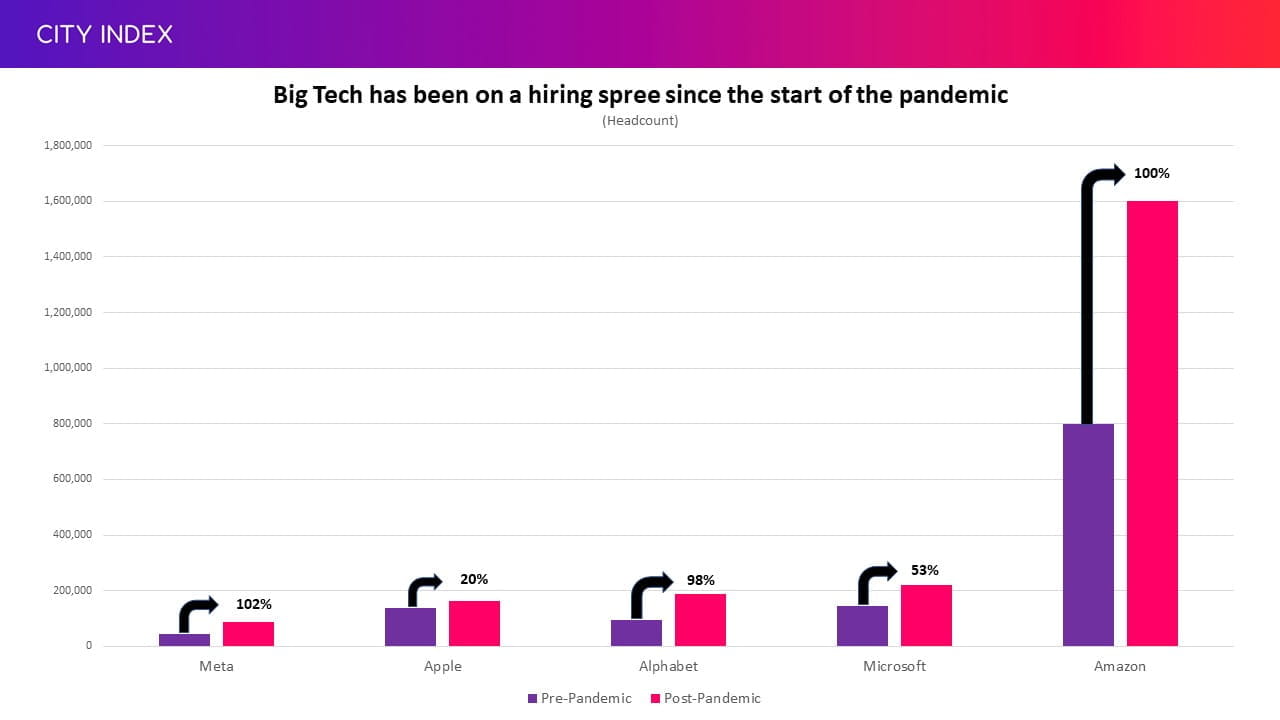
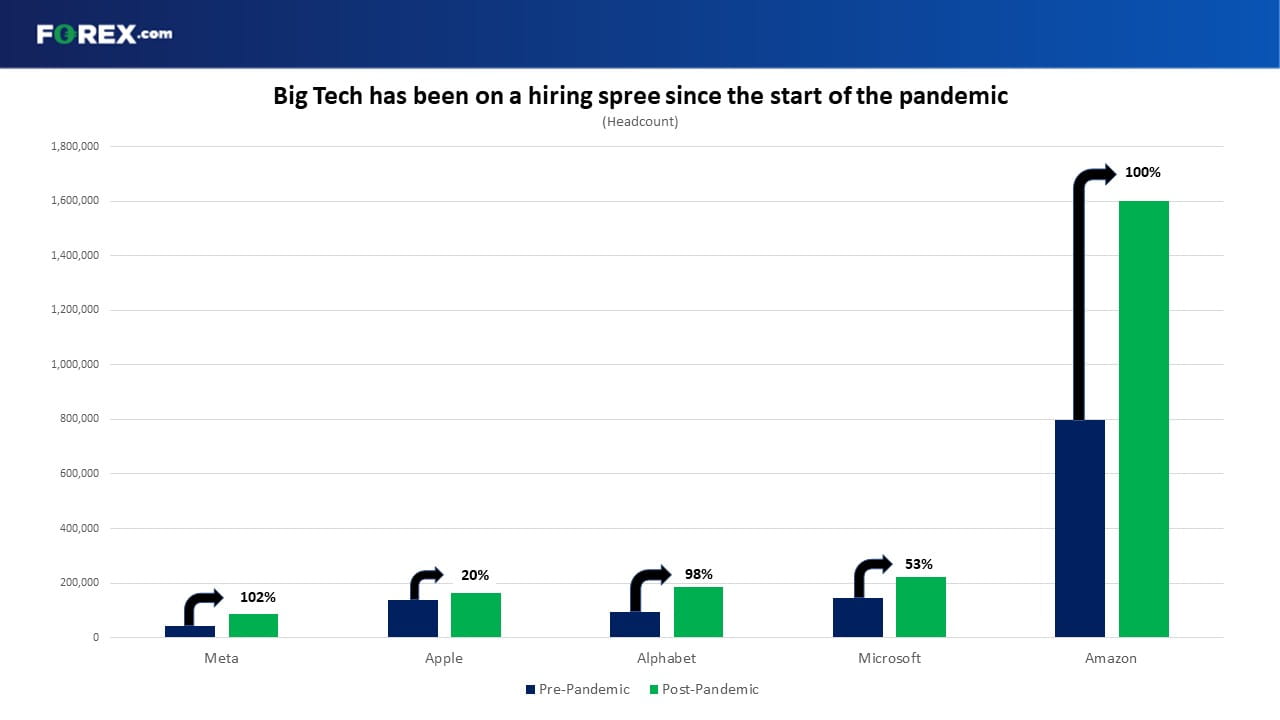
(Source: Company reports. *Alphabet, Apple and Meta pre-pandemic figures are as of September 2019 while post-pandemic figures are from September 2022. Amazon’s figures compare December 2019 to December 2021, while Microsoft’s figures compare the headcount between the end of June 2019 and June 2022.)
The ability to cut the fat will be more crucial going forward and Big Tech has plenty of fat to cut. With this in mind, companies that have already announced layoffs could be preparing to make further, potentially deeper cuts if the economic environment remains challenging and we enter a recession. That would also prompt other companies that have so far refrained from trimming their headcount to pull the trigger.
That may spook some in the markets that the jobs market could be about to implode, but the recent Big Tech layoffs should be treated with caution when being read across to the wider economy. They appear to be far more bloated than other industries and could therefore be more vulnerable than smaller businesses in the current environment as they have a greater need to downsize. Tech only accounts for a small proportion of total employment and is still hiring in key areas. They will undoubtedly contribute to more layoffs in 2023 but we will need to see cuts being made across many other industries for the jobs market to loosen.
How to trade Big Tech stocks
You can trade Big Tech stocks with City Index in just four easy steps:
- Open a City Index account, or log-in if you’re already a customer.
- Search for the stock you want in our award-winning platform
- Choose your position and size, and your stop and limit levels
- Place the trade
Or you can practice trading risk-free by signing up for our Demo Trading Account.
You can trade Big Tech stocks with Forex.com in just four steps:
- Open a Forex.com account, or log-in if you’re already a customer.
- Search for the stock you want in our award-winning platform
- Choose your position and size, and your stop and limit levels
- Place the trade
Or you can practice trading risk-free by signing up for our Demo Account.



Open an account today
Experience award-winning platforms with fast and secure execution.
Economic calendar
Web Trader platform
Our sophisticated web-based platform is packed with features.
Related articles

ASX 200 On Track for Worst Week in Four Years, Raising Bear Market Fears
The ASX 200 faces its worst week in four years as falling commodities, China's economic weakness and broad-based selling threaten a deeper correction.

British Pound Short-term Outlook: GBP/USD 3% Plunge Hits 12-Month Low—Key Support in Focus 11 19 2026
Sterling’s October rebound has unraveled, leaving GBP/USD bears in control—but stretched momentum raises the stakes for the weekly close

Nasdaq 100 forecast: Markets turn jittery as Anthropic debuts at 34% above IPO
Nasdaq futures were up some 2% earlier, but shortly after the Anthropic debut, the index slumped to session lows, down more than 1.5%, before bouncing back from the lows at the time of writing. Much of the selling for the Nasdaq was driven by AMD which slumped nearly 10% after a Hunterbrook Media report raised fresh questions about the company’s exposure to US export controls on China.

From time to time, StoneX Financial Pty Ltd (“we”, “our”) website may contain links to other sites and/or resources provided by third parties. These links and/or resources are provided for your information only and we have no control over the contents of those materials, and in no way endorse their content. Any analysis, opinion, commentary or research-based material on our website is for information and educational purposes only and is not, in any circumstances, intended to be an offer, recommendation or solicitation to buy or sell. You should always seek independent advice as to your suitability to speculate in any related markets and your ability to assume the associated risks, if you are at all unsure. No representation or warranty is made, express or implied, that the materials on our website are complete or accurate. We are not under any obligation to update any such material.
As such, we (and/or our associated companies) will not be responsible or liable for any loss or damage incurred by you or any third party arising out of, or in connection with, any use of the information on our website (other than with regards to any duty or liability that we are unable to limit or exclude by law or under the applicable regulatory system) and any such liability is hereby expressly disclaimed.