



Turbulence turns to panic as investors seek to de-risk (BTC, SPX)
There’s a subtle yet big difference between ‘risk-off’ and ‘de-risking’, in that the latter means investors also offload their safe havens as they flock to the safety of cash.
Share this:

There are various degrees of risk-off, and markets have just entered one of the worst kinds. An example of a less severe form of risk off would be when equities tumble due to a slew of weak earnings, and currencies or bonds take little to no notice. A sure sign of a classic ‘risk-off’ environment would be when equities, commodities and bond yields fall yet bond prices (which move inversely to yields) and gold rise as they’re considered to be ‘safe-haven’ assets. But that’s not what we’re currently seeing.
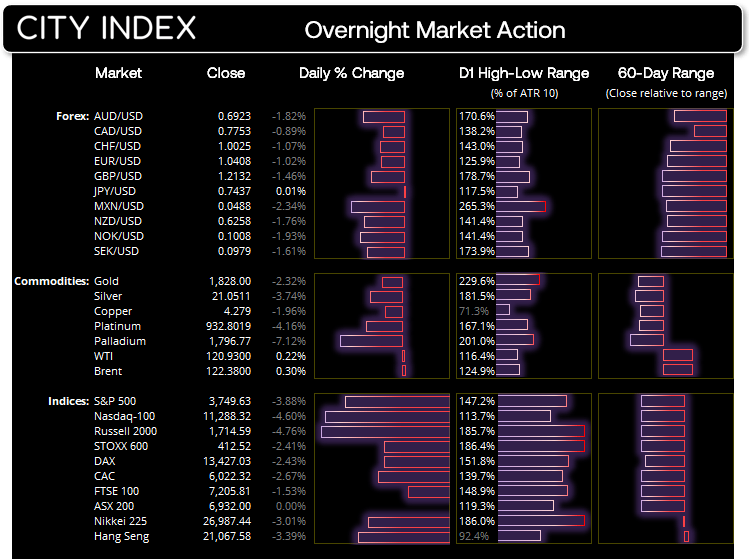
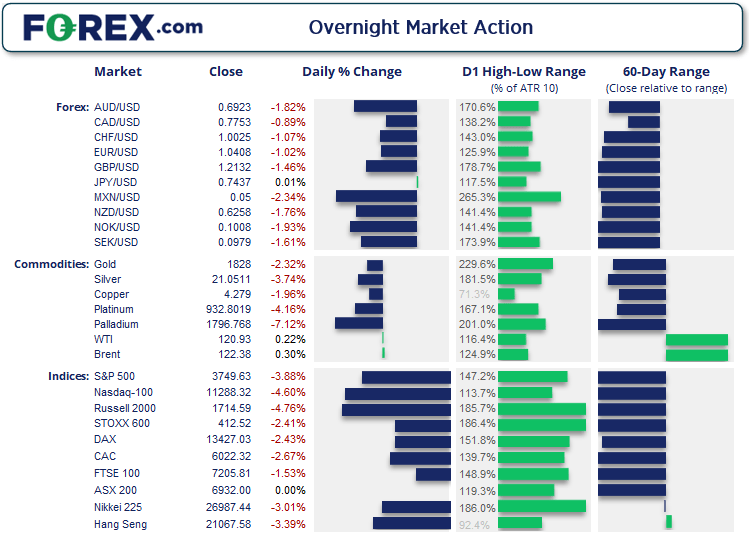
There’s multiple signs that investors are de-risking
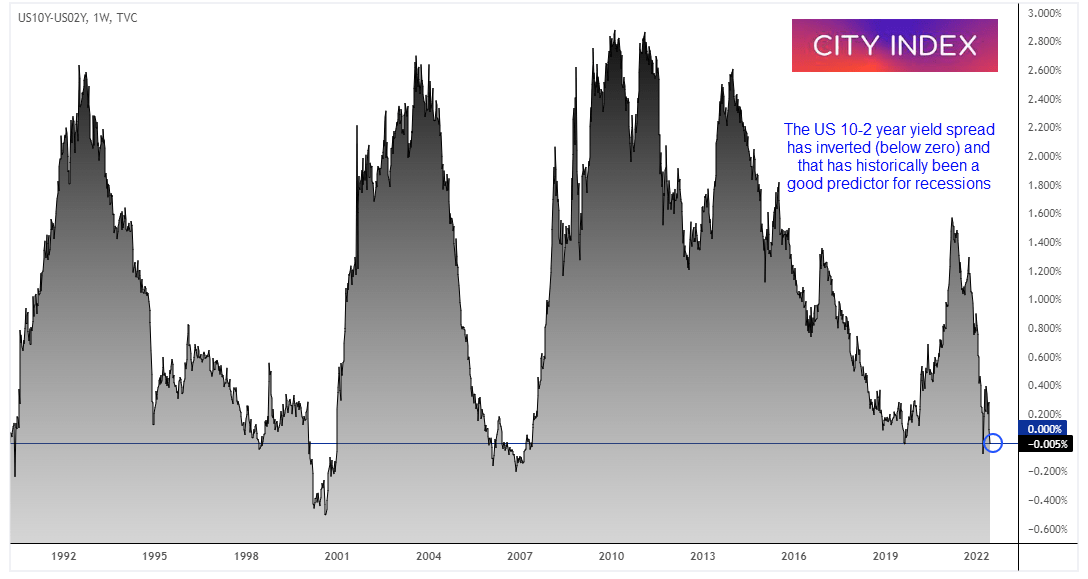
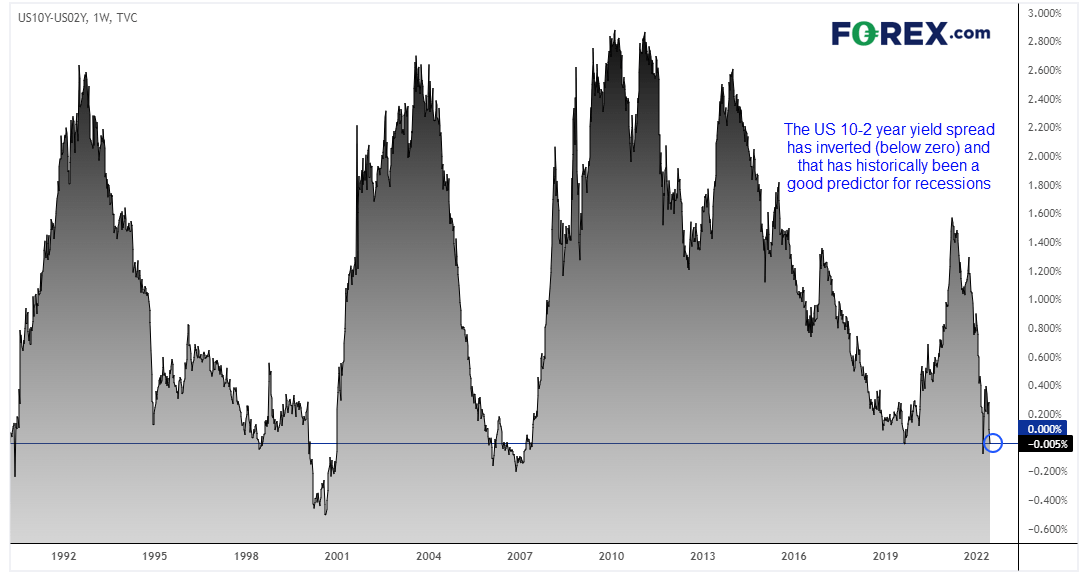
The S&P 500 has entered a technical bear market, the US 2s 10s yield curve inverted (a harbinger of doom if there ever was one), bitcoin is crashing and gold (typically a safe-haven) also being hurled overboard. This is de-risking at its finest. Investors are rushing for the same small exit in hope of offloading their falling assets for cash.
Why are investors de-risking?
The straw which broke the camel’s back was the very hot inflation report form the US on Friday. There had been hopes that inflation had peaked, yet clearly it has not. Eurozone employment also reached a record high last week and central banks are now being forced to hike rates at the risk of tipping the economy into a recession. And to really spice things up, the Fed, BOE and maybe even the SNB are expected to hike interest rates this week. And there are now talks of the Fed even having to hike by 75-bps this week to save credibility.
Incidentally there are also concerns in the crypto area in general, with crypto-lender Celsius hitting the headlines after announcing they are suspending all withdrawals until further notice. Whilst the company statement blamed “market volatility”, it does little to soothe suspicious minds that crypto is just a Ponzi scheme, and likely added to the market turbulence as investors fear contagion (such as other crypto platforms following suit).
Bitcoin is not the safe-haven it was once considered
There was a time that traders would flock to Bitcoin in times of uncertainty. Well those days are clearly no more, having fallen ~65% from its record high. Part of the reasoning is that institutional money has been a huge driver of bitcoin (and crypto in general) since 2017, so when markets enter a period of ‘risk-off’ or ‘de-risking’, crypto such as bitcoin is also vulnerable to being sold as investors move to cash or pay for margin calls.
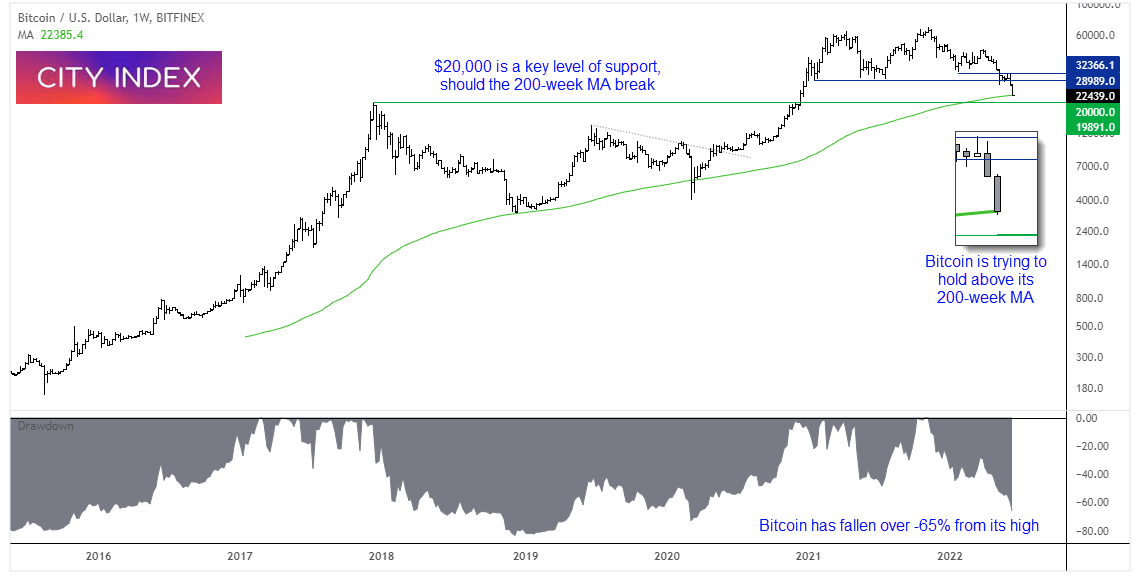
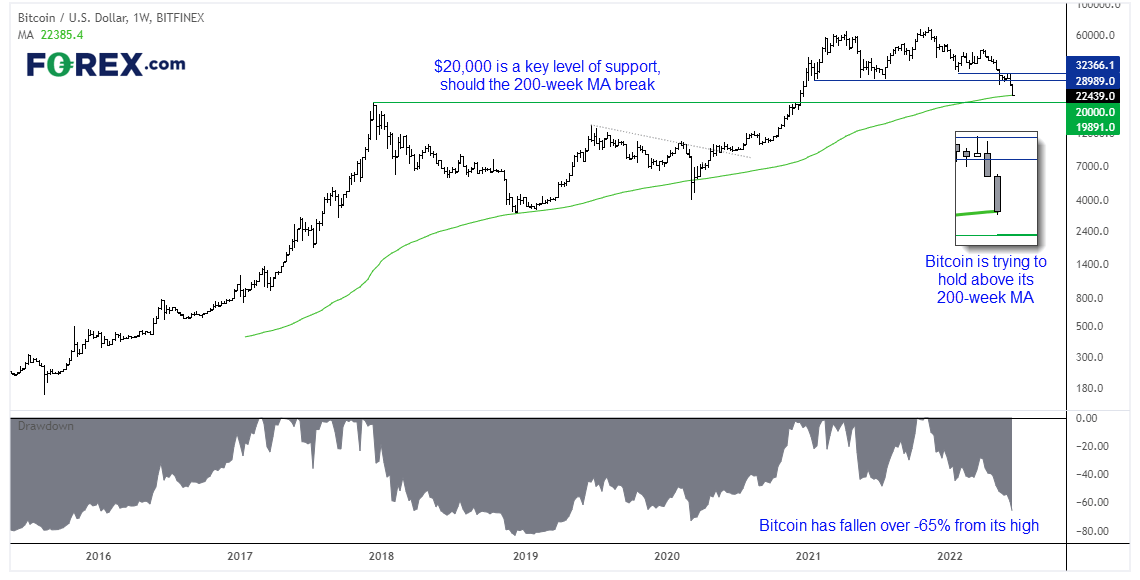
We can see on the weekly bitcoin chart (log scale) that it topped out around the same time as US indices in November. Bearish momentum is now accelerating and the market is down a staggering -65%. Perhaps more worryingly is that we have seen this market fall as much as -80% to -90% in the past (which could see it fall as low as $6,200 - $13,500 is such a fall were to be repeated).
However, two key levels reside nearby which could support a fall. Bitcoin is currently clinging on to its 200-week average, a level which has generally seen the market bounce when tested. And if prices do break lower, $20,000 is a big round number and has provided support and resistance since 2019. But a decent market to watch alongside bitcoin would be the US stock market.
The S&P 500 entered a technical bear market
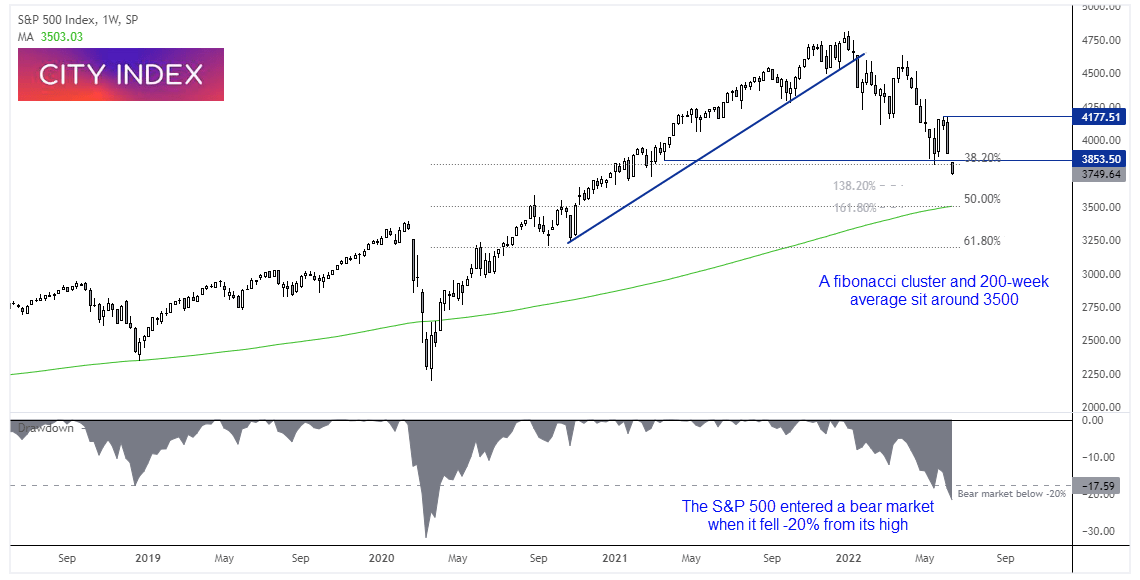
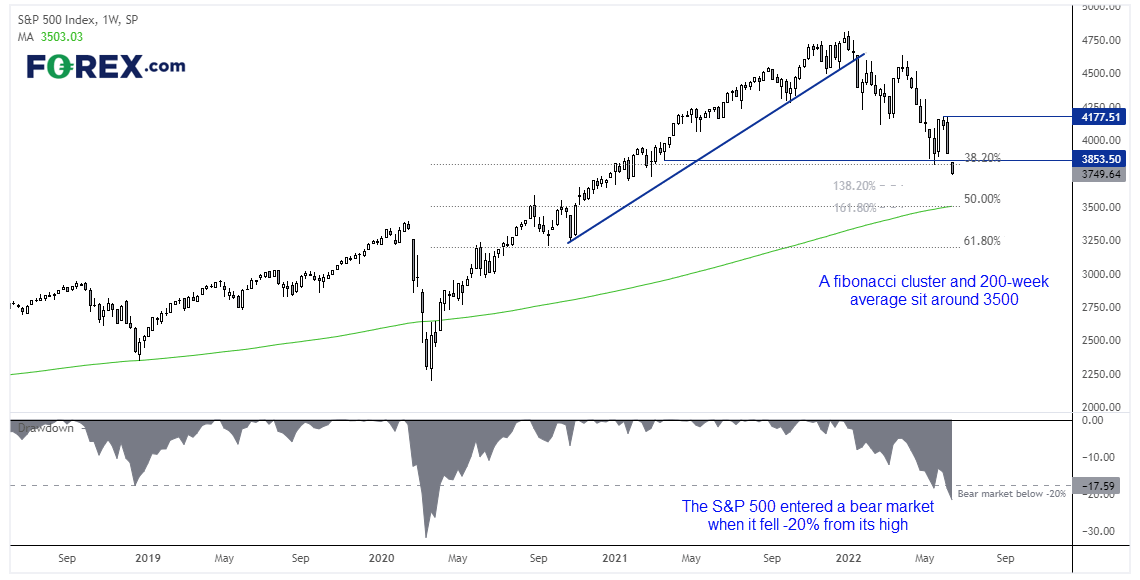
US equities were sharply lower yesterday and entered a technical bear market having fallen -20% from its high. A series of lower lows and highs shows us that the weekly chart is in a confirmed downtrend, although it should be remembered that ‘bear market rallies’ can post strong returns before breaking to new lows. Our bias remains bearish below 4,000 and for a drop down to 3,500, where the 200-week average, and 50% retracement and 161.8% Fibonacci projection reside.
Read our S&P 500 trading guide
Read our S&P 500 trading guide
How to trade with City Index
You can easily trade with City Index by using these four easy steps:
- Open an account, or log in if you’re already a customer
• Open an account in the UK
• Open an account in Australia
• Open an account in Singapore
- Search for the company you want to trade in our award-winning platform
- Choose your position and size, and your stop and limit levels
- Place the trade
How to trade with FOREX.com
Follow these easy steps to start trading with FOREX.com today:
- Open a Forex.com account, or log in if you’re already a customer.
- Search for the pair you want to trade in our award-winning platform.
- Choose your position and size, and your stop and limit levels.
- Place the trade.
Related tags:


Open an account today
Experience award-winning platforms with fast and secure execution.
Economic calendar
Web Trader platform
Our sophisticated web-based platform is packed with features.
Related articles
AUD/USD Outlook: Hot Inflation No Match for Global Risk Aversion
With inflation pressures broadening and the labour market deteriorating, the RBA faces an unenviable task. But for AUD/USD traders, developments offshore may matter far more right now.

NZD/USD Outlook: Reversal Signals Emerge as AI Trade Falters
Kiwi prints a reversal signal comes as cracks appear in the US economic exceptionalism story. An orderly rotation away from AI could provide favourable conditions for a rebound, but another brutal risk-off episode may have the opposite effect.
Bitcoin Analysis: BTC Slips Below 60k as Demand Continues to Fade
As November approaches its end, weakness around Bitcoin remains evident in the short term. During today's trading session alone, the cryptocurrency has lost nearly 2.0% of its value and continues to reflect a relatively consistent bearish dynamic.

From time to time, StoneX Financial Pty Ltd (“we”, “our”) website may contain links to other sites and/or resources provided by third parties. These links and/or resources are provided for your information only and we have no control over the contents of those materials, and in no way endorse their content. Any analysis, opinion, commentary or research-based material on our website is for information and educational purposes only and is not, in any circumstances, intended to be an offer, recommendation or solicitation to buy or sell. You should always seek independent advice as to your suitability to speculate in any related markets and your ability to assume the associated risks, if you are at all unsure. No representation or warranty is made, express or implied, that the materials on our website are complete or accurate. We are not under any obligation to update any such material.
As such, we (and/or our associated companies) will not be responsible or liable for any loss or damage incurred by you or any third party arising out of, or in connection with, any use of the information on our website (other than with regards to any duty or liability that we are unable to limit or exclude by law or under the applicable regulatory system) and any such liability is hereby expressly disclaimed.