



UK Coronavirus Budget Will It Go Far Enough
Will Rishi Sunak's Budget go far enough to stem coronavirus recession fears?
Share this:

The Chancellor of the Exchequer Rishi Sunak is set to unveil the UK Budget on Wednesday. The circumstances surrounding the Budget have change significantly over the past few weeks. This year’s budget now comes at a unique time when not only is the UK preparing for its future outside of the EU but also amid growing anxieties surrounding the outbreak of coronavirus.
The budget comes just two days after the FTSE experienced its worst day of loses since the financial crisis over a decade ago. The coronavirus outbreak is expected to create a supply shock and a demand shock in the UK. The markets are looking to the Chancellor’s Budget for strong signals that the Government will support the UK economy through what is expected to be a very hard but temporary shock.
It is a combination of fiscal stimulus and monetary policy (next BoE rate announcement 26th March, although could be sooner) that will prevent the coronavirus temporary hit becoming a more entrenched downturn and potential recession.
As a result, there is a good chance that the focus for the budget will be coronavirus centred on short term measures which will help businesses and individuals survive what could be a very hard squeeze in the coming weeks. That said Rishi Sunak will be keen to show that the Government is still getting on with implementing its agenda so money will also be earmarked for law and order and upgrading flooding defences. The NHS will be very much in focus.
Measures to help businesses
Coronavirus is expected to cause a slowdown in demand amid increased worker isolation and/or illness meaning firms’ cashflow could take a hit. Keeping smaller firms afloat will be a key focus as will safeguarding the fragile recovery in business confidence since the election.
We already know the Government is planning to increase its “Time To Pay” system enabling firms to pay tax in smaller installments over a longer period.
A temporary VAT cut could also be on the cards. This wouldn’t be the first time that the Chancellor has taken such as dramatic step – doing so in 2008. This has been a successful for, of stimulus in the past.
Talk of a rise in the national insurance threshold, which could benefit millions of workers could also be considered a step to help the UK along a bumpy road.
Coordinated BoE action?
There is growing speculation that the BoE could announce stimulus in coordination with the Budget. Incoming BoE Governor said last week that here should be a coordinate response. We don’t expect this to happen firstly because it raises questions over the central banks’ independence. Secondly, because Andrew Bailey also said that he would prefer more evidence before taking a decision to cut rates. This makes us believe that the BoE will wait until the meeting at the end of the month, or potentially longer.
There is growing speculation that the BoE could announce stimulus in coordination with the Budget. Incoming BoE Governor said last week that here should be a coordinate response. We don’t expect this to happen firstly because it raises questions over the central banks’ independence. Secondly, because Andrew Bailey also said that he would prefer more evidence before taking a decision to cut rates. This makes us believe that the BoE will wait until the meeting at the end of the month, or potentially longer.
GBP
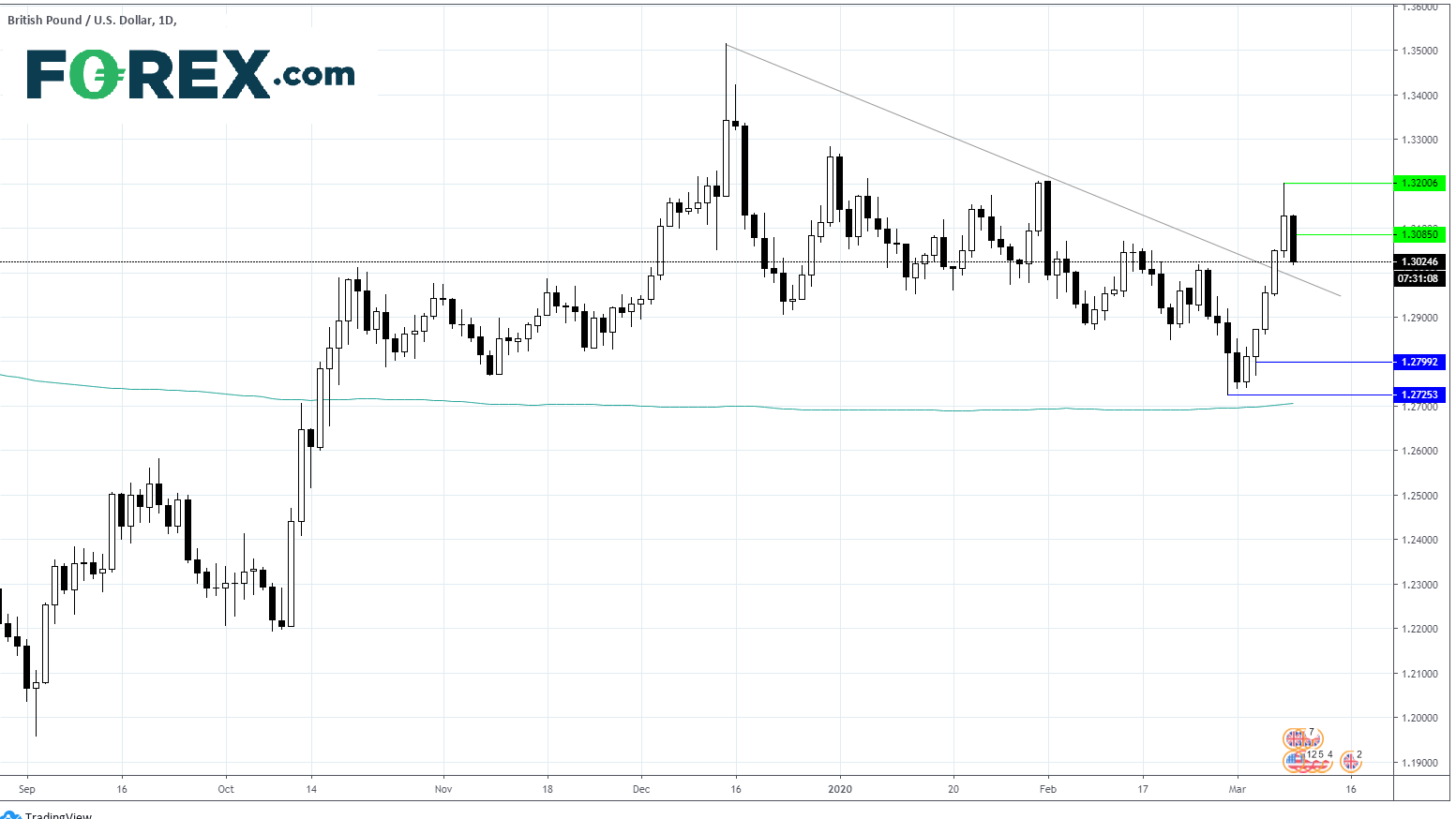
The pound has held up reasonably well amid the coronavirus outbreak in part because of the calm approach from the BoE and in part amid expectation of firm supportive fiscal policies from the Government. The pound could take a hit if the market believes that the budget doesn’t go far enough in tackling coronavirus or limiting its economic impact. Under these circumstances we could see GBP/USD head back towards $1.28. Otherwise the pound is expected to remain stable around the $1.30 until we hear more from BoE.
Retailers
Business rates will be a key theme given the dire state of the UK retail sector and the massive disadvantage that stores with a large footprint endure. Attempts to level up the playing field for bricks and mortar retailers versus the online competition could see these stocks jump. As an example, Tesco pays £700 million in business rates every year. Rate relief details will be scrutinised closely.
Business rates will be a key theme given the dire state of the UK retail sector and the massive disadvantage that stores with a large footprint endure. Attempts to level up the playing field for bricks and mortar retailers versus the online competition could see these stocks jump. As an example, Tesco pays £700 million in business rates every year. Rate relief details will be scrutinised closely.
Housebuilders
With Help to buy due to come to an end in 3 years’ time, investors will be keen to see what else the government has up their sleeve to help the sector. 300,000 homes a year by 2025 or shifting stamp duty to sellers will hoped for. However, given that the government is looking to build more houses and stabilise prices construction material firms could see more upside than housebuilders, given that the latter looks for hour price increases for improved margins.
The Chancellor of the Exchequer Rishi Sunak is set to unveil the UK Budget on Wednesday. The circumstances surrounding the Budget have change significantly over the past few weeks. This year’s budget now comes at a unique time when not only is the UK preparing for its future outside of the EU but also amid growing anxieties surrounding the outbreak of coronavirus.
The budget comes just two days after the FTSE experienced its worst day of loses since the financial crisis over a decade ago. The coronavirus outbreak is expected to create a supply shock and a demand shock in the UK. The markets are looking to the Chancellor’s Budget for strong signals that the Government will support the UK economy through what is expected to be a very hard but temporary shock.
It is a combination of fiscal stimulus and monetary policy (next BoE rate announcement 26th March, although could be sooner) that will prevent the coronavirus temporary hit becoming a more entrenched downturn and potential recession.
As a result, there is a good chance that the focus for the budget will be coronavirus centred on short term measures which will help businesses and individuals survive what could be a very hard squeeze in the coming weeks. That said Rishi Sunak will be keen to show that the Government is still getting on with implementing its agenda so money will also be earmarked for law and order and upgrading flooding defences. The NHS will be very much in focus.
Measures to help businesses
Coronavirus is expected to cause a slowdown in demand amid increased worker isolation and/or illness meaning firms’ cashflow could take a hit. Keeping smaller firms afloat will be a key focus as will safeguarding the fragile recovery in business confidence since the election.
We already know the Government is planning to increase its “Time To Pay” system enabling firms to pay tax in smaller installments over a longer period.
A temporary VAT cut could also be on the cards. This wouldn’t be the first time that the Chancellor has taken such as dramatic step – doing so in 2008. This has been a successful for, of stimulus in the past.
Talk of a rise in national insurance threshold, which could benefit millions of workers could also be considered a step to help the UK along a bumpy road.
Coordinated BoE action?
There is growing speculation that the BoE could announce stimulus in coordination with the Budget. Incoming BoE Governor said last week that here should be a coordinate response. We don’t expect this to happen firstly because it raises questions over the central banks’ independence. Secondly, because Andrew Bailey also said that he would prefer more evidence before taking a decision to cut rates. This makes us believe that the BoE will wait until the meeting at the end of the month, or potentially longer.

There is growing speculation that the BoE could announce stimulus in coordination with the Budget. Incoming BoE Governor said last week that here should be a coordinate response. We don’t expect this to happen firstly because it raises questions over the central banks’ independence. Secondly, because Andrew Bailey also said that he would prefer more evidence before taking a decision to cut rates. This makes us believe that the BoE will wait until the meeting at the end of the month, or potentially longer.
GBP
The pound has held up reasonably well amid the coronavirus outbreak in part because of the calm approach from the BoE and in part amid expectation of firm supportive fiscal policies from the Government. The pound could take a hit if the market believes that the budget doesn’t go far enough in tackling coronavirus or limiting its economic impact. Under these circumstances we could see GBP/USD head back towards $1.28. Otherwise the pound is expected to remain stable around the $1.30 until we hear more from BoE.
Retailers
Business rates will be a key theme given the dire state of the UK retail sector and the massive disadvantage that stores with a large footprint endure. Attempts to level up the playing field for bricks and mortar retailers versus the online competition could see these stocks jump. As an example, Tesco pays £700 million in business rates every year. Rate relief details will be scrutinised closely.
Business rates will be a key theme given the dire state of the UK retail sector and the massive disadvantage that stores with a large footprint endure. Attempts to level up the playing field for bricks and mortar retailers versus the online competition could see these stocks jump. As an example, Tesco pays £700 million in business rates every year. Rate relief details will be scrutinised closely.
Housebuilders
With Help to buy due to come to an end in 3 years’ time, investors will be keen to see what else the government has up their sleeve to help the sector. 300,000 homes a year by 2025 or shifting stamp duty to sellers will hoped for. However, given that the government is looking to build more houses and stabilise prices construction material firms could see more upside than housebuilders, given that the latter looks for hour price increases for improved margins.
Related tags:
Latest market news




Open an account today
Experience award-winning platforms with fast and secure execution.
Economic calendar
Web Trader platform
Our sophisticated web-based platform is packed with features.
Related articles
From time to time, StoneX Financial Pty Ltd (“we”, “our”) website may contain links to other sites and/or resources provided by third parties. These links and/or resources are provided for your information only and we have no control over the contents of those materials, and in no way endorse their content. Any analysis, opinion, commentary or research-based material on our website is for information and educational purposes only and is not, in any circumstances, intended to be an offer, recommendation or solicitation to buy or sell. You should always seek independent advice as to your suitability to speculate in any related markets and your ability to assume the associated risks, if you are at all unsure. No representation or warranty is made, express or implied, that the materials on our website are complete or accurate. We are not under any obligation to update any such material.
As such, we (and/or our associated companies) will not be responsible or liable for any loss or damage incurred by you or any third party arising out of, or in connection with, any use of the information on our website (other than with regards to any duty or liability that we are unable to limit or exclude by law or under the applicable regulatory system) and any such liability is hereby expressly disclaimed.