


USD/CAD Analysis: Is the Loonie Losing Momentum?
The week is just getting underway, and one of the most relevant themes driving market moves remains the growing weakness around the Canadian dollar. This can be clearly seen in recent USD/CAD price action, with the pair gaining more than 0.6% over the last two trading sessions, highlighting that the CAD has once again lost ground against the U.S. dollar.
Share this:

The week is just getting underway, and one of the most relevant themes driving market moves remains the growing weakness around the Canadian dollar. This can be clearly seen in recent USD/CAD price action, with the pair gaining more than 0.6% over the last two trading sessions, highlighting that the CAD has once again lost ground against the U.S. dollar.
For now, this buying pressure has remained in place following Friday's employment reports in both Canada and the United States. The data reinforced expectations of a relatively more cautious Bank of Canada compared with a potentially more aggressive Federal Reserve in the months ahead. This divergence in monetary policy expectations continues to be one of the main drivers for both currencies and, as long as it remains supportive of the U.S. dollar, buying pressure in USD/CAD could continue to be relevant over the coming sessions.

Are Central Bank Expectations Driving the Move?
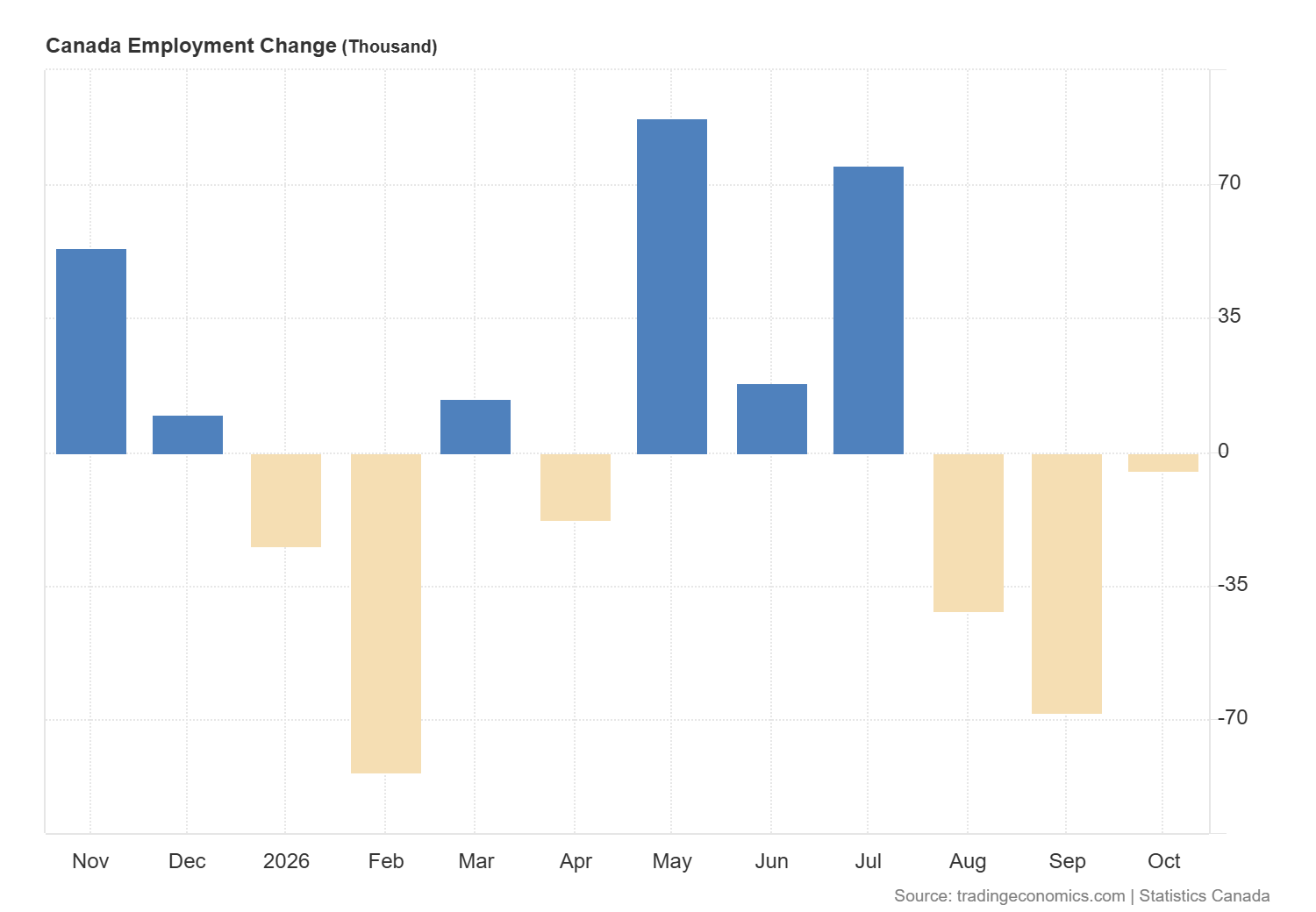
Just a few days ago, employment data for the Canadian economy were released and once again showed signs of slowing momentum. Markets were expecting approximately 14,000 new jobs to be created, but the report surprised to the downside with a loss of roughly 4,700 jobs during the month.
More importantly, the result extends a softer trend that has been developing over recent months and continues to suggest a more fragile backdrop for the Canadian labor market.
Source: TradingEconomics
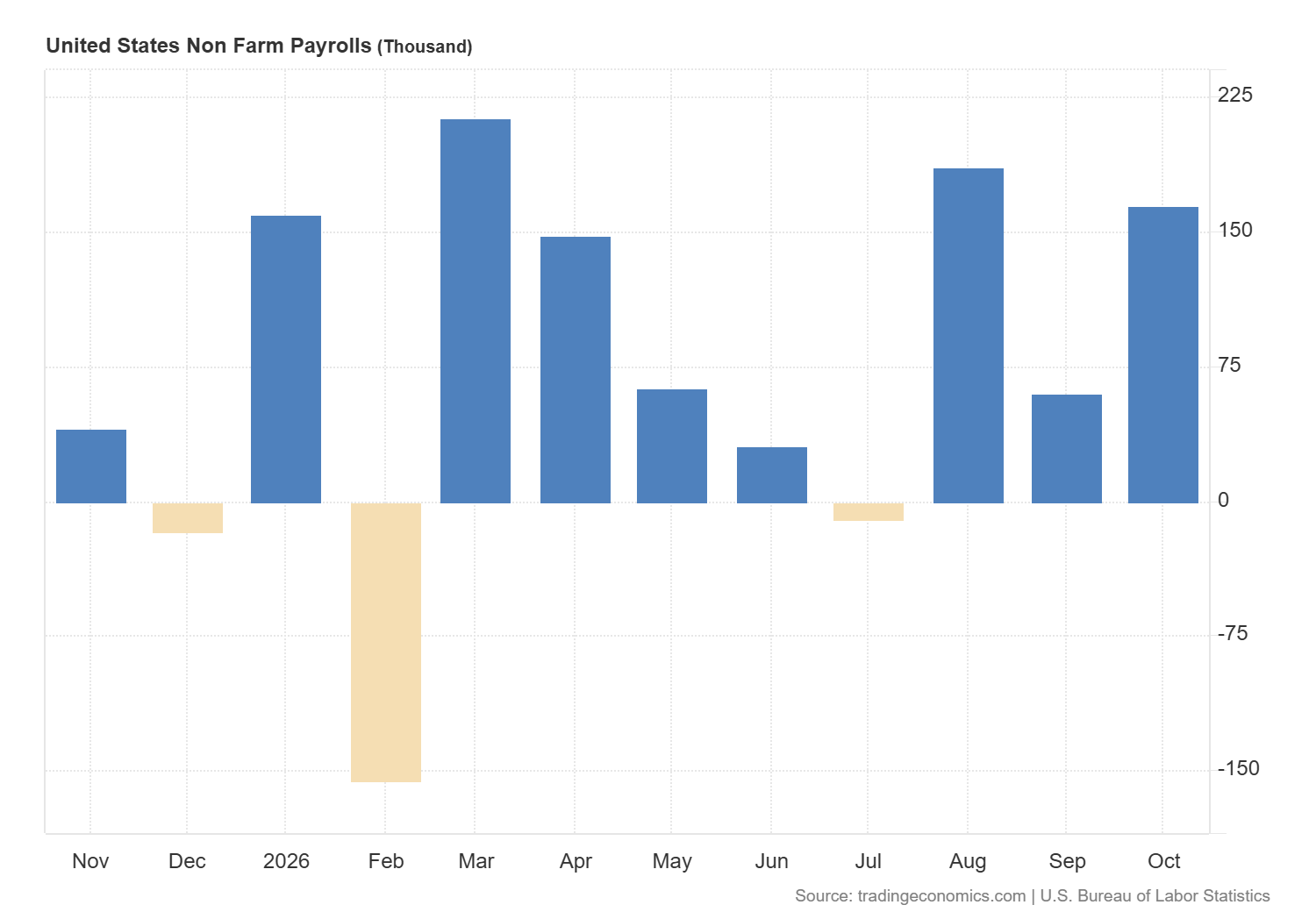
The situation in the United States was very different. The latest Non-Farm Payrolls (NFP) report surprised to the upside with approximately 165,000 jobs created in October, well above market expectations. The result once again highlights the resilience of the U.S. labor market and a significantly stronger economic backdrop compared with what is currently being observed in Canada.
Source: TradingEconomics
This divergence is becoming increasingly important because it reinforces very different outlooks for the two central banks. On one hand, weaker Canadian employment data could keep the Bank of Canada relatively cautious in the months ahead. On the other hand, the strength of the U.S. labor market continues to give the Federal Reserve room to maintain a more aggressive monetary policy stance.
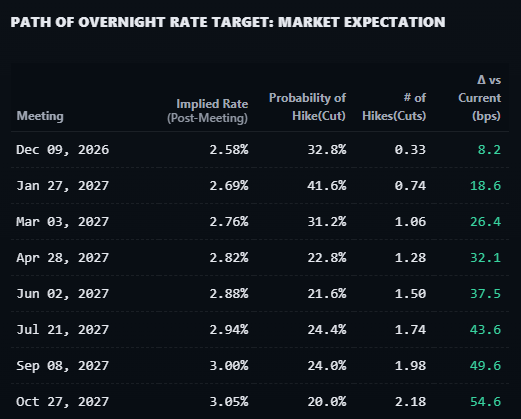
This shift is already visible in market expectations. For the Bank of Canada's December 9 meeting, the probability of a rate hike remains close to 33%, reflecting expectations for a relatively neutral policy stance.
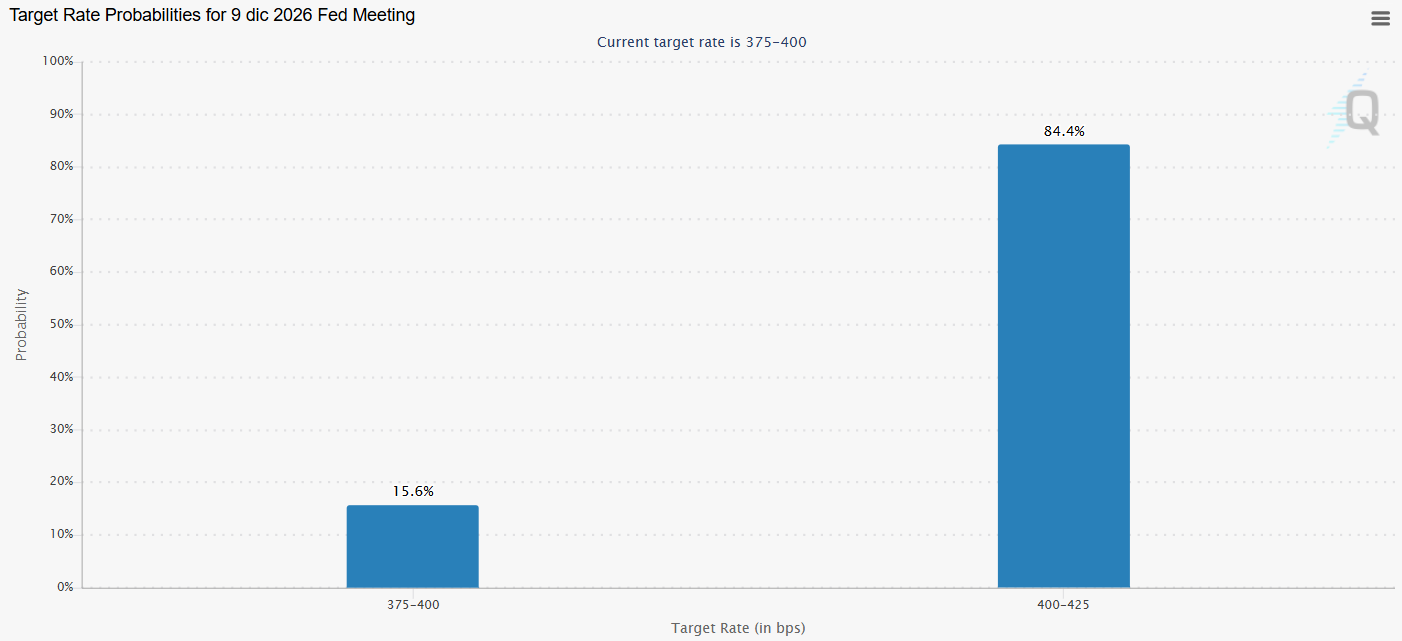
The picture is very different for the Federal Reserve. Following Friday's employment report, the probability of a rate hike at the December 9 meeting climbed to nearly 85%, highlighting that markets continue to price in a relatively more aggressive central bank into year-end.
Source: Rateprobability
Source: CME
With all of this in mind, the situation remains particularly relevant because U.S. interest rates are already above those observed in Canada, and there is a possibility that this gap could continue to widen over the coming months. Under that scenario, U.S. dollar-denominated investments may continue to offer greater relative appeal compared with investments denominated in Canadian dollars.
Part of that dynamic already appears to be reflected in recent USD/CAD price action and could remain an important factor if upcoming U.S. inflation data continue to support the view of a more aggressive Federal Reserve. As long as markets maintain that perception while continuing to price in a relatively cautious Bank of Canada, pressure on the Canadian dollar could remain relevant and the bullish bias around USD/CAD could continue gaining traction in the coming sessions.
USD/CAD Technical Forecast
Source: StoneX, Tradingview
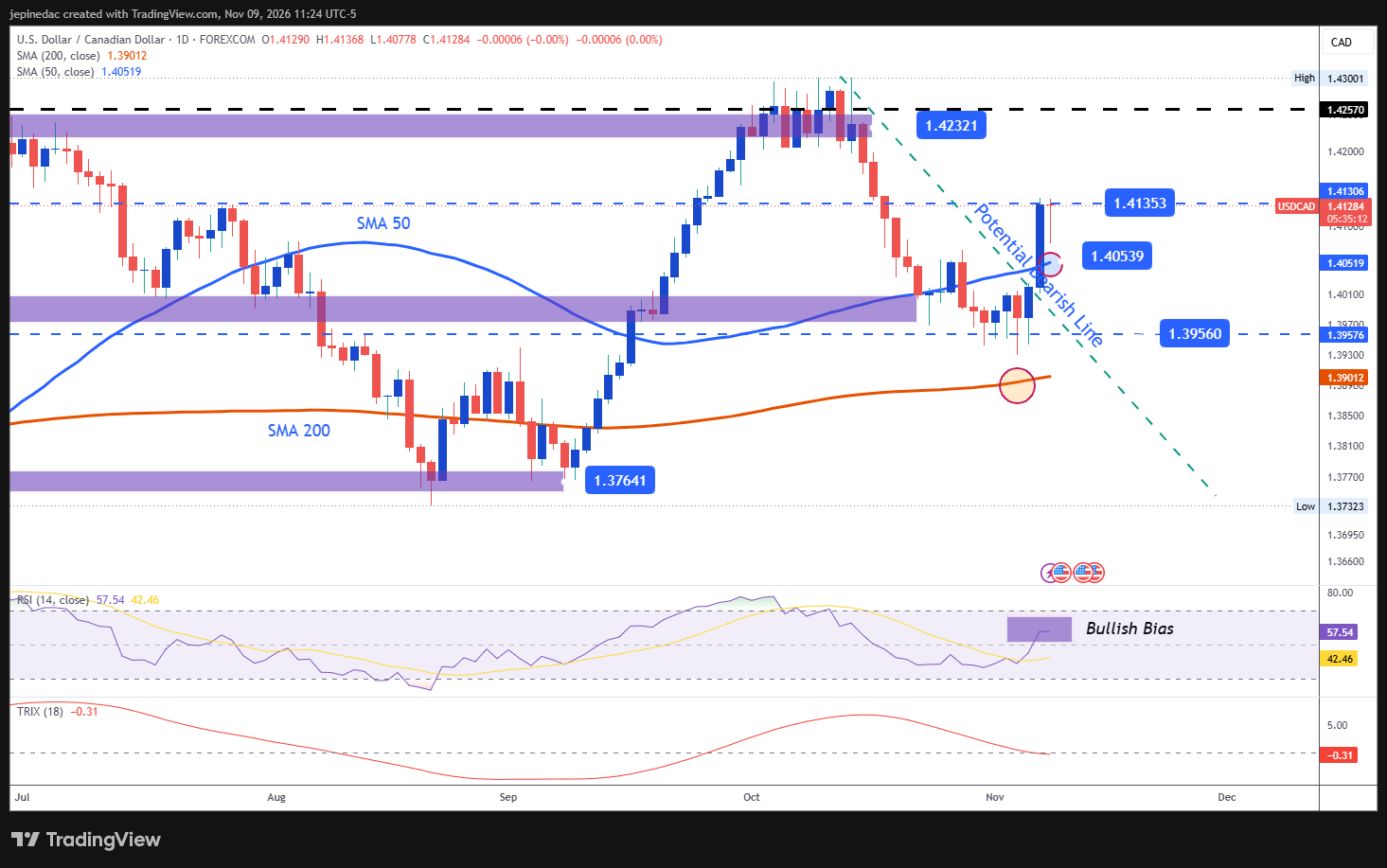
- Lack of direction is becoming increasingly evident: Although USD/CAD had been attempting to develop a short-term bearish trendline since mid-October, the strong recovery observed at the end of last week largely invalidated that structure. The pair is now trading in a market environment without a clearly dominant trend. Unless recent buying momentum can establish itself more convincingly, a broader phase of indecision could emerge, potentially opening the door to a more relevant trading range in the weeks ahead.
- RSI: The RSI has started to develop a bullish slope and remains above the 50 neutral level, reflecting that buying momentum has become increasingly important on the daily chart. As long as this behavior remains in place, the bullish bias could continue to be relevant during the coming sessions.
- TRIX: A slightly different picture can be seen in the TRIX, whose line continues to fluctuate near the 0 neutral level. This behavior reflects a relatively balanced environment within the strength of exponential moving averages and suggests that a broader phase of indecision has not completely disappeared from the chart.
Key Levels:
- 1.41353 – Key Resistance: A recent high that has acted as an important barrier for several months and currently represents the main upside reference on the chart. Price action consolidating above this area could reinforce bullish momentum and gradually open the door to a more consistent short-term uptrend.
- 1.40539 – Near-Term Barrier: A level that coincides with the 50-period simple moving average and could become the main reference to watch in the event of short-term bearish corrections.
- 1.39560 – Critical Support: An area of recent lows that continues to serve as an important reference for downside moves. Price action returning toward this level could once again highlight a lack of direction in the chart and favor the development of a broader consolidation phase over the coming weeks.
Written by Julian Pineda, CFA, CMT – Market Analyst
Follow him on: @julianpineda25
Latest market news




Open an account today
Experience award-winning platforms with fast and secure execution.
Economic calendar
Web Trader platform
Our sophisticated web-based platform is packed with features.
Related articles
Canadian Dollar Forecast: USD/CAD Rally Stalls at Yearly High—Correction Risk Builds 11 24 2026
USD/CAD’s November rebound faces its first meaningful setback, with buyers defending trend support as momentum divergence warns of fatigue.

EUR/USD outlook: Fed hawkishness priced in as Ifo hits 3-year high
The euro is bouncing from the 61.8% Fibonacci retracement as the dollar takes a breather after Monday's surge. With Fed hawkishness largely priced in and Germany's Ifo at a three-year high, a close above 1.1000 would signal a near-term low.

Gold Analysis: Is the XAU/USD Recovery Running Out of Steam?
Gold falls around 1% today after a 2.7% rebound, as Fed uncertainty and upcoming inflation data keep XAU/USD in a phase of indecision.
From time to time, StoneX Financial Pty Ltd (“we”, “our”) website may contain links to other sites and/or resources provided by third parties. These links and/or resources are provided for your information only and we have no control over the contents of those materials, and in no way endorse their content. Any analysis, opinion, commentary or research-based material on our website is for information and educational purposes only and is not, in any circumstances, intended to be an offer, recommendation or solicitation to buy or sell. You should always seek independent advice as to your suitability to speculate in any related markets and your ability to assume the associated risks, if you are at all unsure. No representation or warranty is made, express or implied, that the materials on our website are complete or accurate. We are not under any obligation to update any such material.
As such, we (and/or our associated companies) will not be responsible or liable for any loss or damage incurred by you or any third party arising out of, or in connection with, any use of the information on our website (other than with regards to any duty or liability that we are unable to limit or exclude by law or under the applicable regulatory system) and any such liability is hereby expressly disclaimed.