
The trading week continues to unfold and the recovery in the Canadian dollar has once again become a relevant theme in the short term. This can be clearly seen in the recent performance of USD/CAD, which is down nearly 0.4% during the session, reflecting a consistent recovery in the CAD against the U.S. dollar.
This renewed selling pressure around the pair has gained momentum following the outcome of the U.S. midterm elections, where the Democratic victory introduces greater obstacles for several of the current administration's policy initiatives. For now, the U.S. dollar has reacted with a degree of caution to this political development, allowing the Canadian dollar to regain ground. As long as this catalyst remains relevant, selling pressure on USD/CAD could continue to be an important feature of price action in the coming sessions.

What Was the Outcome of the Midterm Elections?
Yesterday's session was marked by the U.S. midterm elections to renew seats in the Senate, the House of Representatives, and several state governorships. So far, the results show a clear advantage for the Democratic Party, which has secured 54 seats in the Senate, 228 seats in the House of Representatives, and 28 governorships. While a few results are still pending, the overall trend already points to a decisive Democratic victory across the main electoral fronts.
This development significantly alters the political landscape in the United States because, although Donald Trump remains president, he now faces a less favorable political environment for the remaining two years of his term. This could translate into greater difficulties passing new legislation, more disputes surrounding the budget and debt ceiling, and a lower probability of implementing major fiscal measures.
What is particularly relevant is how financial markets have reacted through the bond market and the U.S. dollar. Greater legislative opposition increases the likelihood that some of the administration's economic initiatives may encounter obstacles, a situation that has supported demand for fixed-income assets and contributed to a recent moderation in Treasury yields.
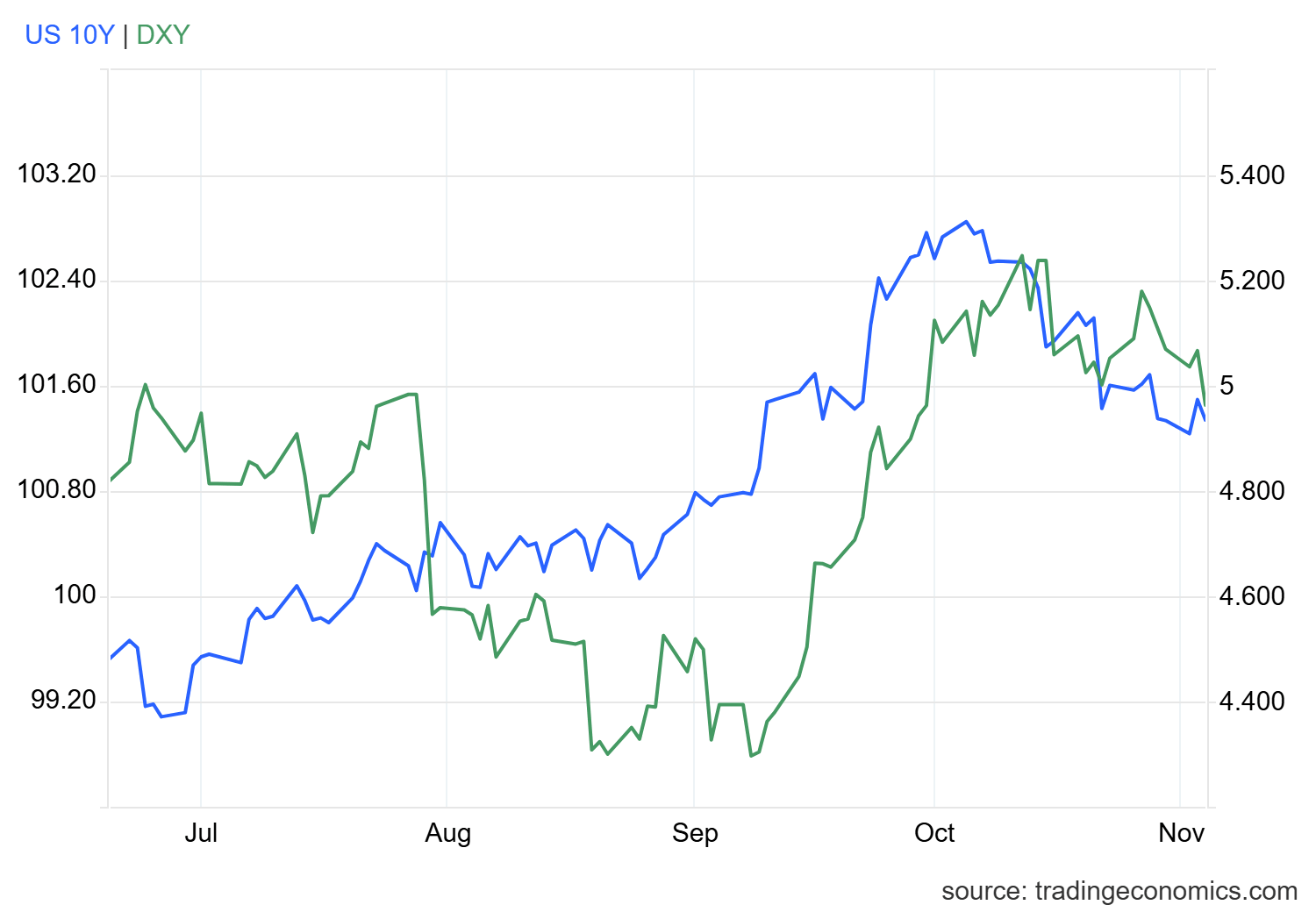
The yield on the 10-year U.S. Treasury has moved back below the 5.00% area, while the DXY Index, which measures the dollar's strength against its major peers, has fallen roughly 0.4% and is once again approaching the 101-point level. This behavior suggests that confidence in the U.S. dollar has weakened somewhat following the election results, partly due to lower bond yields and partly because of growing uncertainty regarding the government's ability to advance new policy measures in the coming months.
Source: TradingEconomics
This situation is important because the election results have begun to act as a bearish catalyst for the U.S. dollar. As a consequence, rival currencies such as the Canadian dollar have found room to recover in the short term. As long as political uncertainty remains elevated and bond yields continue to show signs of moderation, selling pressure around USD/CAD could remain relevant.
Do Central Banks Still Matter?
Despite the recent weakness in the U.S. dollar, it remains important to consider the interest rate differential between the United States and Canada.
While the Federal Reserve maintains its benchmark rate near 4.00%, the Bank of Canada continues to hold its policy rate around 2.50%. Under normal circumstances, this differential continues to favor U.S. dollar-denominated investments and has been one of the factors that limited Canadian dollar strength at various points throughout the year.
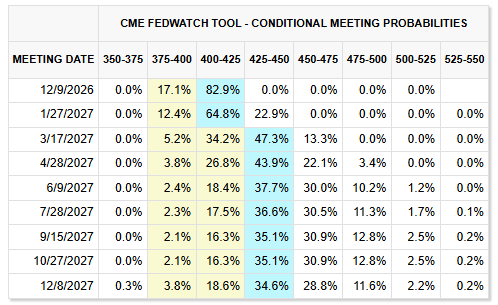
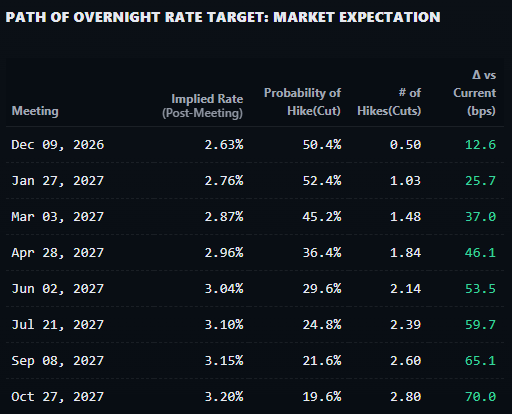
The key question is whether this gap will begin to narrow or widen again in the coming months. In this regard, it is worth noting that markets currently assign more than an 80% probability of another rate hike by the Federal Reserve at its December 9 meeting, while expectations for an additional rate increase from the Bank of Canada remain closer to 50%.
Source: CMEGROUP
Source: Rateprobability
This suggests that markets continue to view the Federal Reserve as potentially more aggressive than the Bank of Canada over the coming months. If this perception continues to strengthen, the interest rate differential could widen again and further increase the relative attractiveness of U.S. dollar-denominated investments.
For that reason, although political uncertainty is currently helping CAD recover ground, central bank expectations are likely to remain an important driver into year-end. If the Fed ultimately adopts a more aggressive stance than the Bank of Canada, the recent bearish move in USD/CAD could begin to lose momentum and give way to a more neutral medium-term environment.
USD/CAD Technical Forecast
Source: StoneX, Tradingview
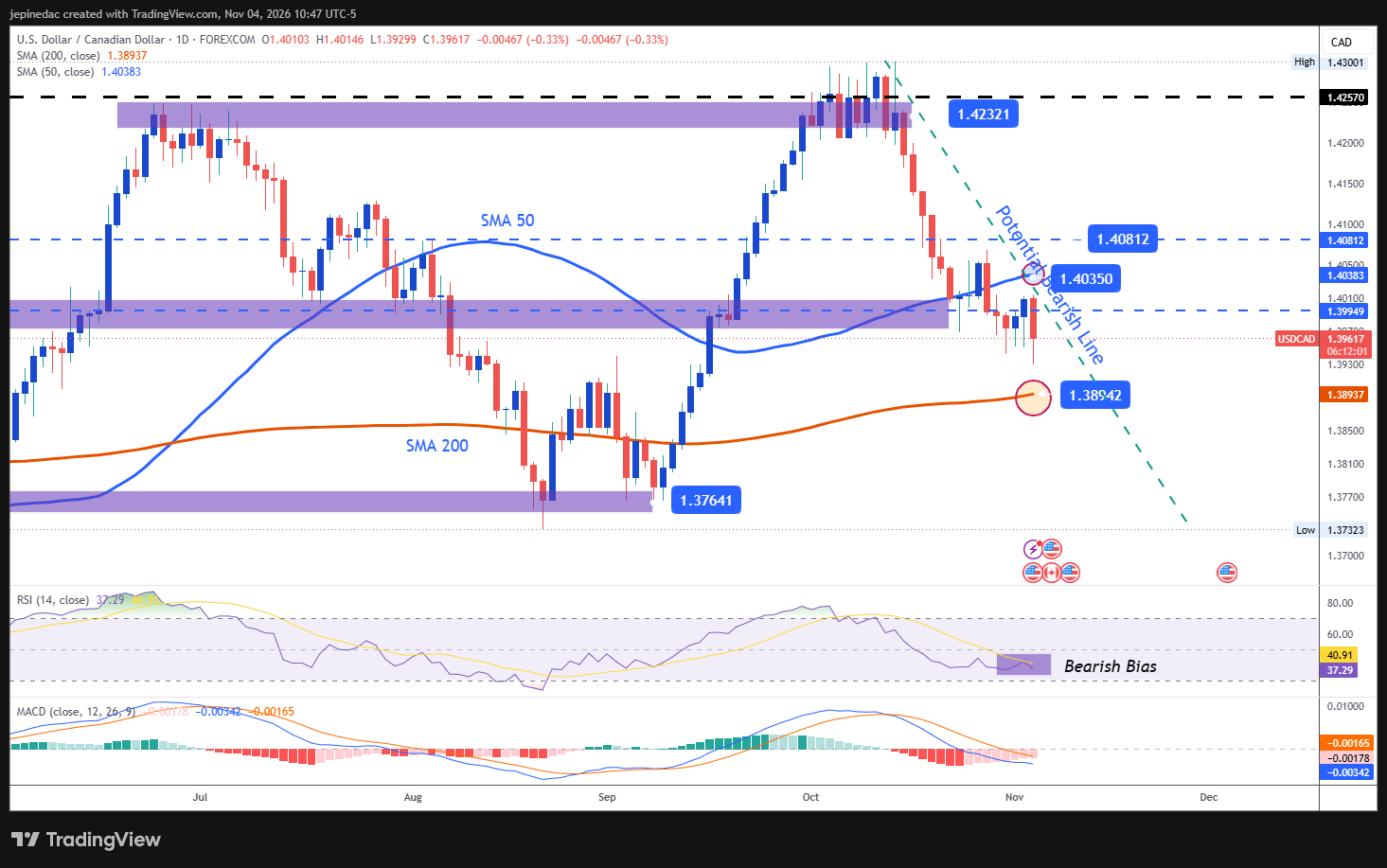
- The bearish trendline continues to gain relevance: Since mid-October, USD/CAD has developed a consistent pattern of lower highs, allowing a short-term bearish trendline to take shape. This structure remains one of the most important technical references on the daily chart. As long as selling pressure continues to dominate and price keeps moving closer to key support levels, the downtrend could continue strengthening in the weeks ahead.
- MACD: The MACD histogram continues to trade below the 0 neutral line, reflecting a bearish dynamic within short-term moving averages. As long as this reading remains in place, it could continue supporting a relatively consistent bearish bias.
- RSI: A similar picture can be observed in the RSI, which continues to develop below the 50 neutral level. This reading suggests that bearish momentum remains dominant within recent price action and supports the possibility that selling pressure could continue to be relevant in the short term.
Key Levels:
- 1.40812 – Key Resistance: A significant high from previous weeks that remains the main upside barrier on the chart. Price action returning toward this area could highlight a renewed lack of direction and favor a more meaningful phase of indecision in the short term.
- 1.40350 – Near-Term Barrier: A level that coincides with the 50-period simple moving average and could become the main reference to monitor in the event of short-term bullish corrections.
- 1.38942 – Critical Support: The last major support zone on the daily chart, aligned with the 200-period simple moving average. Price action consolidating near this level could reinforce seller dominance and open the door to a more consistent bearish trend over the coming weeks.
Written by Julian Pineda, CFA, CMT – Market Analyst
Follow him on: @julianpineda25