


Trading strategies
Forex scalping strategy: How to start scalping forex
Interested in scalping forex? Learn everything you need to know to get started here, including the best forex scalping strategy, how to trade profitably and which scalping indicators to use.
- What is scalping forex?
- Is forex scalping profitable?
- The best forex scalping strategy
- When to scalp forex
- Indicators for scalping forex
- Forex scalping tips
1. What is scalping forex?
Scalping forex is a style of trading the currency markets that involves making lots of extremely short-term positions each day, targeting small profit margins from each one. Essentially, you’re looking to make money on tiny ‘micro trends’. You open your position as one begins and close it the moment it turns against you.
Like day traders, forex scalpers will aim to never leave a position open overnight. But they’ll open and close trades at a much faster rate, meaning scalping requires even more discipline and focus than day trading. It’s the opposite of position trading, where you look to make large gains from a handful of long-term positions.
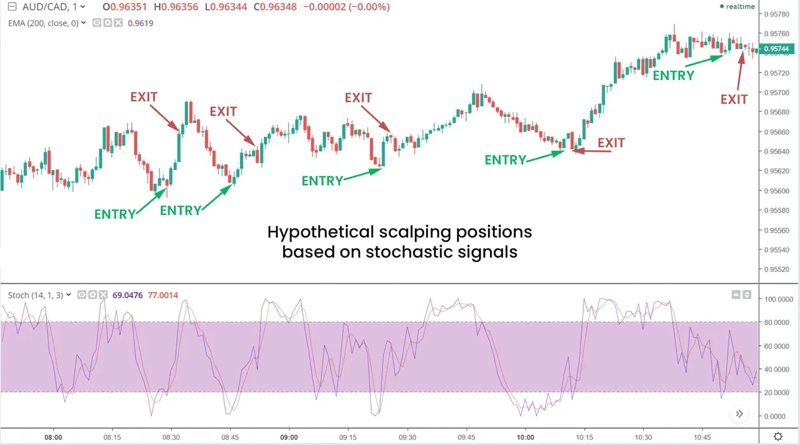
The chart below shows a possible 3-hour session from a scalper, opening five trades on AUD/CAD based on signals from the stochastic oscillator. Many scalp traders, though, will open far more positions than this.
You don’t have to scalp forex. In fact, lots of scalpers focus on other markets like commodities and indices instead. But currencies do have some characteristics that make them particularly suitable to this approach:
- Volatility. FX pairs tend to be highly volatile, which provides lots of opportunities for scalpers each day
- Liquidity. Forex is the most-traded market in the world by volume. This means you can usually enter and exit trades quickly and cheaply – which are both key to scalping successfully
- Round-the-clock trading. The currency markets trade 24 hours a day, so you can build a scalping strategy that suits you. However, some times are better to trade than others
Learn more about how to trade forex.
2. Is forex scalping profitable?
Scaping forex can be highly profitable; but it requires a lot of time, dedication and patience. When the profit margins are so tight on each trade, a single mistake can wipe out the gains from several winning trades, so risk management and discipline are essential to your success.
A day trader, for example, might look to open 5-10 positions over a single session. A scalper might do that in a single hour, on a single market – keeping each trade open for minutes or even seconds at a time, to capture a handful of pips of profit.
If you deviate from your plan and let a loss run, the profit from your day could be wiped out instantly.
You’ll also have to factor in the effect of losing trades on your bottom line. When you scalp forex, you’ll need to ensure that you make more winning trades than losing ones, since your risk-reward ratio is likely to be so tight on each position.
Explore how to manage risk in the FOREX.com Academy.
3. What’s the best forex scalping strategy?
The best forex scalping strategy for you will depend on your plan and aims. However, there are a few popular options among scalp traders:
- Breakout trading. Probably the most popular forex scalping strategy, breakout traders look for the new mini trends to begin, then trade them until they peter out
- High-volume trading. This strategy involves trading in large quantities to make as much profit as possible from the smallest moves, sometimes just a few pips
- Spread trading. Spread traders buy and sell an asset at the same time with different providers to attempt to profit from the differences in market prices. It can be hard to execute, as you’re going up against institutional traders and market makers
- Momentum trading. When you trade momentum, you look to capture smaller price action within an overall wider trend
Let’s take a look at a potential momentum trading strategy to see how one of these might work in practice.
4. Scalping forex breakouts on AUD/CAD
1. Look at the wider trend
The first step you’ll need to take when looking for momentum trades is to establish the overall trend of the market. When momentum trading, you always open positions in the same direction as the overall trend – but even if you’re employing a different strategy, it is still useful to take in the wider picture before you dive in.
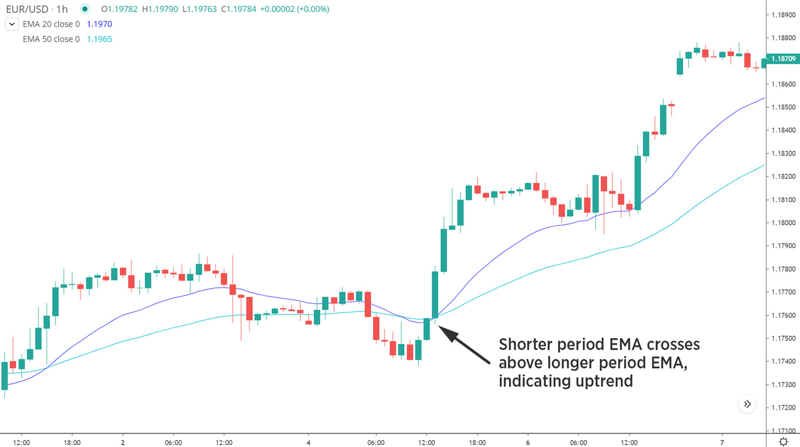
In our AUD/CAD chart, for example, we can use two EMAs to identify an impending upward trend, which may contain mini moves suitable for scalping.
2. Zoom in
Next, it’s time to move over to a shorter-term chart. Which chart you use is up to you, but most scalpers tend to look at markets in 1-minute timeframes, or even less. In this example, we’re using a 1-minute chart.
3. Watch for opportunities
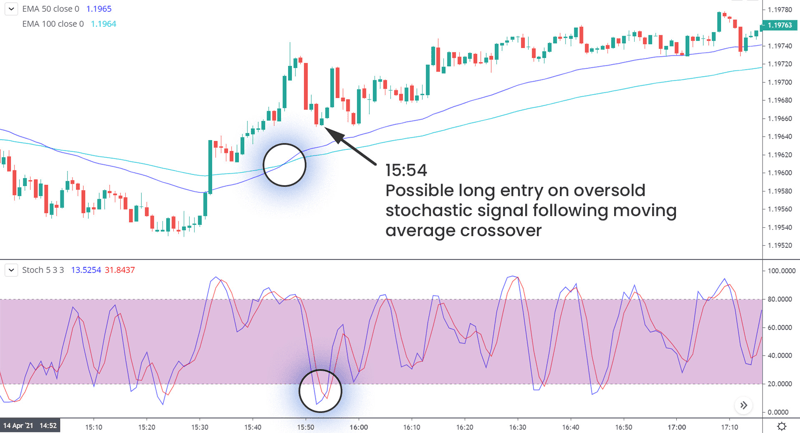
Now we hunt for new trades that fit our plan. You can use a wealth of indicators or price action analysis to look for opportunities, but here we’re going to use the stochastic oscillator, combined with two long-term EMAs to confirm the move before opening our position.
Below, for instance, we can see the stochastic giving an oversold signal, with a corresponding EMA crossover. A long trade may be on the cards.
4. Plan your exits
The speed of trading required when scalping means you won’t necessarily have time to refine your entry before seizing the opportunity, but you’ll still need to set a stop and a limit at your planned exit points.
Scalpers often have their stop very close to the point of entry, to limit losses if the signal proves incorrect. And your limit order will probably be five or ten points above – risk-reward ratios above 1:2 are fairly rare when scalping.
Best time to scalp forex
Forex markets are open 24 hours a day, so theoretically you can scalp forex whenever you want. But as we cover above, you’ll want to ensure that you have sufficient liquidity to enter and exit positions quickly – and keep your spread costs low.
Liquidity tends to peak when two sessions overlap, which happens three times each day:
- New York and London from 1pm to 4pm (UTC)
- Tokyo and Sydney from 12am to 7am (UTC)
- Tokyo and London from 8am to 9am (UTC)
5. Best indicators for scalping forex
To scalp forex, you’ll want to use indicators that can give you lots of opportunities you can execute quickly each session. Some popular options include:
- RSI. The relative strength index (RSI) is an oscillator that evaluates recent price action to give a reading between 0-100. Anything under 30 is usually viewed as oversold, while over 70 is overbought
- Bollinger bands. Bollinger bands can be used to give instant insight into a market’s current volatility – and when the price moves beyond either of the outer bands, it may present a chance to trade
- Stochastic oscillator. Like the RSI, the stochastic is an oscillator that tells you a market’s current momentum with a reading between 0-100. However, it does so by comparing an FX pair’s closing price to the range of its recent closes
- Moving averages (MA). As we saw in our example, MA crossovers are often seen as a sign of an impending trend. Or you can use moving average convergence divergence (MACD) to spot new signals
However, you don’t have to use indicators when scalping forex. Lots of traders use price action alone, looking for certain candlestick patterns that indicate price patterns.
Learn more about MT4, a popular platform for automated FX trading.
6. Forex scalping tips
- Use stops and limits. Stops and limits help ensure that you don’t hold positions for too long, which can be devastating to your bottom line when scalping. Ideally, you’ll never open a position without at least a stop in place
- Consider the 1% rule. The 1% rule involves never risking more than 1% of your total balance on any single position. If you have an account worth $10,000, for example, you’d only ever risk $100 on one opportunity
- Make a trading plan before you start. Scalping requires discipline, and the best way to stay disciplined is to set out a strict set of rules before you open a single position. The more comprehensive your plan, the better your chances of success
Share this:




Ready to trade?
Open a live account in minutes.
Go to our Trading Academy
Choose one of our four market-leading educational courses.
A better trading experience
Discover how FOREX.com's platforms can give you an edge.
Economic calendar
This report is intended for general circulation only. It should not be construed as a recommendation, or an offer (or solicitation of an offer) to buy or sell any financial products. The information provided does not take into account your specific investment objectives, financial situation or particular needs. Before you act on any recommendation that may be contained in this report, independent advice ought to be sought from a financial adviser regarding the suitability of the investment product, taking into account your specific investment objectives, financial situation or particular needs.
StoneX Financial Pte. Ltd., may distribute reports produced by its respective foreign entities or affiliates within the StoneX group of companies or third parties pursuant to an arrangement under Regulation 32C of the Financial Advisers Regulations. Where the report is distributed to a person in Singapore who is not an accredited investor, expert investor or an institutional investor (as defined in the Securities Futures Act), StoneX Financial Pte. Ltd. accepts legal responsibility to such persons for the contents of the report only to the extent required by law. Singapore recipients should contact StoneX Financial Pte. Ltd. at 6826 9988 for matters arising from, or in connection with the report.
In the case of all other recipients of this report, to the extent permitted by applicable laws and regulations neither StoneX Financial Pte. Ltd. nor its associated companies will be responsible or liable for any loss or damage incurred arising out of, or in connection with, any use of the information contained in this report and all such liability is hereby expressly disclaimed. No representation or warranty is made, express or implied, that the content of this report is complete or accurate.
StoneX Financial Pte. Ltd. is not under any obligation to update this report.
Trading CFDs carries a high level of risk that may not be suitable for some investors. Consider your investment objectives, level of experience, financial resources, risk appetite and other relevant circumstances carefully. The possibility exists that you could lose some or all of your investments, including your initial deposits. If in doubt, please seek independent expert advice. Visit www.forex.com/en-sg/terms-and-policies for the complete Risk Disclosure Statement.