


Rivian IPO: How does RIVN’s first week compare to TSLA’s?
If we’re looking at first-week performance only, RIVN is DRAMATICALLY outperforming TSLA...
Share this:

By definition, it’s not every day or even every year (heck, it’s barely every decade) that you see the biggest IPO in nine years.
As my colleague Ben Lobel noted in his initial pre-IPO article, Rivian Automotive (RIVN) raised nearly $12B based on its official IPO price of $78/share, the largest amount raised since Facebook’s (FB) $16B in 2012. While this figure is staggering, Rivian may nonetheless have left billions on the table based on the first week’s price action!
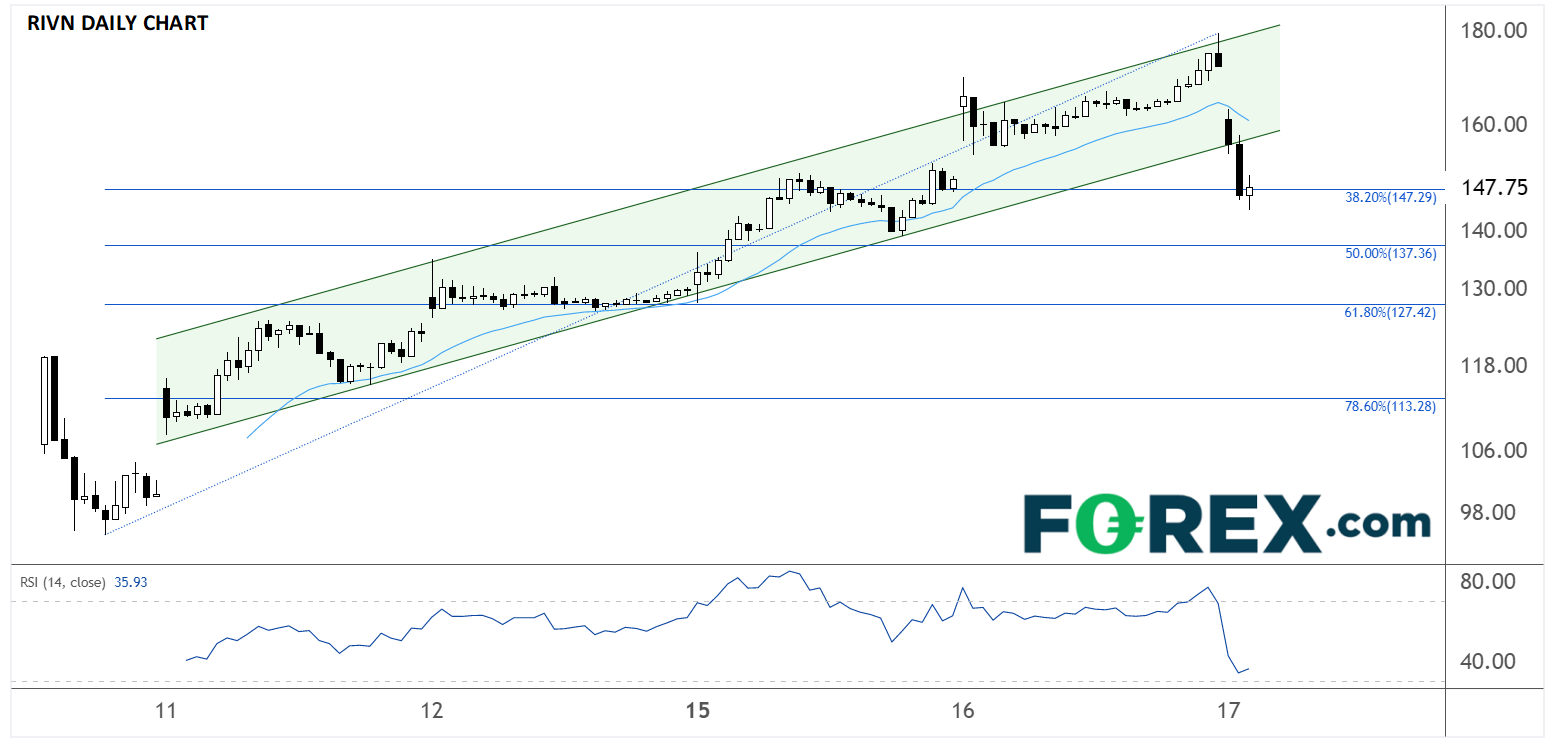
As the 15-min chart below shows, RIVN’s first trades went off near $107, and the stock has surged from there, closing yesterday’s trade above $172, up more than 120% from the $78 IPO price!
Source: StoneX, TradingView
How does Rivian’s first week of trading compare to rival Tesla’s?
To answer the above question in a word: Favorably.
Elon Musk’s EV behemoth is the paragon that all the nascent EV startups seek to emulate, and based on its first week of trade, RIVN is ahead of the pace. Turning our calendars back to June 2010, Tesla Motors priced its IPO at a (split-adjusted) $3.40 per share, saw an IPO-day spike to nearly $5, then faded throughout the rest of its first week to close at $3.22, below its IPO price. Of course, that ultimately marked essentially the lowest price that TSLA shares ever saw, but if we’re looking at first-week performance only, RIVN is dramatically outperforming TSLA.
Rivian’s first-week surge in context: What does it mean for markets and the global auto industry?
As we’ve seen throughout the last couple of years, RIVN’s IPO reinforces that traders’ demand for fast-growing companies in innovative industries is insatiable, regardless of whether they’re currently profitable, and the recent bout of higher inflation is doing little to dampen that appetite.
The more interesting questions raised by the IPO related to the global automobile market. Looking at the market capitalizations of the 10 largest global auto companies, a clear trend emerges (EV-only manufacturers in italics):
- Tesla Motors: $1,089B
- Toyota: $259B
- Volkswagen: $136B
- BYD: $133B
- Rivian: $125B
- Daimler: $108B
- General Motors: $92B
- Lucid Motors: $87B
- Ford: $78B
- Great Wall Motors: $70B
For reference, electric vehicles accounted for just 2.6% of the global auto market in 2020. In other words, with four EV-focused automakers in the Top 10 (and 3 in the Top 5!), it’s clear that EV manufacturers are punching way above their weight. In essence, it appears that traders are essentially valuing the gas-powered segments of incumbent automakers at zero and viewing the global vehicle market as purely a race to produce EVs at scale.
The biggest risk to this perspective is that manufacturing intricate machines like modern vehicles at scale is unfathomably complex, and current market valuations are suggesting that young upstart EV manufacturers like Rivian and Lucid will be able to scale up to mass production smoothly, or at least more quickly than legacy automakers with decades (in some cases more than a century’s worth) of experience can retool to producing primarily EVs.
It remains to be seen whether that will ultimately be the case, but after Rivian’s impressive first week, it’s critical for traders to understand the narratives and competitive dynamics at play in the broader industry.
How to trade with FOREX.com
Follow these easy steps to start trading with FOREX.com today:
- Open a Forex.com account, or log-in if you’re already a customer.
- Search for the market you want to trade in our award-winning platform.
- Choose your position and size, and your stop and limit levels.
- Place the trade.
By definition, it’s not every day or even every year (heck, it’s barely every decade) that you see the biggest IPO in nine years.
As my colleague Ben Lobel noted in his initial pre-IPO article, Rivian Automotive (RIVN) raised nearly $12B based on its official IPO price of $78/share, the largest amount raised since Facebook’s (FB) $16B in 2012. While this figure is staggering, Rivian may nonetheless have left billions on the table based on the first week’s price action!
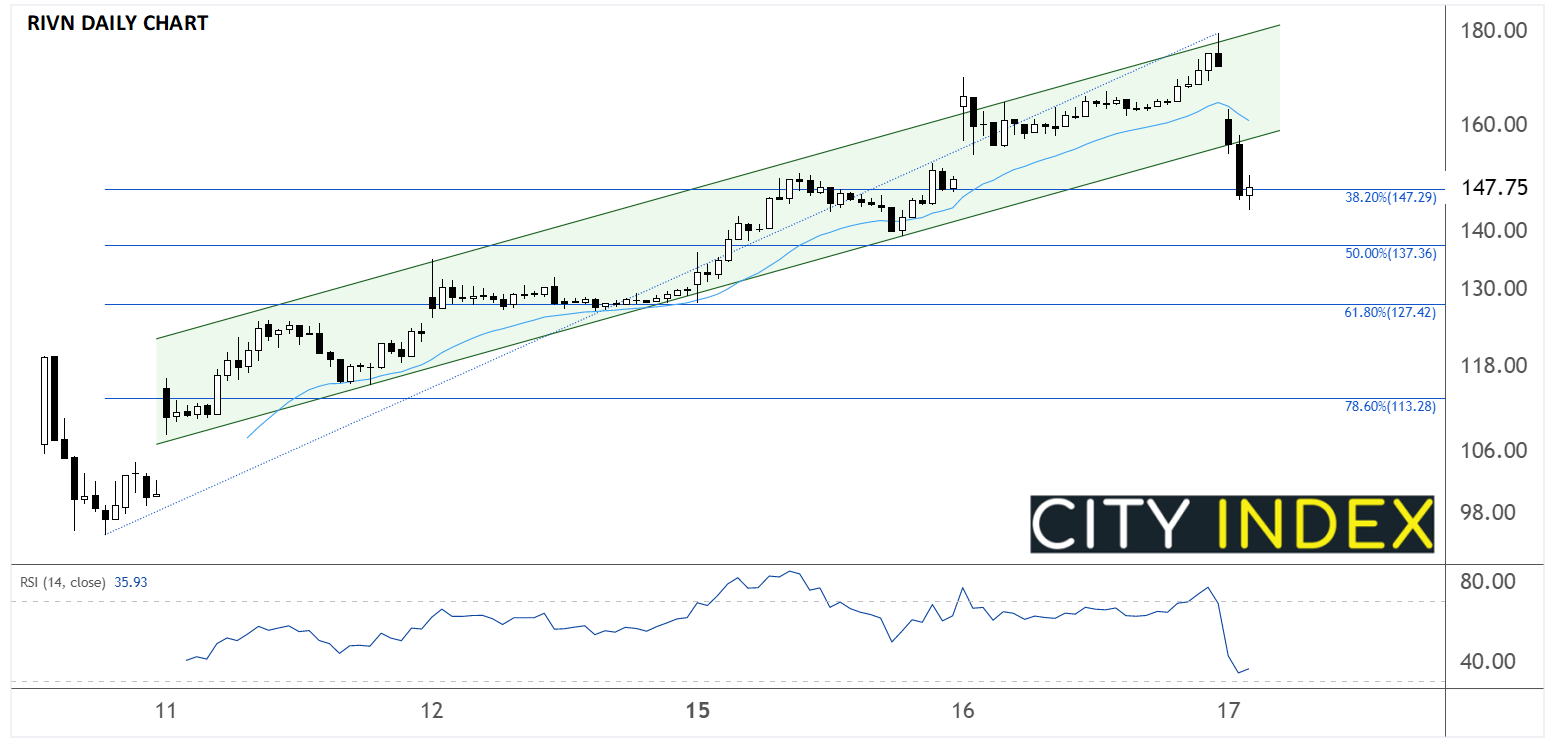
As the 15-min chart below shows, RIVN’s first trades went off near $107, and the stock has surged from there, closing yesterday’s trade above $172, up more than 120% from the $78 IPO price!
Source: StoneX, TradingView
How does Rivian’s first week of trading compare to rival Tesla’s?
To answer the above question in a word: Favorably.
Elon Musk’s EV behemoth is the paragon that all the nascent EV startups seek to emulate, and based on its first week of trade, RIVN is ahead of the pace. Turning our calendars back to June 2010, Tesla Motors priced its IPO at a (split-adjusted) $3.40 per share, saw an IPO-day spike to nearly $5, then faded throughout the rest of its first week to close at $3.22, below its IPO price. Of course, that ultimately marked essentially the lowest price that TSLA shares ever saw, but if we’re looking at first-week performance only, RIVN is dramatically outperforming TSLA.
Rivian’s first-week surge in context: What does it mean for markets and the global auto industry?
As we’ve seen throughout the last couple of years, RIVN’s IPO reinforces that traders’ demand for fast-growing companies in innovative industries is insatiable, regardless of whether they’re currently profitable, and the recent bout of higher inflation is doing little to dampen that appetite.
The more interesting questions raised by the IPO related to the global automobile market. Looking at the market capitalizations of the 10 largest global auto companies, a clear trend emerges (EV-only manufacturers in italics):
- Tesla Motors: $1,089B
- Toyota: $259B
- Volkswagen: $136B
- BYD: $133B
- Rivian: $125B
- Daimler: $108B
- General Motors: $92B
- Lucid Motors: $87B
- Ford: $78B
- Great Wall Motors: $70B
For reference, electric vehicles accounted for just 2.6% of the global auto market in 2020. In other words, with four EV-focused automakers in the Top 10 (and 3 in the Top 5!), it’s clear that EV manufacturers are punching way above their weight. In essence, it appears that traders are essentially valuing the gas-powered segments of incumbent automakers at zero and viewing the global vehicle market as purely a race to produce EVs at scale.
The biggest risk to this perspective is that manufacturing intricate machines like modern vehicles at scale is unfathomably complex, and current market valuations are suggesting that young upstart EV manufacturers like Rivian and Lucid will be able to scale up to mass production smoothly, or at least more quickly than legacy automakers with decades (in some cases more than a century’s worth) of experience can retool to producing primarily EVs.
It remains to be seen whether that will ultimately be the case, but after Rivian’s impressive first week, it’s critical for traders to understand the narratives and competitive dynamics at play in the broader industry.
How to trade with City Index
You can trade easily trade with City Index by using these four easy steps:
- Open an account, or log in if you’re already a customer
• Open an account in the UK
• Open an account in Australia
• Open an account in Singapore
- Search for the company you want to trade in our award-winning platform
- Choose your position and size, and your stop and limit levels
- Place the trade
Latest market news



The complete CFD trading experience
Award-winning platforms, competitive spreads, low commissions and dedicated support.
We live and breathe the markets and are dedicated to helping traders realise their ambitions as we continue to set the industry bar.
Economic calendar
Web Trader platform
Our sophisticated web-based platform is packed with features.
Related articles

DeepSeek IPO: Everything You Need to Know About DeepSeek
DeepSeek IPO: Learn about its potential 2027 listing, valuation, revenue, profitability, ownership, competitors and what investors should watch.

Bloomberg IPO: Everything You Need to Know About Bloomberg
Explore everything investors need to know about a potential Bloomberg IPO, including valuation, ownership, profitability, competitors, leadership and possible timing.

Moonshot AI IPO: Everything You Need to Know About Moonshot AI
Moonshot AI is reportedly preparing for a Hong Kong IPO. Here is what investors need to know about Kimi, its valuation, ownership, financials, and risks.
StoneX Europe Ltd may make third party material available on this website which may contain information included but not limited to the conditions of financial markets. The material is for information purposes only and does not contain, and should not be construed as containing, investment advice and/or investment recommendation and/or an investment research and/or an offer of or solicitation for any transactions in financial instruments; any decision to enter into a specific transaction shall be made by the client following an assessment by him/her of their situation.
StoneX Europe Ltd makes no representation or warranty and assumes no liability as to the accuracy or completeness of the information provided, nor any loss arising from any investment based on a recommendation, forecast or other information supplied. You should always seek independent advice as to your suitability to speculate in any related markets and your ability to assume the associated risks, if you are at all unsure. We are not under any obligation to update any such material. Any opinion made may be personal to the author and may not reflect the opinion of StoneX Europe Ltd.