



Weekly Fundamental Crypto Outlook: Is Trump Affecting Market Confidence?
Cryptocurrencies have started to show a decline in short-term confidence as new fundamental factors emerge—particularly the recent comments by President Trump, which point to a possible reactivation of the trade war.
Share this:

Cryptocurrencies have started to show a decline in short-term confidence as new fundamental factors emerge—particularly the recent comments by President Trump, which point to a possible reactivation of the trade war. This development has halted the early-week bullish momentum, prompting the market to shift toward traditional safe-haven assets. If these risks of a renewed trade conflict persist, economic uncertainty could intensify, potentially leading to stronger selling pressure across the crypto market in the short term.


Trump’s New Threats
On October 10, President Donald Trump made remarks suggesting new retaliatory measures against China, in response to export restrictions imposed by Beijing on rare earth materials and key components used in the production of chips and electric vehicles.
Trump once again adopted an aggressive tone, calling the move an “economic aggression,” and warned that his administration is preparing strong countermeasures, potentially through new tariffs on Chinese technology goods. Although no specific rates were mentioned, it’s worth recalling that during the last escalation, proposed tariffs reached as high as 200%.
These comments have heightened risk perception in financial markets, leading the crypto sector to lose its temporary safe-haven appeal and revert to its traditional status as a risk asset. In times of uncertainty, investors tend to move their capital into safer instruments, which undermines cryptocurrency performance.
Indeed, Bitcoin’s (BTC) open interest has started to trend lower, falling toward $43.1 billion. Combined with the decline in BTC’s price, this points to a steady outflow of long positions, partly due to profit-taking at recent highs. Now, the increase in global risk is accelerating position liquidations, putting downward pressure on Bitcoin demand in the short term.
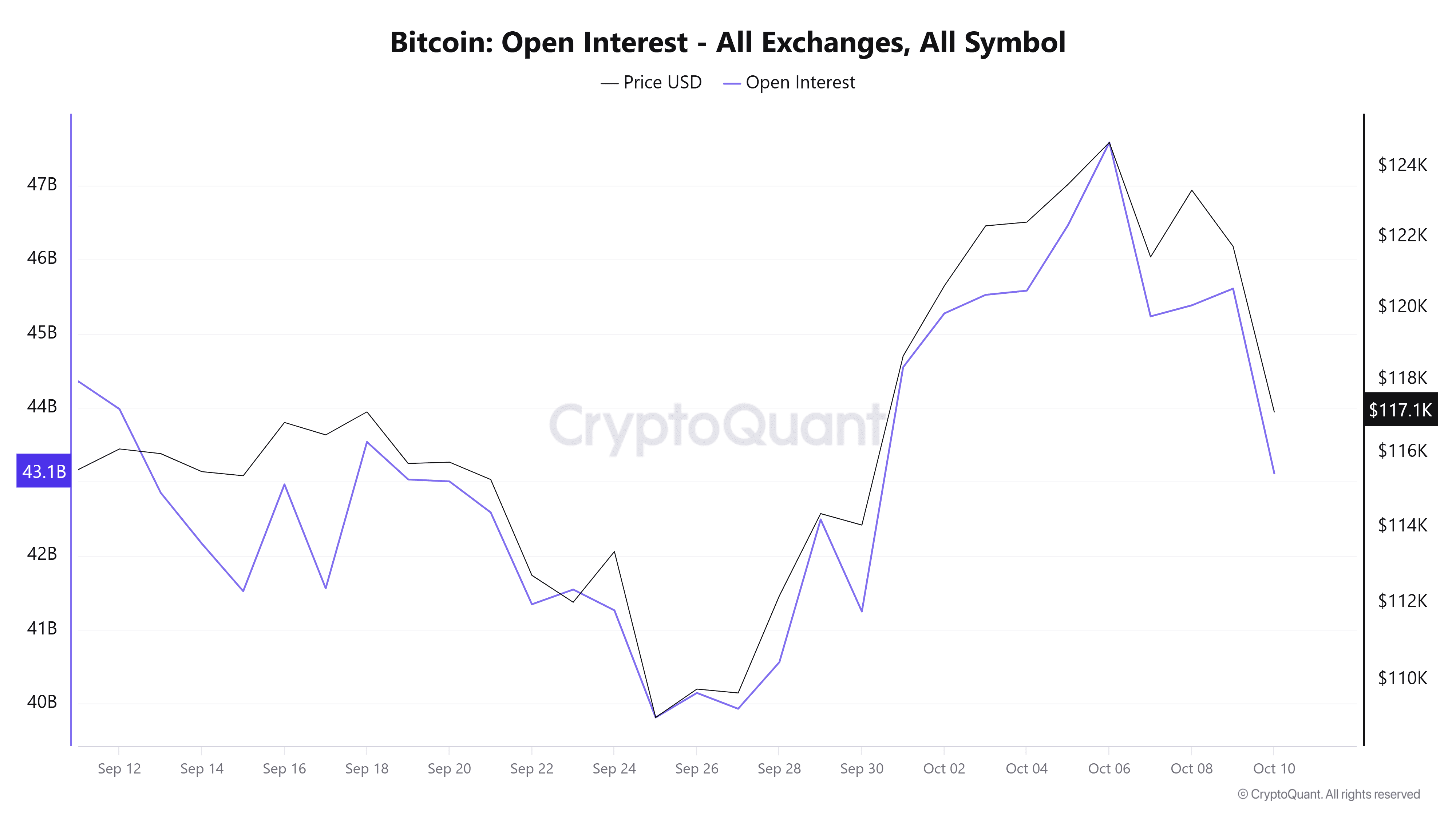
Source: Cryptoquant
In this new environment of global economic risk, confidence in the crypto market has begun to weaken. If expectations of a renewed trade war persist, selling pressure could become a key driver in the coming sessions.
Bitcoin vs. Other Markets
Recent BTC price movements show a neutral correlation with the DXY Index, which measures the strength of the U.S. dollar against other major currencies. The correlation coefficient between both assets has moved closer to zero, suggesting that Bitcoin is currently not tracking the dollar’s movements. While this reinforces its diversification potential, the rising global risk sentiment could lead investors to favor more stable assets, such as the dollar, reducing the appeal of Bitcoin and cryptocurrencies in general.
Conversely, Bitcoin’s correlation with stock indices has increased, now standing around 0.5, indicating that the crypto market is increasingly mirroring the behavior of traditional risk assets. As a result, BTC tends to benefit from bullish market sentiment but can underperform during uncertainty spikes.
It’s important to note that these correlation coefficients may change as trading sessions progress.
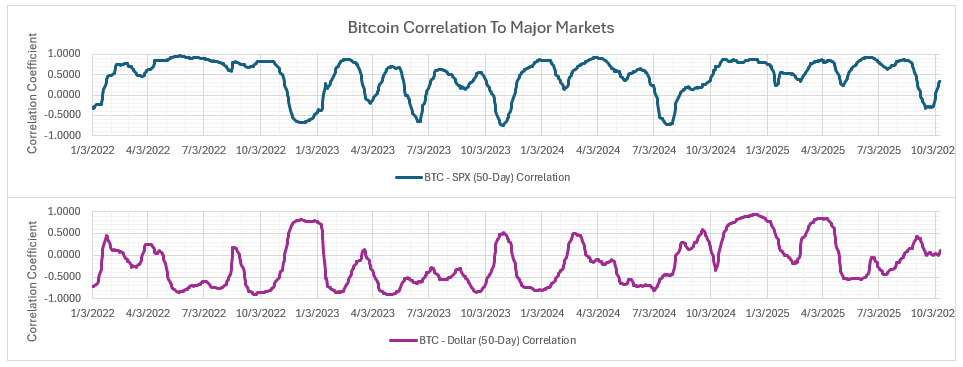
Source: Data – TVC, StoneX, Tradingview
Furthermore, when analyzing relative volatility, all major cryptocurrencies — except Ripple (XRP) and Cardano (ADA), which maintain volatility below the weekly average — have seen significant increases compared to early-week levels. This signals a rising risk sentiment across the crypto space. By contrast, the U.S. 10-year Treasury bond has maintained more stable volatility, reinforcing its position as a safer refuge amid growing uncertainty.

Source: Data – TVC, StoneX, Tradingview
Overall, as BTC’s correlation with risk assets rises and its link to the dollar weakens, the overall perception of volatility continues to grow. This environment could undermine crypto’s role as a temporary safe haven, while strengthening selling pressure in the short term.
Market Sentiment
The Crypto Fear & Greed Index currently stands at 54 points, below last week’s close, moving further into the neutral zone. This reflects a steady decline in confidence within the cryptocurrency market in the short term.
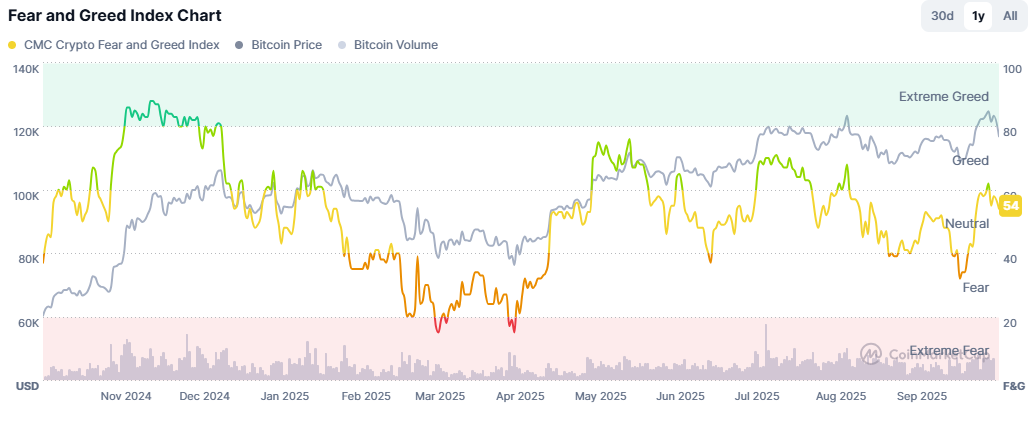
Source: Coinmarketcap
This decline in confidence has started to erode the market’s appeal. If the index continues trending toward the “fear zone,” heightened risk sentiment could accelerate selling pressure, increasing the likelihood of persistent bearish movements among major cryptocurrencies, including Bitcoin.
Written by Julian Pineda, CFA – Market Analyst
Follow him on: @julianpineda25



The complete CFD trading experience
Award-winning platforms, competitive spreads, low commissions and dedicated support.
We live and breathe the markets and are dedicated to helping traders realise their ambitions as we continue to set the industry bar.
Economic calendar
Web Trader platform
Our sophisticated web-based platform is packed with features.
Related articles

Bitcoin Analysis: Is Uncertainty Returning to BTC?
Recent trading sessions have not been particularly supportive of a clear directional move in Bitcoin. This can be seen in the behavior of the price over the last four sessions, where fluctuations have remained close to 1.00% without establishing a consistent trend. As a result, a growing sense of neutrality is beginning to emerge around BTC.

Gold Dips Below Three-Month Uptrend, Bitcoin Pulls Back from Nine-Month High
Gold has dipped below its three-month uptrend, while Bitcoin has pulled back from a nine-month high as U.S. bond yields test levels last seen in 2004 and 2007. Risks build as Fed rate-hike expectations remain above 70%, while the Dollar Index holds near yearly highs.


Crypto Outlook: Altcoins Lead the Rally as Bitcoin Pauses
With only a few days left in September, the cryptocurrency market continues to show a constructive short-term outlook. The latest trading week has delivered meaningful gains across most major digital assets and, broadly speaking, the bullish bias remains the dominant force within the market.
StoneX Europe Ltd may make third party material available on this website which may contain information included but not limited to the conditions of financial markets. The material is for information purposes only and does not contain, and should not be construed as containing, investment advice and/or investment recommendation and/or an investment research and/or an offer of or solicitation for any transactions in financial instruments; any decision to enter into a specific transaction shall be made by the client following an assessment by him/her of their situation.
StoneX Europe Ltd makes no representation or warranty and assumes no liability as to the accuracy or completeness of the information provided, nor any loss arising from any investment based on a recommendation, forecast or other information supplied. You should always seek independent advice as to your suitability to speculate in any related markets and your ability to assume the associated risks, if you are at all unsure. We are not under any obligation to update any such material. Any opinion made may be personal to the author and may not reflect the opinion of StoneX Europe Ltd.