

Central banks
A complete guide to the Organization of the Petroleum Exporting Countries (OPEC)
What is OPEC?
The Organization of the Petroleum Exporting Countries (OPEC) is a group of 13 of the world’s largest oil-exporting nations. It was founded in 1960 by Iran, Iraq, Kuwait, Saudi Arabia, and Venezuela to coordinate petroleum policies and support cooperation between member countries.
OPEC’s members collectively control a significant portion of the global petroleum supply, enabling them to influence the price of oil and reduce volatility that could harm their economies.
Who is in OPEC?
The current 13 members of OPEC are:
- Iran (founder)
- Iraq (founder)
- Kuwait (founder)
- Saudi Arabia (founder)
- Venezuela (founder)
- Algeria
- Angola
- Congo
- Equatorial Guinea
- Gabon
- Libya
- Nigeria
- United Arab Emirates
OPEC distinguishes between founders and full members in terms of voting rights. To join, a country must export crude petroleum, have aligned interests, and gain approval from three-fourths of full members, including all founding members.
An additional membership type, ‘Associate Member,’ applies to petroleum-exporting countries that do not qualify for full membership but share aligned interests.
What is the role of OPEC?
OPEC’s role is to coordinate and unify petroleum policies of its member countries, ensuring stability in oil markets and fair returns for producers.
It aims to stabilize oil prices by adjusting production to balance supply and demand, providing a steady income for producers and reliable supply for consumers.
OPEC also sought to counterbalance U.S. dominance in oil markets prior to 1960. This influence was demonstrated during the 1973 oil embargo, which triggered a fuel crisis in the U.S.
How does OPEC influence oil prices?
OPEC influences prices by altering production quotas. Oil prices reflect both current supply and future expectations. When production is cut, prices often rise—provided demand remains steady.
However, excessive cuts can reduce member revenue. Production quotas are set during twice-yearly meetings, often leading to price volatility ahead of announcements.
Keep an eye on the economic calendar for the next OPEC meeting.
Saudi Arabia, the largest producer, is a key market indicator. Many investors use its output as a proxy for oil market liquidity.
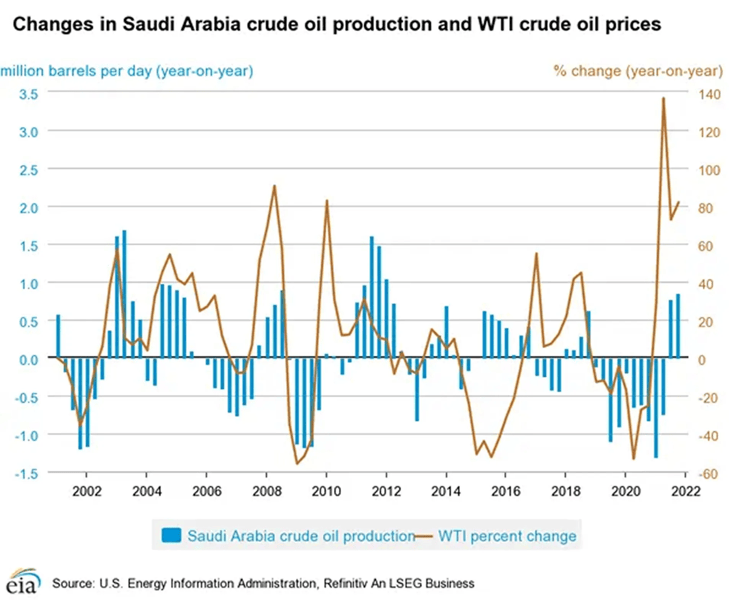
Spare production capacity—oil that can be brought online within 30 days and sustained for 90—is a key stability factor. Saudi Arabia maintains 1.5–2 million barrels/day in reserve.
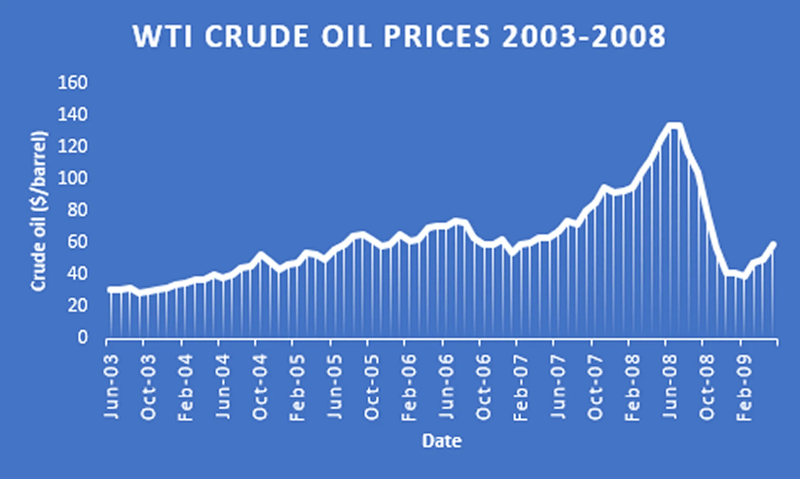
OPEC’s spare capacity signals its ability to manage crises. Low capacity can trigger market anxiety and rising prices. For instance, from 2003 to 2008, low capacity and geopolitical risks pushed oil from $25 to $147/barrel.
Unexpected production changes also affect prices. These can result from:
- Non-compliance with quotas
- Strikes or disruptions
- Geopolitical instability
That’s why staying updated on OPEC news is essential.
Does OPEC control the world’s oil reserves?
OPEC claims control over 79.4% of global oil reserves and produces 40% of crude oil, accounting for 60% of internationally traded petroleum.
However, new technologies like fracking have diluted its power. As of 2020, the top five producers were the U.S., Saudi Arabia, Russia, Canada, and China—only one is an OPEC member.
Unlike OPEC, U.S. companies are restricted by antitrust laws and cannot coordinate production, limiting their global influence.
Difference between OPEC and non-OPEC countries
OPEC members form a coordinated group, while non-OPEC producers operate independently. Non-OPEC hubs include North America, former Soviet nations, and North Sea countries.
In 2016, OPEC partnered with 10 non-OPEC countries—Russia, Kazakhstan, Azerbaijan, Malaysia, Mexico, Bahrain, Brunei, Oman, Sudan, and South Sudan—forming the OPEC+ alliance.
Share this:
Latest market news



Open an account in minutes
Experience award-winning platforms with fast and secure execution.
Go to our Trading Academy
Choose one of our four market-leading educational courses.
A better trading experience
Discover how FOREX.com's platforms can give you an edge.