



AUD/USD Analysis: Australian Dollar Holds Steady Ahead of Inflation Data and the Fed
As the trading week progresses, a cautious tone is becoming increasingly evident around the Australian dollar. This can be observed in the recent performance of AUD/USD, where price action has remained largely unchanged over the last three trading sessions, recording a move of barely 0.1%. This behavior highlights a clear lack of direction within the market.
Share this:

As the trading week progresses, a cautious tone is becoming increasingly evident around the Australian dollar. This can be observed in the recent performance of AUD/USD, where price action has remained largely unchanged over the last three trading sessions, recording a move of barely 0.1%. This behavior highlights a clear lack of direction within the market.
For now, this phase of neutrality is being driven primarily by the wait for two key events: Australia's inflation release and the Federal Reserve's monetary policy decision scheduled for tomorrow. The combination of these events has limited the market's ability to develop a clear trend, although once the results are known, a more defined directional bias could begin to emerge around AUD/USD during the coming sessions.

What Is Expected from Australia's Inflation Data?
Following the close of today's session, markets will receive the latest annual CPI (YoY) figures for Australia. Current expectations point to a reading of around 4.2%, slightly above the previous figure.
This expectation remains important because it would confirm a renewed acceleration in inflationary pressures observed over recent months. August inflation came in at 4.0%, well above the lows recorded during 2026, when inflation reached levels close to 3.5% in July.
The situation is becoming increasingly relevant for the Australian economy because inflation continues to move further away from the long-term target established by the Reserve Bank of Australia (RBA), which stands near 3.0%. If today's release confirms stronger price pressures, it could reinforce the perception that inflation remains a significant challenge for the Australian economy.
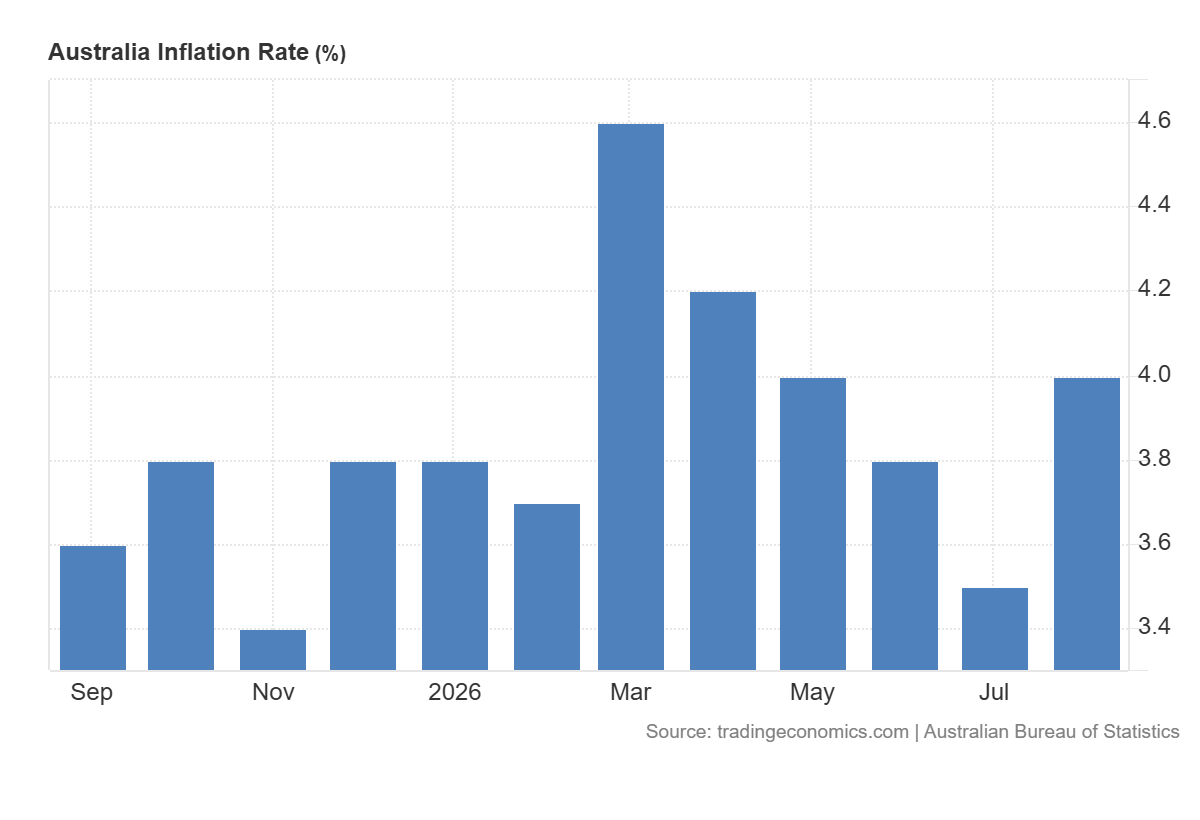
Source: TradingEconomics
This backdrop is also important because markets have already begun adjusting expectations regarding the RBA's monetary policy outlook. For the November 3 meeting, markets currently assign a probability of more than 56% that interest rates could increase by 25 basis points from the current 4.6% level.
This suggests that investors are already preparing for the possibility of a more aggressive Reserve Bank of Australia in the coming months, even before today's inflation figures are released.
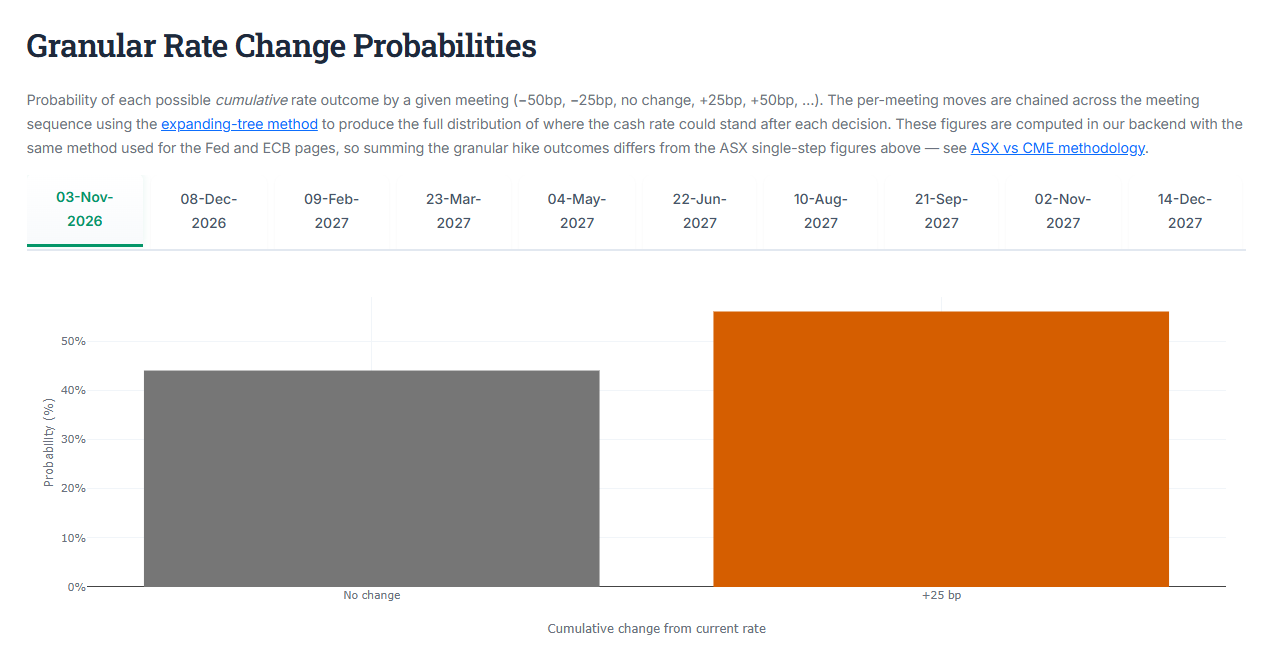
Source: Centralbankwatch
With all this in mind, the inflation report could become a key catalyst for the Australian dollar. If inflation comes in meaningfully above expectations, markets may begin to assign a higher probability to a more aggressive RBA during upcoming policy meetings.
A higher-rate environment could improve the relative attractiveness of Australian dollar-denominated assets compared to other regions and support stronger demand for the currency. Under that scenario, buying pressure around the AUD/USD could become increasingly relevant in the coming sessions.
Is the USD Still a Threat?
Beyond Australia's inflation data, attention will also remain focused on tomorrow's Federal Reserve policy decision.
Although markets continue to assign more than a 90% probability that interest rates will remain unchanged, according to CME Group data, the U.S. dollar has nevertheless begun to regain strength at the start of the week.
This can be observed through the recent performance of the DXY, the index that measures the strength of the U.S. dollar against its major peers. Over recent sessions, the index has resumed a consistent upward trend and is now trading above the 102-point level, reflecting renewed demand for the U.S. currency.
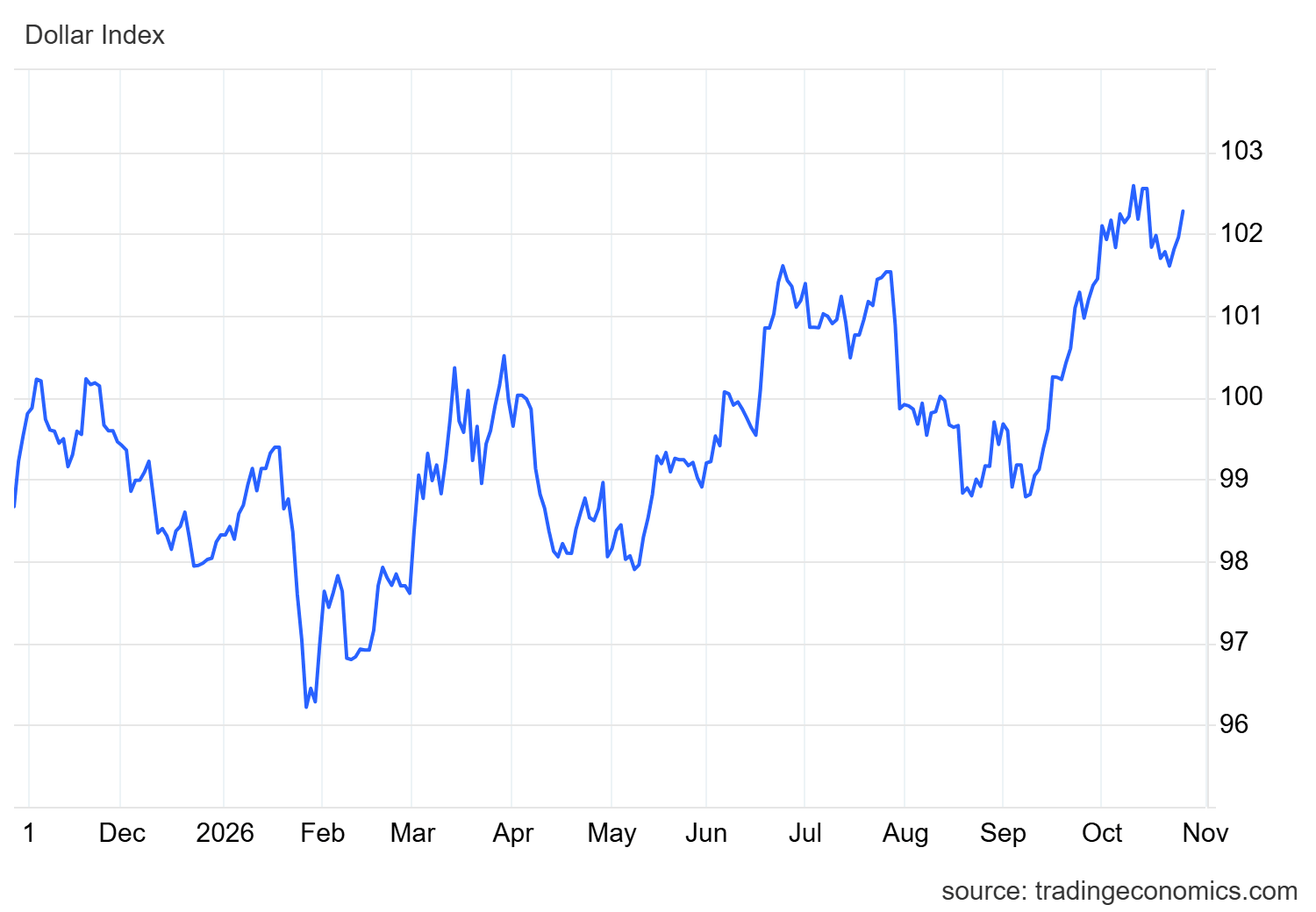
Source: TradingEconomics
Part of this recovery reflects the cautious tone that has dominated markets ahead of this week's central bank decisions. However, the Fed meeting could become particularly important because any signals suggesting a more aggressive policy stance in the coming months could further strengthen the dollar.
If this dynamic continues to support the DXY, it may make it more difficult for the Australian dollar to recover ground and could prolong the current phase of neutrality in AUD/USD over the coming weeks.
AUD/USD Technical Forecast
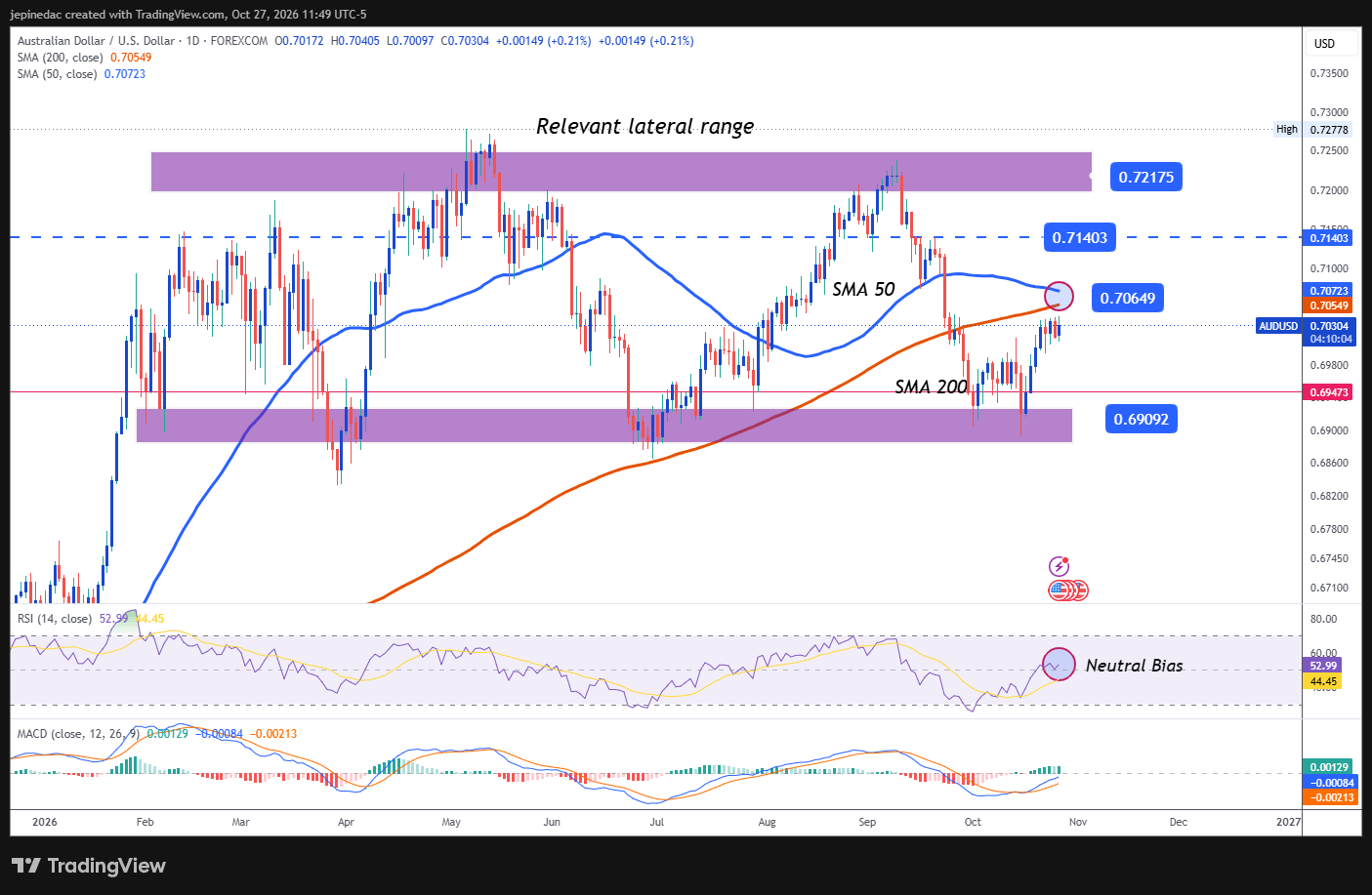
Source: StoneX, Tradingview
- The trading range remains the dominant structure: Despite several attempts at recovery, AUD/USD continues to trade within a broad sideways range that remains the most important technical structure of recent months. As long as price fails to break through key barriers on the chart, the lack of direction is likely to remain a dominant feature of market behavior.
- MACD: The MACD histogram continues to trade very close to the 0 neutral line, reflecting a relatively balanced dynamic in short-term moving-average momentum. This continues to support a broader picture of indecision within the daily chart.
- RSI: A similar situation can be observed in the RSI, which remains near the 50 neutral level. This reading reflects a relatively stable balance between buying and selling momentum, reinforcing the possibility that the current lack of direction could remain relevant in the short term.
Key Levels:
- 0.71403 – Key Resistance: A resistance area positioned above the most important moving averages on the chart. A sustained move above this level could begin to signal a meaningful structural shift and open the door to a more established bullish trend during the coming sessions.
- 0.70649 – Near-Term Barrier: An equilibrium level that coincides with both the 50-period and 200-period simple moving averages. As long as price remains near this area, a phase of neutrality could continue to dominate, favoring the continuation of the broader trading range observed over recent months.
- 0.69092 – Key Support: A major support zone that has been widely respected throughout much of 2026 and remains the most important downside barrier on the chart. A sustained break below this level could bring an end to the current trading range and open the door to a more clearly defined bearish structure in the weeks ahead.
Written by Julian Pineda, CFA, CMT – Market Analyst
Follow him on: @julianpineda25
Latest market news




Open an account today
Experience award-winning platforms with fast and secure execution.
Economic calendar
Web Trader platform
Our sophisticated web-based platform is packed with features.
Related articles
Australian Dollar Extends Slump as RBA Rate Hikes Look Dead and Buried
Australian unemployment surges to a five-year high of 4.9%, casting further doubt on RBA rate hikes as AUD/USD sinks below 67 cents.
Rates Shock, Metals Rout Leave Aussie Dollar Under the Pump
The global environment is becoming increasingly hostile for the Aussie. With AUD/USD breaking major support and AUD/JPY threatening further downside, today's jobs report faces an uphill battle to change the picture.


Euro Short-term Outlook: EUR/USD Plunges to 19-Month Low—Bears Face Critical Test 11 18 2026
The Euro selloff is now approaching pivotal support, raising the prospect of downside exhaustion as the November decline extends.

From time to time, StoneX Financial Pty Ltd (“we”, “our”) website may contain links to other sites and/or resources provided by third parties. These links and/or resources are provided for your information only and we have no control over the contents of those materials, and in no way endorse their content. Any analysis, opinion, commentary or research-based material on our website is for information and educational purposes only and is not, in any circumstances, intended to be an offer, recommendation or solicitation to buy or sell. You should always seek independent advice as to your suitability to speculate in any related markets and your ability to assume the associated risks, if you are at all unsure. No representation or warranty is made, express or implied, that the materials on our website are complete or accurate. We are not under any obligation to update any such material.
As such, we (and/or our associated companies) will not be responsible or liable for any loss or damage incurred by you or any third party arising out of, or in connection with, any use of the information on our website (other than with regards to any duty or liability that we are unable to limit or exclude by law or under the applicable regulatory system) and any such liability is hereby expressly disclaimed.