
- Trade framework agreed ahead of APEC
- Tariffs likely paused, export controls delayed
- AUD and NZD outperform in early Asian trade
Summary
A framework deal between U.S. and Chinese negotiators has eased trade tensions ahead of the APEC summit, halting tariff plans and pushing back export controls. The development sparked early strength in AUD and NZD, though technical barriers suggest the rally may face stiff tests before confirming a trend.
Another Day, Another Looming Deal
U.S. and Chinese negotiators have agreed on a framework for a trade deal that Trump and Xi are expected to finalise later this week at the APEC summit in South Korea. The proposal would pause Trump’s planned 100% tariffs on Chinese imports and see Beijing delay its new rare earth export controls by a year. Other issues discussed included trade expansion, the TikTok ownership transfer, and China’s role in easing the U.S. fentanyl crisis.
While Washington was quick to describe the outcome as progress, Chinese officials were far more guarded, saying only that a “preliminary consensus” had been reached. The deal, if signed, would likely extend the current tariff truce beyond mid-November and see China resume purchases of U.S. soybeans. Still, it’s clear both sides are moving cautiously, mindful of the repeated breakdowns that have marked trade relations in recent years.
Trump’s confidence in reaching a deal has become a familiar feature of these negotiations, often driving bursts of optimism across China-linked assets. But if history is any guide, that enthusiasm tends to fade once the details settle. For now, the Australian and New Zealand dollars have found some early support, though the risk remains that gains prove short-lived.

AUD/USD breaks to multi-week highs
Source: TradingView
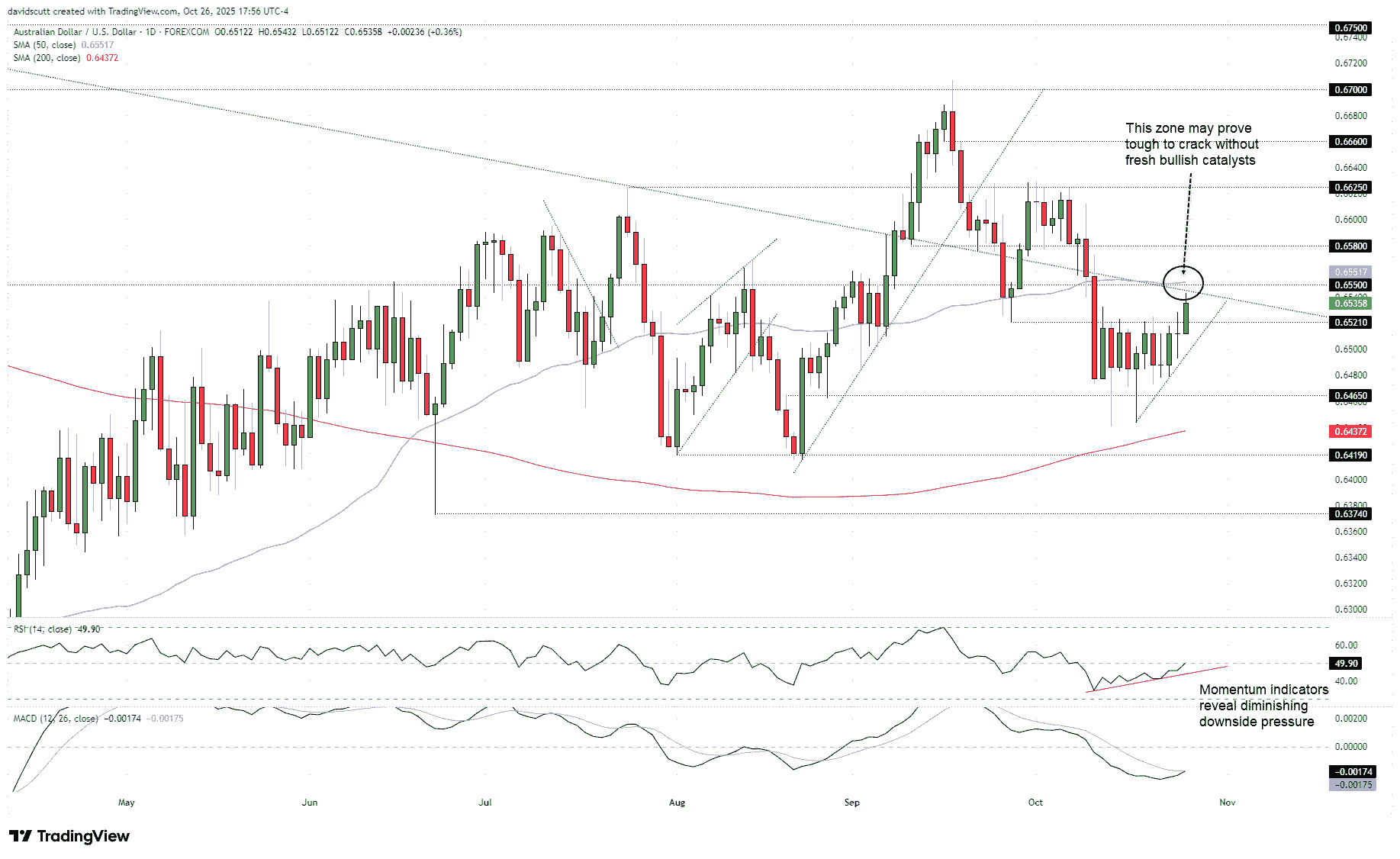
The news has seen AUD/USD break resistance above .6521 that had capped it for more than a fortnight, pushing the pair towards a major resistance zone consisting of the 50-day moving average, horizontal resistance at .6555, and the downtrend from the highs in early 2021. The confluence of these levels may prove difficult to overcome initially given good news is already priced in, putting extra emphasis on how the pair interacts around the zone for clues on directional risks.
Should we see a break and close or definitive push above the 50-day moving average, which forms the top of the resistance zone, it would put .6580, .6625, and .6666 on the radar as possible bullish targets. If the pair is unable to break through the resistance zone, .6521 may now revert to offering support, with bids also likely to emerge on dips beneath .6480 down to .6465.
The message from RSI (14) and MACD is one of shifting price momentum, with the former trending higher and back at neutral levels while the latter has just crossed the signal line from below in negative territory, providing a cautionary message that bearish momentum is weakening. Combined, the indicators suggest more emphasis should be put on price action near term.
NZD/USD rally may not be sustained
Source: TradingView
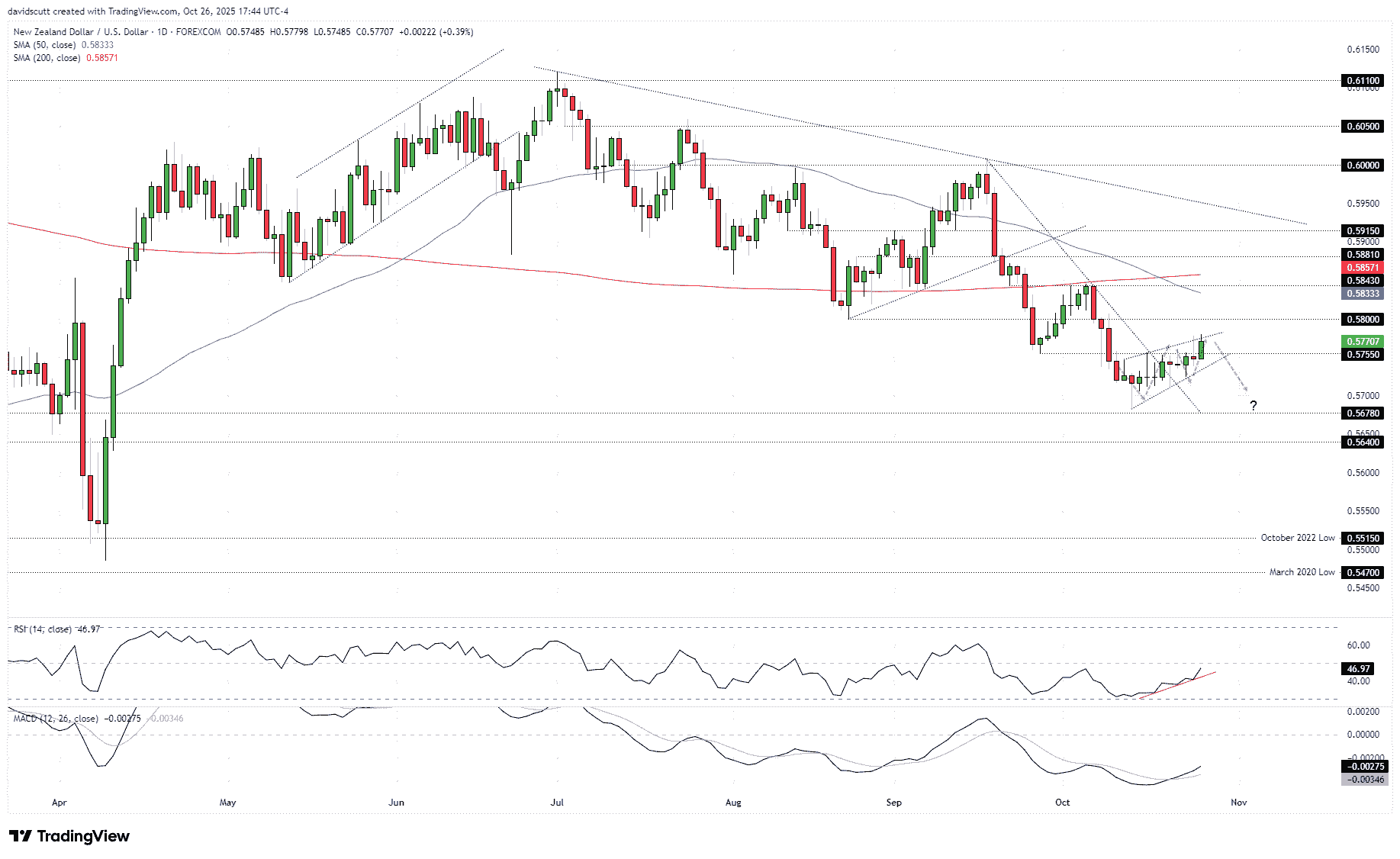
NZD/USD has also broken higher, climbing above .5755 where it has struggled recently, including on Friday when a gravestone doji printed on the daily timeframe. That bearish signal is further enhanced by the broader pattern it finds itself trading in, grinding higher within a narrowing range that resembles a rising wedge. As a bearish continuation pattern, that too warns of eventual downside risks. Like AUD/USD, the momentum signal from RSI (14) and MACD is one of diminishing downside pressure, putting more emphasis on price action to guide decision-making.
Wedge resistance is found at .5775 today, with a clean break of that level opening the door for a run towards .5800 before a string of tougher levels awaits above with the 50- and 200-day moving averages and horizontal resistance at .5843. Should rallies continue to falter at wedge resistance, .5755 is the first downside level to watch, with wedge support located around 25 pips lower. A break of that level would point to the increased likelihood of a retest of the October 14 low of .5680.