



Australian 1H2022 earnings season overview
The equities reporting season takes place twice a year in Australia. As a guide, most companies report half-year earnings in February for the six months of the new financial year (July 1 to December 31) before full-year earnings are reported in August.
Share this:

The 2021 Financial Year (FY) witnessed a remarkable economic turnaround, supported by unprecedented central bank policy and government intervention, fostering a more robust rebound from the first wave of Covid than even the most optimistic forecasters predicted.
The last set of financial results (August 2021) now stands as the peak in post-Covid expectations for earnings, as a Covid outbreak in three states along the Eastern Seaboard, marked the first half of 2022.
Growth rates have continued to roll over as the consumer, spooked by the fast spreading Omicron variant, went into voluntary lockdown pre and post-Christmas, providing another hurdle for reopening reality.
Also thrown into the mix, supply-chain disruption as Omicron forced workers into home isolation. This left inventory levels low, compounded by unseasonal weather that affected the fresh food supply.
At the same time, wage and price pressures have become more persistent. Following recent hot employment and inflation data, the RBA will likely follow other central banks and lift cash rates in 2022, thereby putting further pressure on earnings momentum.
The trend to higher interest rates has supported growth stocks over value globally. According to U.S. investment bank Morgan Stanley, here in Australia, value has outperformed growth by ~13% since December 1. Elsewhere Consumer Discretionary and Staples sectors have underperformed the ASX200 by 5.4% and 9.1%, respectively, since the start of December.
The key dates to watch this reporting season will be Week 2 (February 7 – February 11), when the action begins to hot up with reports from companies including the Commonwealth Bank of Australia (CBA) and ASX Limited (ASX).
Week 3 (14th to 18th of February) will see reports from companies including mining heavyweights BHP Group Ltd (BHP), Fortescue Metals Group (FMG), as well as JB Hi-Fi Ltd (JBH) and CSL Limited (CSL).
Week 4 (21st to 25th of February) will see reports from companies including the a2 Milk Company (A2M), Rio Tinto (RIO), Flight Centre Travel Group (FLT), and Qantas Airways Limited (QAN).
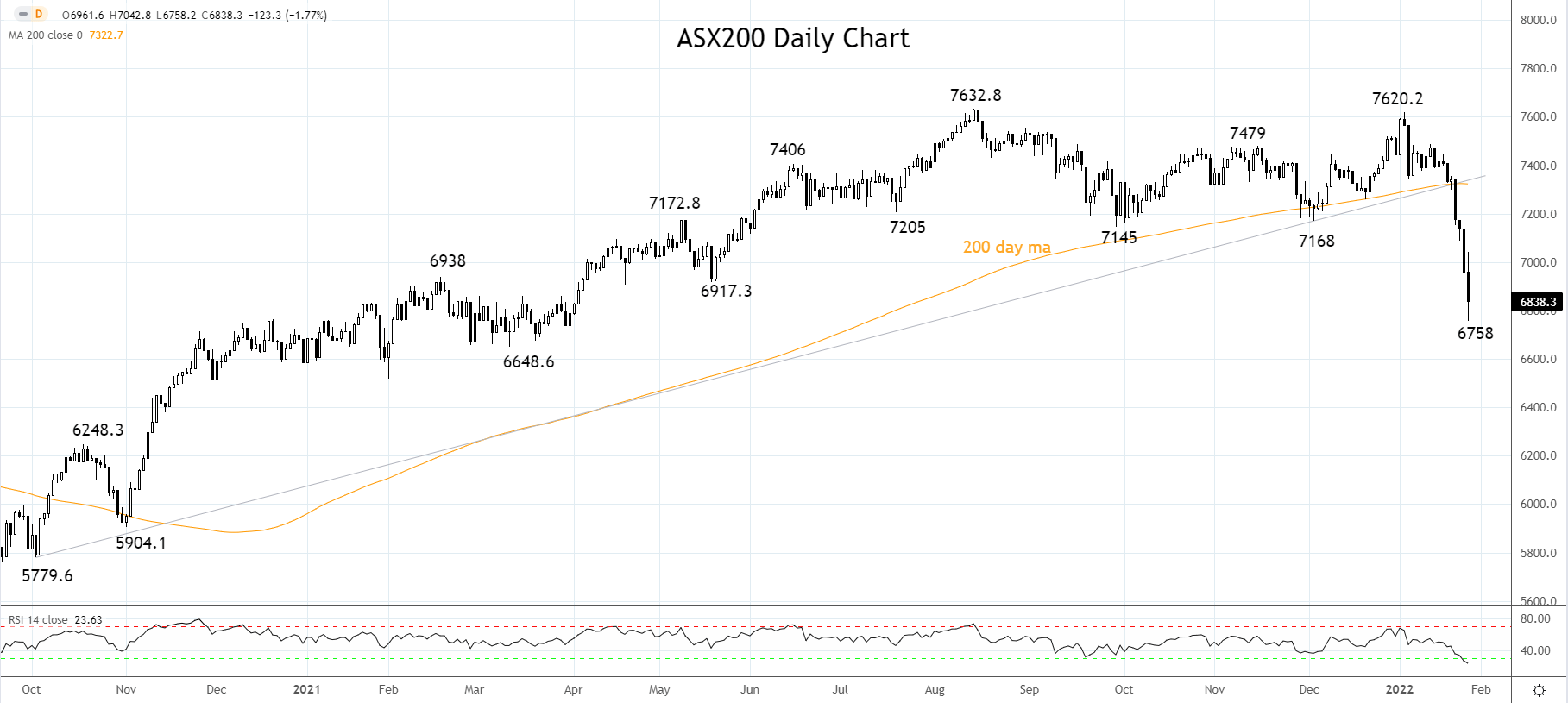
Australia's benchmark index, the ASX200, has fallen over 10% below the 2021 peak Index level. The bulk of the fall came after the ASX200 broke below critical support last week at 7300, consisting of the 200 day moving average and uptrend support from the October 5779 low.
Whether the savage repricing of the ASX200 to the end of lower interest rates and quantitative easing (QE) is complete for now remains to be seen. However, with reporting season just around the corner bringing with it earnings risk, the volatility episode of January looks set to extend into February.
Source Tradingview. The figures stated areas of January 27, 2022. Past performance is not a reliable indicator of future performance. This report does not contain and is not to be taken as containing any financial product advice or financial product recommendation
How to trade with City Index
You can trade with City Index by following these four easy steps:
- Open an account, or log in if you’re already a customer
• Open an account in the UK
• Open an account in Australia
• Open an account in Singapore
- Search for the company you want to trade in our award-winning platform
- Choose your position and size, and your stop and limit levels
- Place the trade
The 2021 Financial Year (FY) witnessed a remarkable economic turnaround, supported by unprecedented central bank policy and government intervention, fostering a more robust rebound from the first wave of Covid than even the most optimistic forecasters predicted.
The last set of financial results (August 2021) now stands as the peak in post-Covid expectations for earnings, as a Covid outbreak in three states along the Eastern Seaboard, marked the first half of 2022.
Growth rates have continued to roll over as the consumer, spooked by the fast spreading Omicron variant, went into voluntary lockdown pre and post-Christmas, providing another hurdle for reopening reality.
Also thrown into the mix, supply-chain disruption as Omicron forced workers into home isolation. This left inventory levels low, compounded by unseasonal weather that affected the fresh food supply.
At the same time, wage and price pressures have become more persistent. Following recent hot employment and inflation data, the RBA will likely follow other central banks and lift cash rates in 2022, thereby putting further pressure on earnings momentum.
The trend to higher interest rates has supported growth stocks over value globally. According to U.S. investment bank Morgan Stanley, here in Australia, value has outperformed growth by ~13% since December 1. Elsewhere Consumer Discretionary and Staples sectors have underperformed the ASX200 by 5.4% and 9.1%, respectively, since the start of December.
The key dates to watch this reporting season will be Week 2 (February 7 – February 11), when the action begins to hot up with reports from companies including the Commonwealth Bank of Australia (CBA) and ASX Limited (ASX).
Week 3 (14th to 18th of February) will see reports from companies including mining heavyweights BHP Group Ltd (BHP), Fortescue Metals Group (FMG), as well as JB Hi-Fi Ltd (JBH) and CSL Limited (CSL).
Week 4 (21st to 25th of February) will see reports from companies including the a2 Milk Company (A2M), Rio Tinto (RIO), Flight Centre Travel Group (FLT), and Qantas Airways Limited (QAN).
Australia's benchmark index, the ASX200, has fallen over 10% below the 2021 peak Index level. The bulk of the fall came after the ASX200 broke below critical support last week at 7300, consisting of the 200 day moving average and uptrend support from the October 5779 low.
Whether the savage repricing of the ASX200 to the end of lower interest rates and quantitative easing (QE) is complete for now remains to be seen. However, with reporting season just around the corner bringing with it a earnings risk, the volatility episode of January looks set to extend into February.
Source Tradingview. The figures stated areas of January 27, 2022. Past performance is not a reliable indicator of future performance. This report does not contain and is not to be taken as containing any financial product advice or financial product recommendation
Related tags:




Open an account today
Experience award-winning platforms with fast and secure execution.
Economic calendar
Web Trader platform
Our sophisticated web-based platform is packed with features.
Related articles

Nvidia Earnings Preview: NVDA’s First Test of the Post Jenson Huang Era
Nvidia is expected to report $2.47 in EPS on $108.8B in revenue this quarter, but investors will be more interested in the company's guidance after the unexpected departure of founder and CEO Jenson Huang.


Nvidia Holds Support Ahead of Earnings as Nasdaq 100 Rebounds
Nvidia shares approach major support as selling pressure eases, while the Nasdaq 100 rebounds. Could upcoming earnings fuel a broader recovery?


S&P 500 Analysis: Earnings Uncertainty Continues to Weigh on the SPX
The trading week is coming to an end, and a phase of weakness remains evident across the S&P 500 in the short term. Recent price action reflects this dynamic, with SPX losing more than 2.00% over the last two trading sessions, bringing selling pressure back into focus.
From time to time, StoneX Financial Pty Ltd (“we”, “our”) website may contain links to other sites and/or resources provided by third parties. These links and/or resources are provided for your information only and we have no control over the contents of those materials, and in no way endorse their content. Any analysis, opinion, commentary or research-based material on our website is for information and educational purposes only and is not, in any circumstances, intended to be an offer, recommendation or solicitation to buy or sell. You should always seek independent advice as to your suitability to speculate in any related markets and your ability to assume the associated risks, if you are at all unsure. No representation or warranty is made, express or implied, that the materials on our website are complete or accurate. We are not under any obligation to update any such material.
As such, we (and/or our associated companies) will not be responsible or liable for any loss or damage incurred by you or any third party arising out of, or in connection with, any use of the information on our website (other than with regards to any duty or liability that we are unable to limit or exclude by law or under the applicable regulatory system) and any such liability is hereby expressly disclaimed.