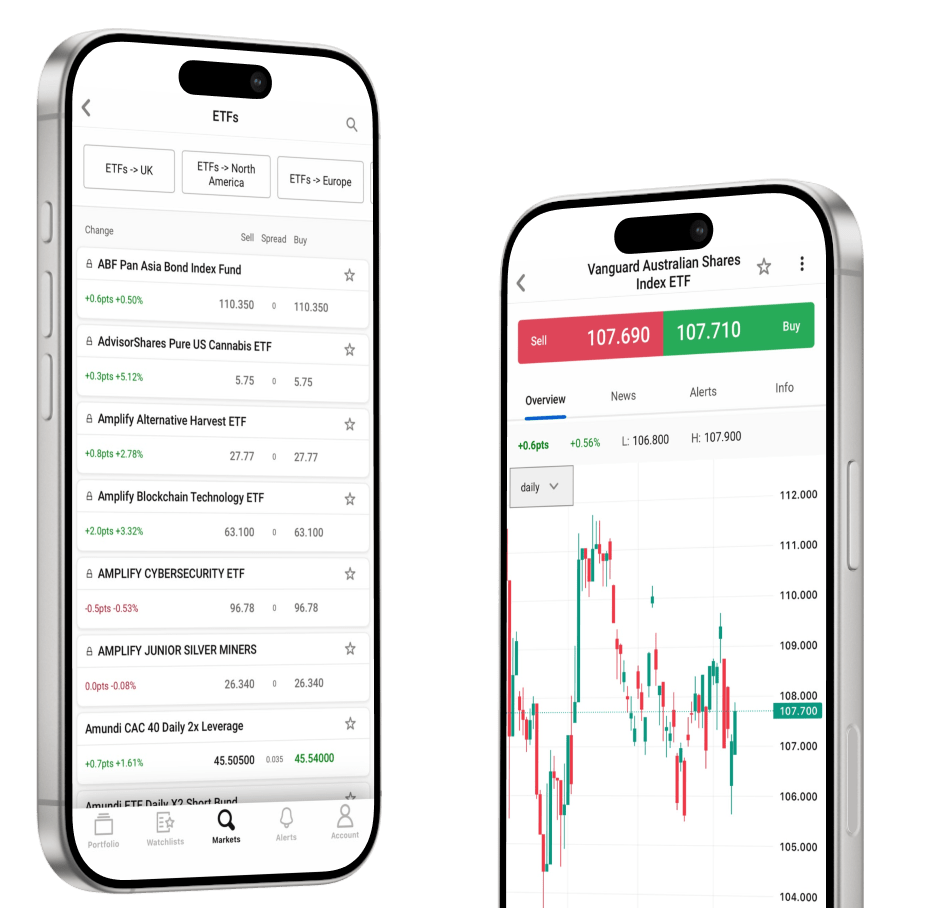
Trade ETF CFDs with FOREX.com
Trade a wide range of Australian and global share ETFs from a single position via CFDs with FOREX.com. Diversify without owning the underlying asset and refine your strategy by going long or short on an ETF of your choice.
What are ETFs?
ETFs, which refer to Exchange-traded funds, are pooled investment funds which hold and track the performance across a basket of assets across sectors.
ETFs typically involve ownership exposure to these underlying assets – for example, the VAS (Vanguard Australian Shares Index) ETF would provide exposure to 300 of the largest companies on the ASX (Australian Securities Exchange).
What are ASX ETFs?
ASX ETFs are funds which are listed on the Australian Securities Exchange, or ASX. Typically, these ETFs are geared to track and provide access to major Australian markets.
Key differences between ETF CFDs & ETFs
| ETF CFDs | ETFs | |
|---|---|---|
| Instrument type | Derivative | Basket of assets |
| Ownership | No |
Yes |
| Leverage | Yes | Dependent on ETF |
| Trading type |
Speculative | Ownership exposure |
| Additional costs | Overnight holding fees or spreads, dependent on broker | Management or brokerage fees, dependent on ETF |
The material provided herein is general in nature and does not take into account your objectives, financial situation or needs. All trading involves risk. Trading CFDs is not suitable for everyone and can result in losses that exceed deposits.
How to trade ETF CFDs
Speculate on the price of ETFs via CFDs – start trading with these simple steps:
- Learn how to trade CFDs
Find out how CFDs work, as well as the risks and benefits of trading derivatives
- Create an account with FOREX.com
Get started trading on live markets, or practise trading in a risk-free demo account first
- Search for the ETF you want to trade
Decide which ETF you’re interested in and find it on our award-winning platform
- Decide whether you want to go long or short
Click ‘buy’ if you think the market will rise in price, and ‘sell’ if you think it will fall
- Open your position
Enter the market by clicking ‘place a trade’, you may want to consider adding a stop loss to your trade to manage your risk
- Monitor and close your trade
Use analysis to stay up to date with any price movements and identify an exit point for your position
How to trade ASX ETFs via CFDs
Speculate on the price of ASX ETFs via CFDs – start trading with these simple steps:
- Log into your FOREX.com account
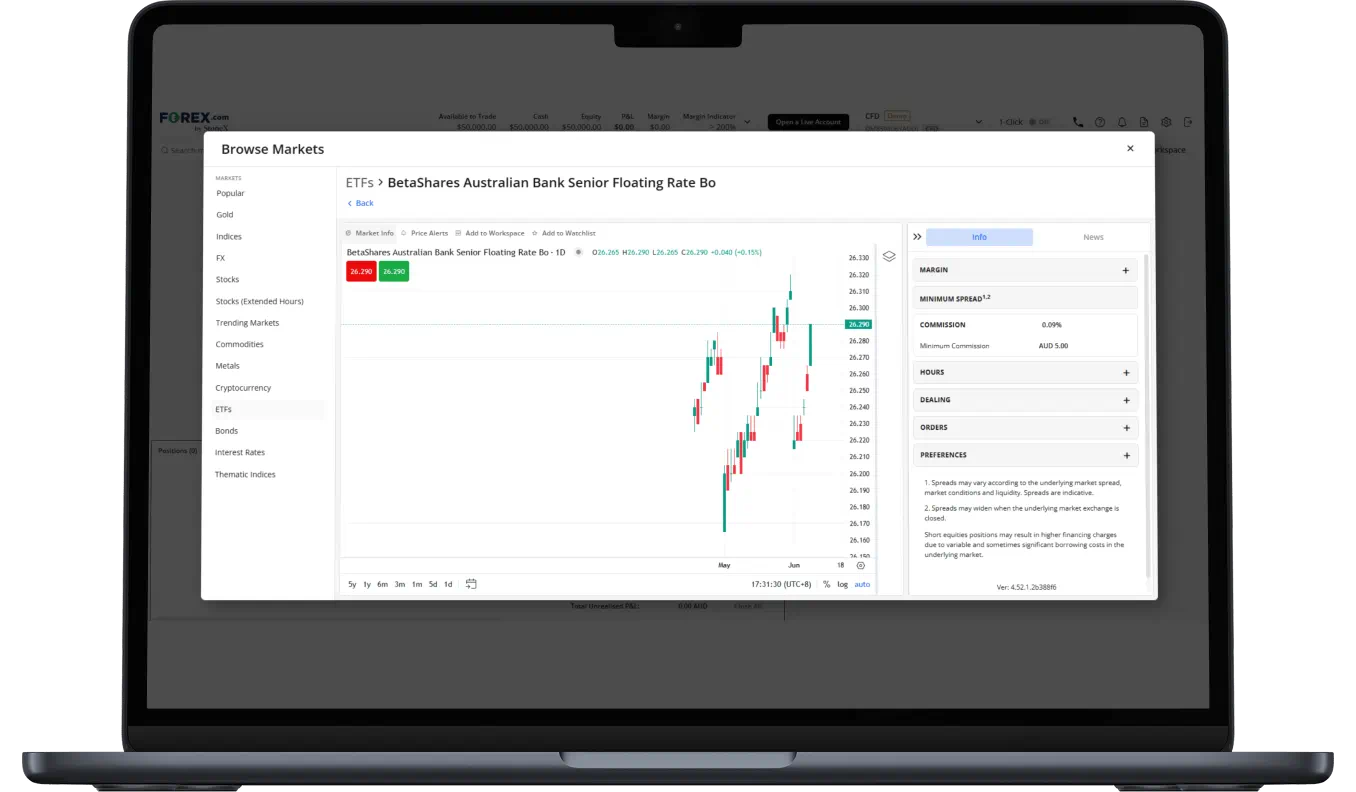
- Select ETFs, followed by choosing an ETF of your choice in the search bar to view the market
- Place your CFD trade.


Australian ETF CFDs on FOREX.com
Gain targeted exposure to fast-growing Australian markets with FOREX.com, through a broad range of ASX-listed ETFs covering technology, semiconductors, AI infrastructure, consumer growth and more – all through a single position.
Access a broad range of ASX ETFs via CFDs – along with 27 newly-listed ETFs, now on FOREX.com.
| Ticker | ETF Name |
|---|---|
| OOO | Betashares Crude Oil Index (Hedged) |
| IVV | iShares S&P 500 ETF |
| A200 | Betashares Australia 200 ETF |
| VEU |
Vanguard All-World ex-US Shares Index ETF |
| FANG | Global X Fang+ ETF |
| BBOZ |
Betashares Strong Australian Bear Fund |
| EMIM |
iShares Core MSCI EM IMI ETF |
| ATEC | Betashares S&P/ASX Australian Tech ETF |
| HJPN | Betashares Japan ETF (Currency Hedged) |
| VDHG |
Vanguard Diversified High Growth Index ETF |
Please note that the list above is not exhaustive.
Refer to this for our full range of newly listed ASX ETF CFDs available for trading.
Types of ETFs
An ETF can be structured so that it tracks an entire index, sector, basket of currencies, or investment strategy. We offer CFDs on a range of ETF types, and your choice of ETF will depend on your interests, trading plan and available capital.
Stock index ETFs
A stock index ETF tracks the performance of an index. Indices aren’t typical assets – they’re just a calculation that tells you how a group of stocks are performing. An index ETF typically buys the shares of all the companies on the index in question, giving you exposure to the entire index at once.
For example, an S&P 500 ETF would track the performance of the index by holding shares of all the constituents. Or sometimes, by owning products that mimic the S&P 500’s movements.
Find out more about indices
Sector ETFs
A sector ETF tracks a group of companies within the same industry, such as technology, banking, or energy. For example, the VanEck Vectors Gold Miners UCITS ETF enables you to invest in the world’s largest gold and silver miners.
Sector ETFs give investors and traders exposure to an entire section of the economy from just a single position, which can be useful both in terms of speculation and hedging against existing exposures.
Trading currencies (forex) via ETF CFDs
A currency ETF invests in foreign currencies, providing exposure to the market without having to buy or sell specific forex pairs. Most currency ETFs track a basket of currencies, enabling you to trade multiple exchange rates from just one position.
Currency ETFs can also be a great way to speculate on the health of the global economy, as you’ll be looking at the currencies of multiple countries, not just one. This does mean that the risks associated with currency ETFs are greater, as there are a larger number of variables involved.
Commodity ETFs
Commodity ETFs usually hold a physical commodity in storage or are invested in futures contracts. They can hold a range of commodities, including agricultural goods, precious metals, energies and natural resources.
These ETFs are popular as they provide the opportunity to trade commodities without having to learn the intricacies of futures contracts.
Commodity ETFs can also refer to commodity index ETFs or sector ETFs, which track companies within the supply chain.
Learn how to trade commodities
Short ETFs
Short ETFs, also known as inverse ETFs, generate profit when the underlying asset falls in price.
You’d buy shares in an inverse ETF if you expected the price of a market – normally an index or group of shares – to decline and want to take advantage of that movement. It’s the same investment strategy as shorting a stock.
Leveraged ETFs
A leveraged ETF uses derivatives to magnify the returns of the underlying asset – usually an index. Normally, an ETF will invest in the underlying in a way that mimics the exact returns of the market, on a 1:1 basis. A leveraged ETF would aim to generate a higher ratio of returns, such as 2:1 or 3:1.
As with any leveraged product, there is the potential for greater profits but also greater losses. This makes it important to have a suitable risk management strategy in place. For traders, this can include stop-losses and limit orders.
Open a FOREX.com account and benefit from competitive spreads and fast, reliable execution.
- Award-winning platforms and apps
- Exclusive trading tools like Guaranteed Stop Loss Orders and Performance Analytics
- Fast, secure deposits and withdrawals