

Bitcoin has begun to face a strong bearish bias in the short term, recording a drop of more than 7% during the last trading session. The recent selling pressure is partly due to the rise in risk aversion across financial markets, which has reduced appetite for risk assets such as BTC. As long as market confidence remains low and investors continue to seek more stable assets, downward pressure is likely to remain relevant in Bitcoin’s short-term movements.

Declining Appetite for BTC
The past few weeks have been pivotal for market sentiment. Since central banks, such as the U.S. Federal Reserve, have adopted more neutral and defensive stances, maintaining elevated interest rates, risk appetite has declined significantly.
The lack of clear signs of future rate cuts has increased borrowing costs, encouraging investors to seek safer assets rather than remain exposed to the highly volatile cryptocurrency market.
This trend is reflected in the behavior of 10-year U.S. Treasury bonds, whose yields remain around 4%, and in the U.S. Dollar Index (DXY), which has risen above the 100-point mark. Both indicators signal a defensive positioning among investors and a steady outflow of capital from risk assets, including Bitcoin.
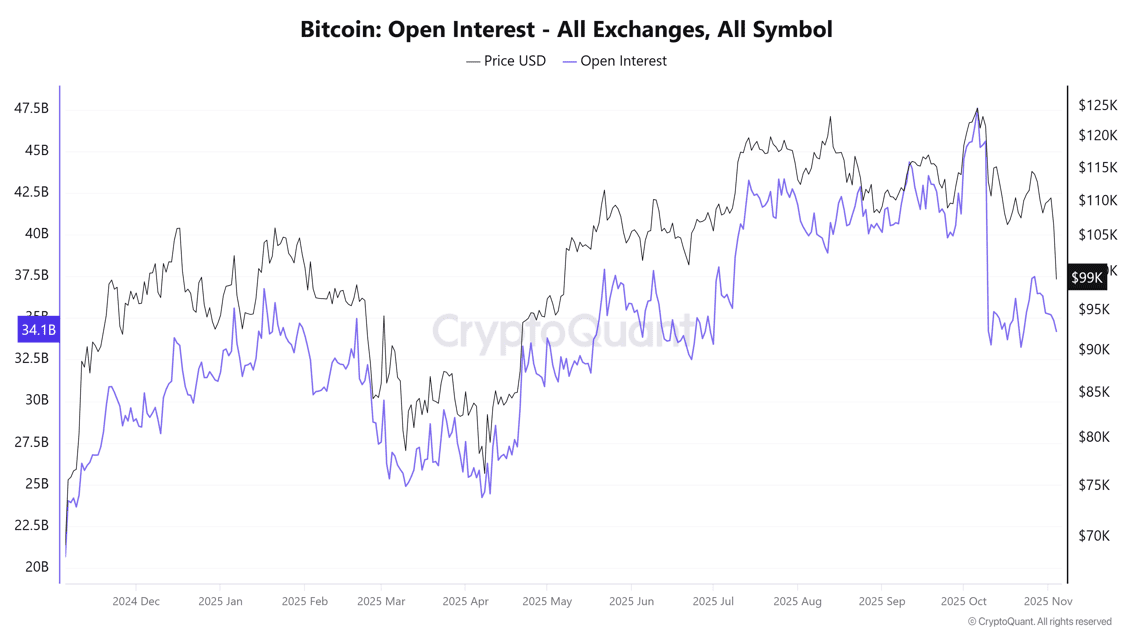
In fact, this trend is clearly seen in the Open Interest indicator, which measures the total number of open positions in the BTC market. Open Interest has steadily declined toward the $34 billion zone, marking one of the sharpest drops of 2025. This decline, together with Bitcoin’s recent price retreat, suggests that a significant number of long positions have been closed, pointing to weakened demand and a loss of macroeconomic confidence.
Source: Cryptoquant
In this context, the metrics confirm that Bitcoin is no longer being perceived as an attractive asset in the current pessimistic market environment. As this loss of confidence persists and capital outflows continue, selling pressure is likely to remain dominant in BTC’s movements through the end of the year.
Confidence in the Cryptocurrency Market
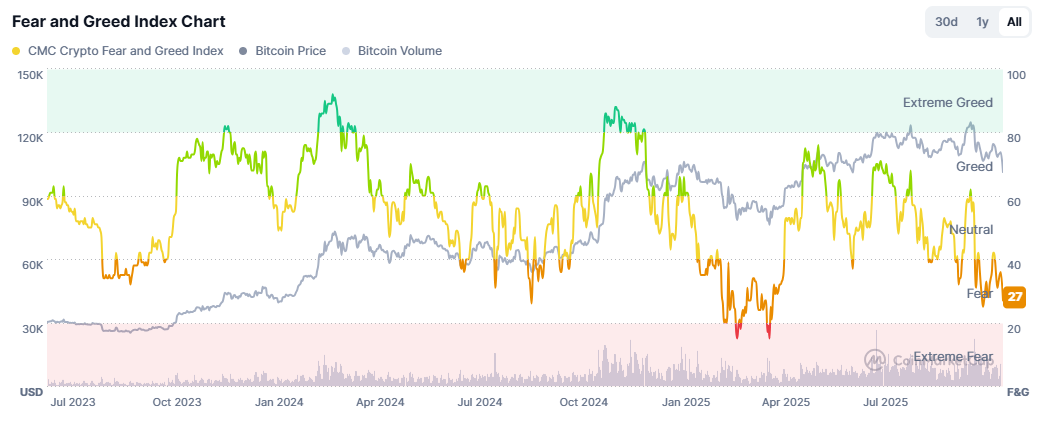
The broad loss of confidence has also spread to the broader crypto market. The Crypto Fear & Greed Index from CoinMarketCap has recently dropped to 27 points, maintaining a negative slope in the “fear” zone and approaching the “extreme fear” region. This trend reflects a sharp decline in market confidence, which has contributed to the sustained bearish pressure observed in recent sessions.
Source: Coinmarketcap
If confidence indicators continue to deteriorate, demand for Bitcoin is likely to remain limited in the short term. This could lead to stronger selling pressure, extending the bearish phase until overall sentiment shows a clear recovery.
Bitcoin Technical Outlook
Source: StoneX, Tradingview
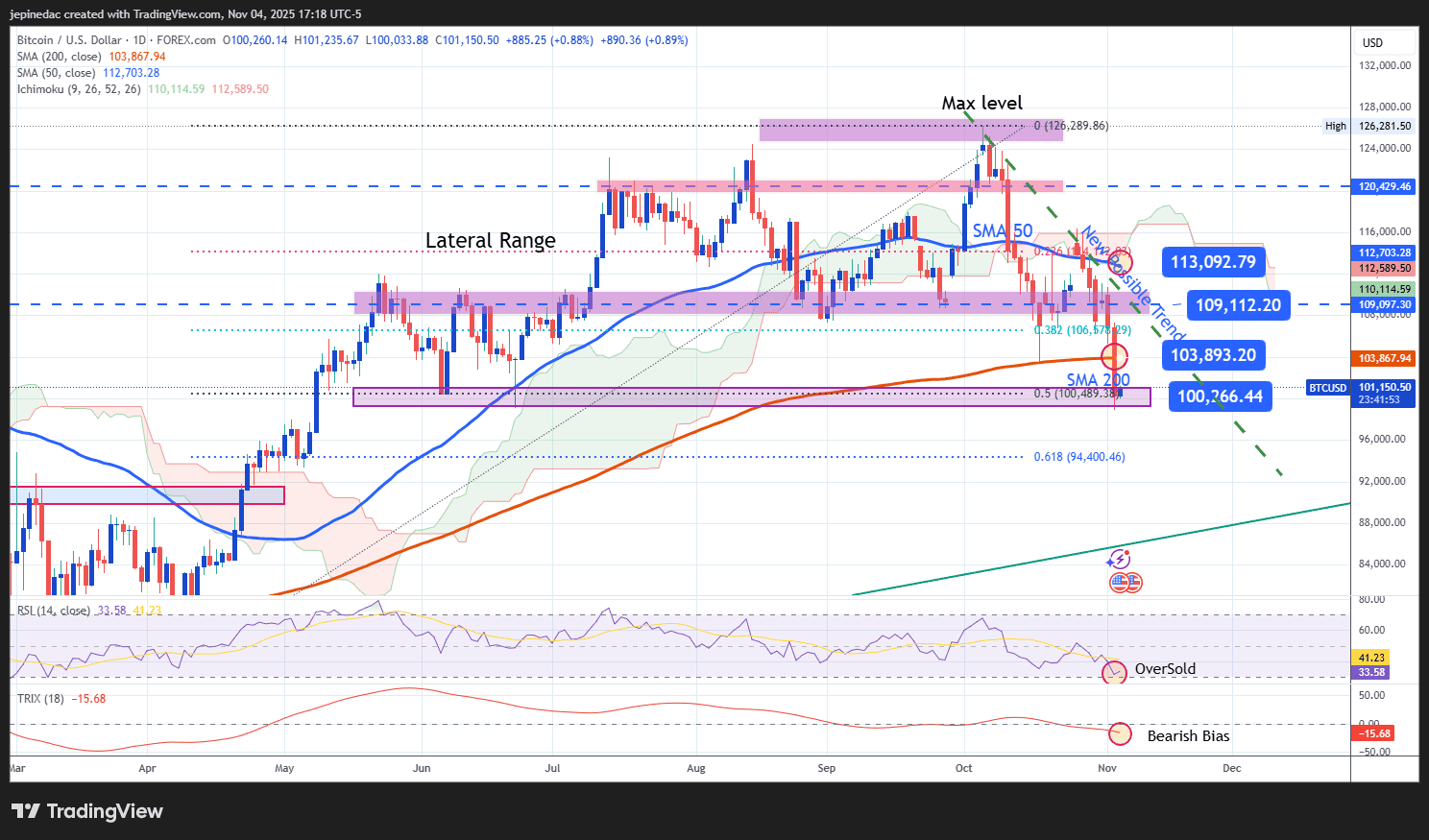
- Emerging Downtrend: Since early October, Bitcoin has recorded progressively lower lows, suggesting the formation of a short-term downtrend line. The price has even fallen below the 200-period simple moving average, returning to the $100,000 zone per BTC. This confirms that selling pressure remains dominant, and if the price stays below this level, the emerging downtrend could continue to strengthen in the coming weeks.
- RSI: The RSI remains below the neutral 50 level, indicating that selling momentum has dominated the last 14 sessions. However, the indicator is gradually approaching the 30 level (oversold zone), which could anticipate short-term technical rebounds, given the speed of the recent decline.
- TRIX: Similarly, the TRIX indicator shows a downward slope, with readings below the zero line, confirming a consistent bearish bias in the average of the exponential moving averages. If this trend persists, it could result in stronger selling pressure in the medium term.
Key Levels:
- $109,000 – Major Resistance: This level represents the most significant retracement area of recent weeks. A sustained return to this level could activate a bullish bias, challenging the current downtrend.
- $103,000 – Near-Term Barrier: This level aligns with the 200-period simple moving average. If the price consolidates around this zone, a sideways movement could develop in the short term.
- $100,000 – Key Support: This is the most important psychological level and acts as the main price floor. A decisive break below this level could accelerate the downtrend and reinforce the bearish bias in the market.
Written by Julian Pineda, CFA – Market Analyst
Follow him on: @julianpineda25