

The past three trading sessions have been critical for WTI crude oil, which has dropped more than 6.5%. For now, the bearish bias remains, as the market continues to digest the latest OPEC+ statements, which point to a sustained increase in production. This outlook has begun to erode confidence in the oil market, and if concerns about oversupply persist, selling pressure is likely to intensify in the near term.

What Did OPEC+ Say?
On Sunday, a meeting was held between key OPEC+ members, who agreed to maintain their current plan to increase oil production in the short term. The organization expects to add 547,000 barrels per day in September, following a similar increase of 548,000 barrels in August. This decision is based on forecasts for stable demand and low inventory levels reported in recent weeks.
This shift confirms the end of the prolonged production cut policy and introduces a new strategy of consistent output growth. However, it also brings market uncertainty, as any gap between expected and actual demand could lead to oversupply and downward pressure on prices. This risk becomes more pressing if global appetite for oil fails to keep up, potentially driving WTI to even lower price levels.
In this context, bearish pressure has become a constant. If OPEC+ continues to send similar signals, negative sentiment may persist, along with indecisive market action that could keep WTI under pressure in the short term.
What About Market Confidence?
Confidence in the oil market has also been shaken by rising global trade tensions. Last Friday, Donald Trump’s administration formalized a new list of tariffs ranging from 15% to 50% on products from various countries. The market is now assessing whether these measures could trigger a global economic slowdown, as deteriorating trade relations with the U.S. may have a direct impact on oil demand for the remainder of 2025.
This effect is already visible in market sentiment indicators, particularly the MM Sentiment Indicator, which currently shows only 12.26% optimism, compared to 47.17% neutral and 40.57% pessimism. This setup suggests that confidence in the oil market has weakened significantly in recent sessions.
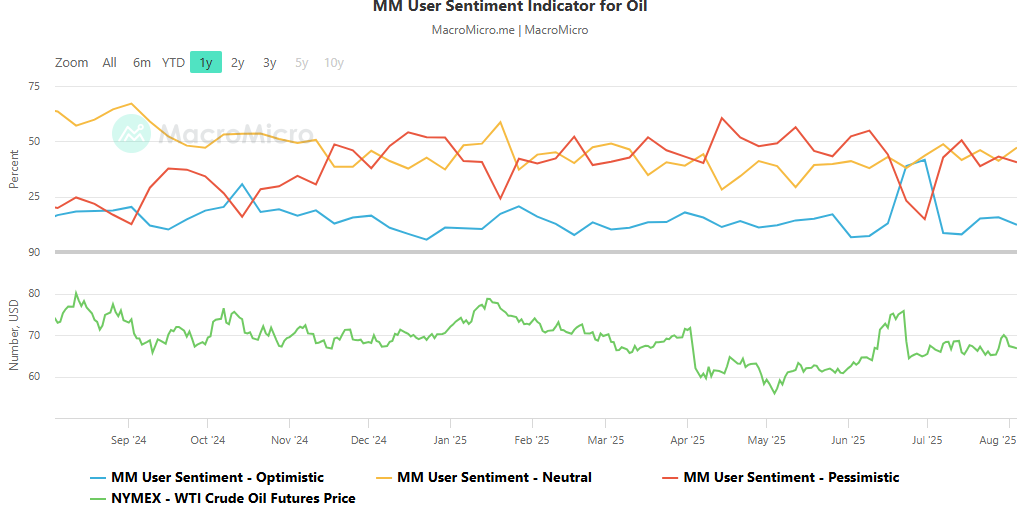
Source: MacroMicro
If this trend persists, uncertainty around the price of oil is likely to continue in the short term. In that scenario, the lack of clarity regarding global growth could open further space for selling pressure to gain traction, keeping WTI in a structurally weak position over the coming sessions.
WTI Technical Outlook

Source: StoneX, Tradingview
- Weak Trend: Although WTI has managed to preserve a general bullish structure, it has recently seen significant downward corrections, which have called the continuation of the bullish bias into question. The latest drop brought the price down to the trendline base, although no decisive breakout has occurred yet. However, the lack of a bullish reaction suggests the market may be entering a sideways phase, which could begin to dominate the technical behavior in the short term.
- RSI: The Relative Strength Index has crossed below the neutral 50 level, signaling that the average momentum over the past 14 sessions has turned negative. If this continues, the market may experience stronger selling pressure.
- MACD: The MACD histogram is approaching the zero line, indicating balance between buying and selling forces. However, if the histogram dips below the axis, a more clearly defined bearish bias could emerge, giving sellers greater control of the trend.
Key Levels:
- $70 – Key Resistance: This level marks the recent highs and aligns with the 38.2% Fibonacci retracement, making it technically significant. A close above this level could reactivate the weakened uptrend and open the door to a more sustained recovery.
- $68 – Immediate Resistance: Located near the 200-period simple moving average, this resistance has capped rebound attempts in recent sessions. If the price fails to break above it clearly, indecision may persist in the short term.
- $65 – Key Support: This level is aligned with recent lows and serves as the most relevant technical floor for now. A breakdown below this area could confirm a structural shift, triggering a more consistent bearish bias.
Written by Julian Pineda, CFA – Market Analyst
Follow him on: @julianpineda25