

Over the past two trading sessions, WTI crude has shown a new bullish bias, with gains of more than 1.6% in the short term. This comes as concerns emerge over India’s crude purchases from Russia, which could face new challenges in the coming weeks. For now, buying pressure remains in place, and if this scenario persists, it could consolidate into a more significant bullish trend in the short term.
Concerns About Production?
Since the outbreak of the conflict in Ukraine in 2022, Russia has been subjected to severe economic sanctions that, in theory, also affect its crude exports to the West. Against this backdrop, India has become one of Russia’s main allies, consistently increasing its oil purchases. It is estimated that India currently buys around 2 million barrels per day, representing roughly one-third of Russia’s seaborne exports.
Recently, CLSA (Credit Lyonnais Securities Asia) warned that if India were to reduce or halt imports of Russian crude, the global market could face a supply deficit of 1.5–2 million barrels per day. Moreover, Russia would struggle to redirect that output to other markets due to ongoing Western sanctions. These warnings also reflect mounting pressure from Western countries on India to curb purchases of Russian oil. If these flows were interrupted and Russia failed to find alternative buyers, the global market could face a shortage of supply, particularly to meet Indian demand, adding further upward pressure on prices.
Thus, the oil market remains highly sensitive to any potential shifts in production. A scenario where Western pressure triggers a significant disruption of Russian exports, while global demand holds steady, could create a sustained upward push in WTI prices in the short term.
Is There Confidence in Oil?
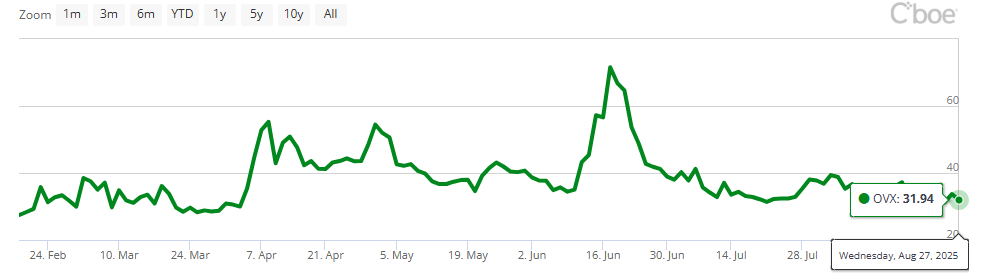
Currently, the CBOE Crude Oil Volatility Index (OVX) stands at 31.94 points, showing a steady decline in recent weeks. From a technical perspective, values around 30 points suggest a moderate level of volatility.
Source: CBOE
As long as the index continues to fall, there are no signs of imminent risk that could trigger sharp swings in oil prices. This indicates an environment of moderate confidence with controlled risk in the short term. If this stability holds, the recent buying pressure in crude could become even more relevant in the coming sessions.
WTI Technical Outlook
Source: StoneX, Tradingview
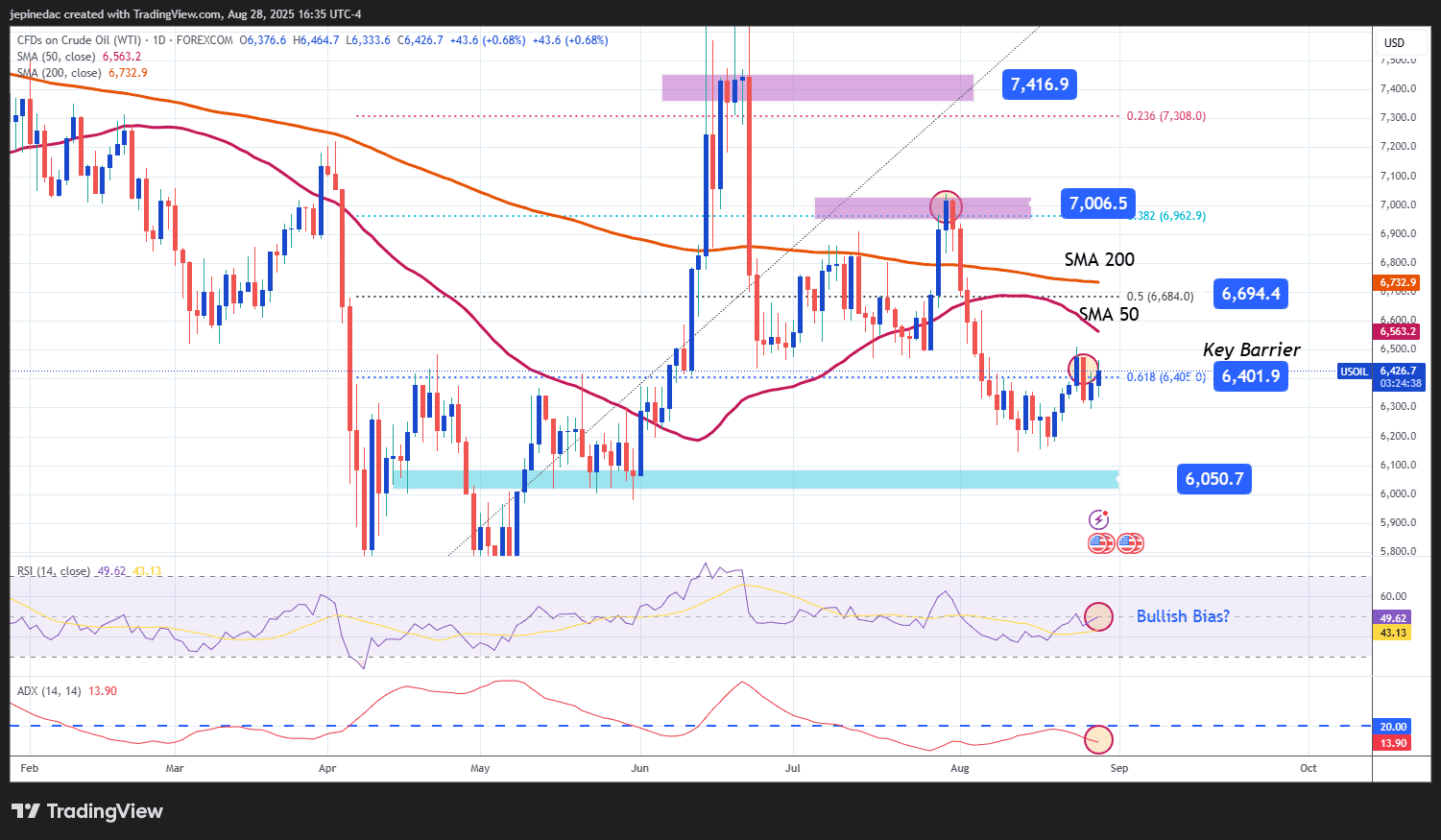
- Bullish Bias Attempts to Emerge: In recent weeks, WTI has advanced toward higher levels, reflecting a developing bullish bias. However, there are not yet enough signals to define a solid new uptrend; rather, this appears to be a bullish correction following the sharp drop recorded in early August. For now, the price lacks a clear long-term direction and faces key barriers that will determine whether it can establish a more consistent upward trend.
- RSI: the RSI line continues to move higher, approaching the neutral 50 level. A breakout above this level would highlight stronger buying momentum and reinforce the possibility of a more stable bullish bias.
- ADX: the ADX remains below 20, showing that volatility in recent sessions has been low. While it stays at these levels, a neutral technical scenario will prevail, limiting more defined directional moves.
Key Levels:
- $67 – Relevant Resistance: coincides with the 50- and 200-period moving averages, marking the most important barrier for buyers in the short term. A breakout above would strengthen a more consistent bullish bias.
- $64 – Near-Term Barrier: corresponds to the 61.8% Fibonacci retracement, considered the first short-term technical hurdle. Holding above this level would consolidate buying pressure.
- $60 – Key Support: a psychological level and the most important floor on the chart. A sustained drop below this area would confirm a bearish bias, resuming the downtrend seen in previous months.
Written by Julian Pineda, CFA – Market Analyst
Follow him: @julianpineda25