


Crypto Fundamental Analysis: Inflation relief fails to revive crypto confidence
As we move into mid-July, the lack of demand around the cryptocurrency market is once again standing out across financial markets. This is partly because the market failed to maintain consistent strength after the inflation data released at the beginning of the trading week.
Share this:

As we move into mid-July, the lack of demand around the cryptocurrency market is once again standing out across financial markets. This is partly because the market failed to maintain consistent strength after the inflation data released at the beginning of the trading week.
For now, caution remains around the possibility of a more aggressive central bank in the United States, which could continue to limit appetite for risk markets such as cryptocurrencies. If this effect continues, a phase of indecision or weakness could remain relevant over the next few sessions.


A week of inflation data
At the beginning of the trading week, relevant inflation data was released in the United States. First, annual CPI came in at 3.5%, below the expected 3.8%. Shortly after, Core PPI registered a reading of 0.2%, also below the expected 0.3%.
Both figures suggested a slowdown in inflation pressures, both in consumer prices and producer prices, during June. This dynamic opened room for expectations of a less aggressive Federal Reserve and helped temporarily stabilize risk appetite in markets such as cryptocurrencies.
However, this sentiment only lasted a couple of sessions. For now, a scenario of a calmer U.S. central bank in the short term has not been confirmed, especially as risk perception around the Middle East remains present.
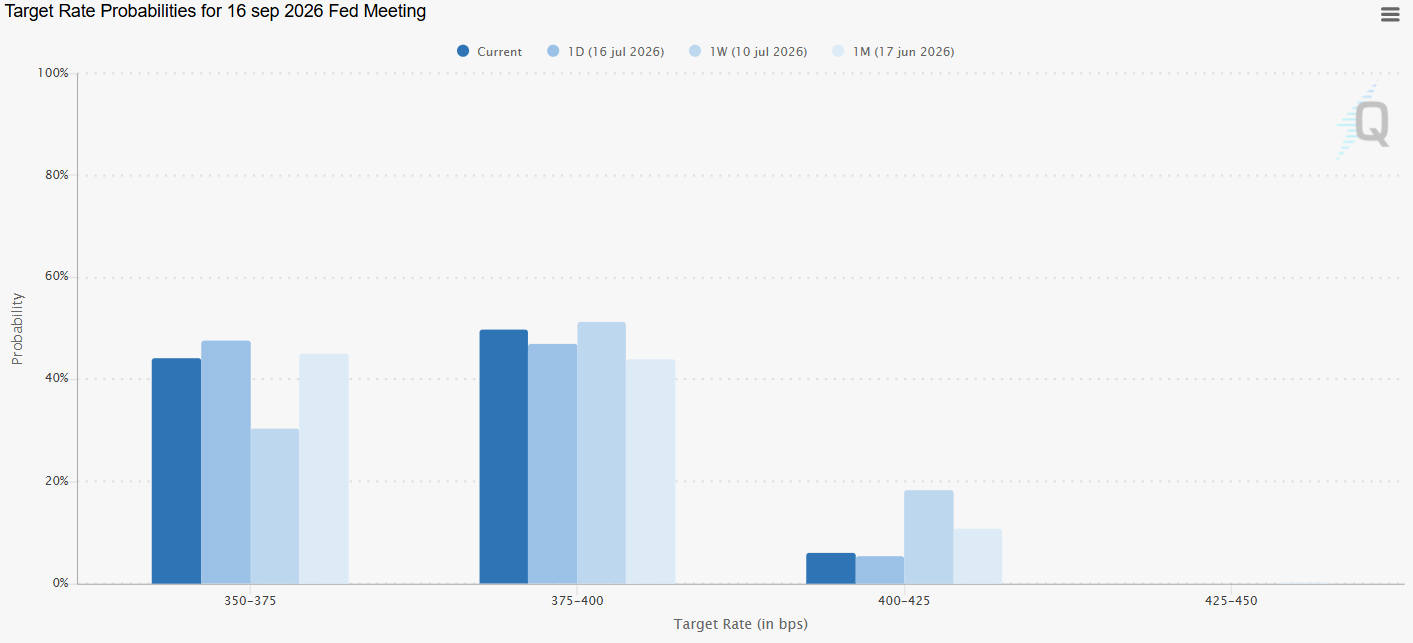
In addition, probabilities around what the Fed could do in the coming months continue to show a relevant figure. For the September 16 decision, the market still assigns a probability of just over 49.5% to a 0.25% increase in U.S. interest rates.
This is partly because the recent inflation slowdown is still not considered enough to return to the central bank’s 2.00% target. For this reason, the possibility remains that the Fed could continue to focus on a higher-rates scenario over the coming months.
Source: CMEGROUP
This dynamic remains relevant for the cryptocurrency market, as the prospect of higher rates in the United States can increase borrowing costs and reduce available liquidity for consumption and investment. In this scenario, demand for risk markets such as cryptocurrencies could remain limited.
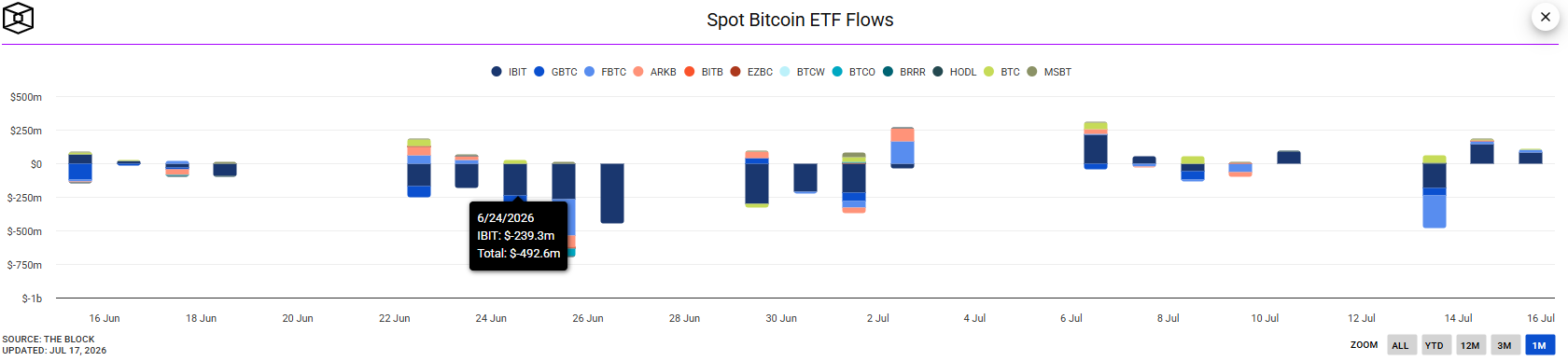
In fact, the slowdown in demand continued during the week, even after inflation data showed signs of moderation. The Bitcoin ETF market, as the reference crypto asset, failed to accumulate relevant positive flows. After the release of the inflation data, inflows were only recorded on July 14 and 15, totaling just over 100 million dollars. This does not reflect consistent demand for BTC and coincides with caution around a potentially more aggressive U.S. central bank over the coming months.
Source: Theblock
This dynamic is important because, if there is no clearer resolution to the conflict in the Middle East or signs that could open the door to a more flexible Fed, caution could continue to limit appetite for risk assets. For now, the recent inflation data do not appear sufficient to clearly restore the appeal of markets such as cryptocurrencies. If this effect continues, a phase of indecision or weakness could continue to affect the crypto market over the next few sessions.
Bitcoin compared to other markets
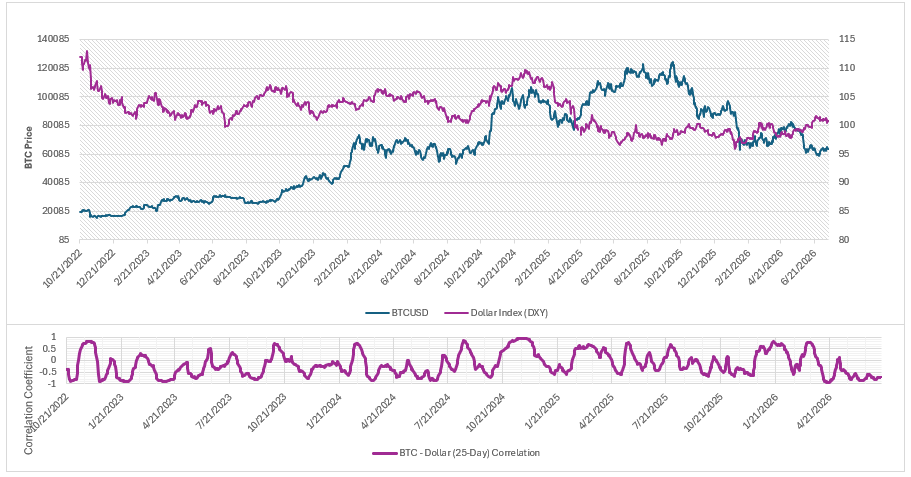
One of the most relevant short-term behaviors is the increase in the negative correlation between the DXY, the U.S. dollar index, and Bitcoin price movements, as the reference currency of the crypto market.
Now, the coefficient remains very close to the -1 area, showing an important inverse relationship between both markets over the last 25 sessions. This indicates that movements in the U.S. dollar and Bitcoin currently tend to move in opposite directions. However, it is important to remember that the correlation coefficient can change over time.
Source: Data – TVC, StoneX, Tradingview
This relationship is important because the recent weakness and neutrality in Bitcoin coincides with some strength in U.S. dollar demand toward the end of the trading week. This suggests that caution continues to dominate market risk sentiment.
It may also reflect a possible rotation of capital toward more stable markets, such as the dollar, reducing interest in higher-risk assets like cryptocurrencies. This dynamic remains in place in a context where concerns about more aggressive central banks over the coming months are still present.
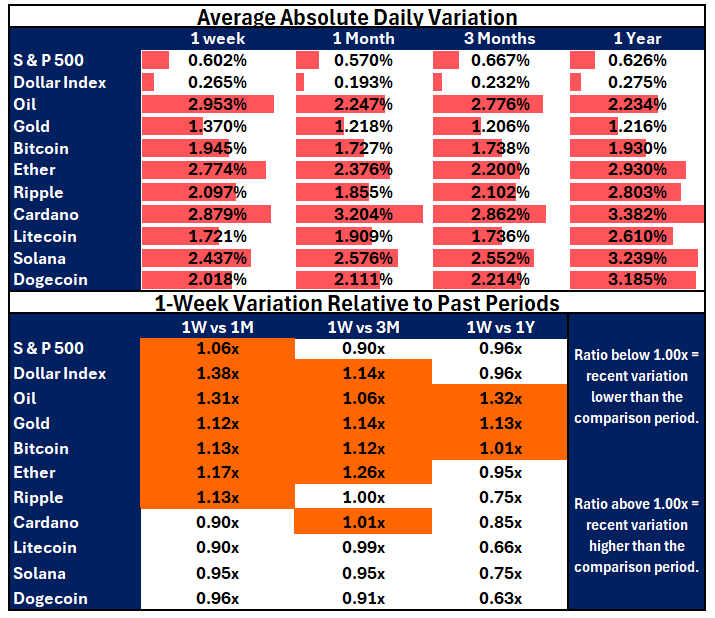
In addition, when looking at the average daily variation of the cryptocurrency market during the last trading week, only Bitcoin, ETH, and Ripple managed to exceed their average variation from the last month. The rest of the main cryptocurrencies remain below that level, reflecting a broader lack of activity in the market.
In contrast, markets such as the dollar and oil have shown an average weekly variation above 1.3 times their monthly variation. This shows that, for now, market activity and interest appear to be more focused on the U.S. dollar and oil, as an asset sensitive to the situation in the Middle East, leaving cryptocurrency activity in the background.
Source: Data – TVC, StoneX, Tradingview
With all of this in mind, if no more relevant movements are observed in the daily variations of the crypto market and more stable substitute assets continue to show greater appeal, weak cryptocurrency demand could remain important. This scenario could maintain a phase of indecision or weakness in the crypto market in the short term.
Confidence does not show a relevant recovery
Looking at the behavior of the cryptocurrency Fear and Greed Index, despite the slight recovery seen in recent sessions, the indicator still remains near 32 points, within the “fear” zone and without reaching “neutrality.” This shows that confidence perception in the crypto market remains sensitive.
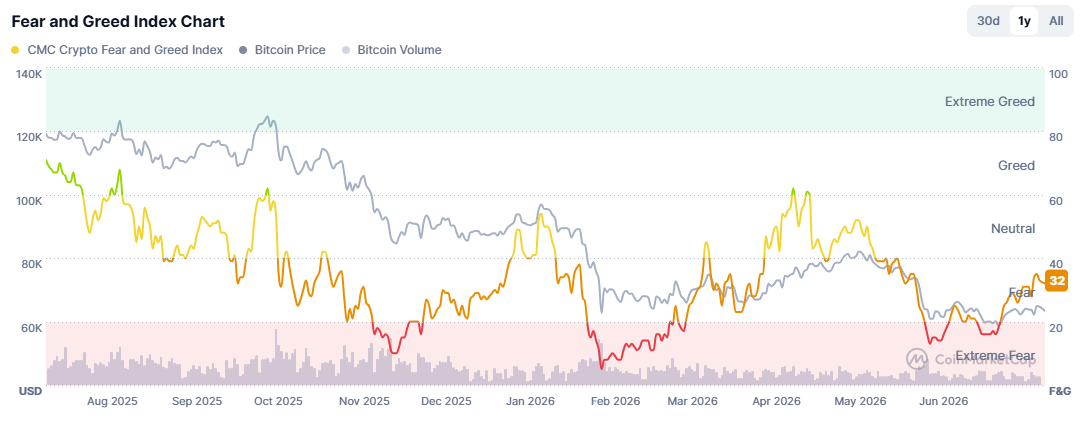
Source: Coinmarketcap
This dynamic suggests that, for now, there is not enough stability to support dominant demand. If the index fails to move into positive territory, confidence could continue to show fragility and reflect a phase of indecision or weakness in the market over the next few sessions.
Written by Julian Pineda, CFA, CMT – Market Analyst
Follow him on: @julianpineda25




Open an account today
Experience award-winning platforms with fast and secure execution.
Economic calendar
Web Trader platform
Our sophisticated web-based platform is packed with features.
Related articles
Gold Outlook: Can XAU/USD Sustain Its Recent Rebound?
The trading week is coming to an end, and gold continues to exhibit a lack of clear direction in the short term. Although the precious metal spent most of the week under pressure, it managed to recover more than 2.3% heading into the close, reclaiming part of its recent losses. Even so, the rebound remains insufficient to sustain consistent moves above the $3,700 per ounce level.

USD/MXN Forecast: Mexican Peso Weakness Persists as Year-End Approaches
These continue to be challenging sessions for the Mexican peso. The currency has remained under pressure in recent weeks, a trend clearly reflected in USD/MXN, which has now posted seven consecutive bullish sessions, gaining more than 7.0% over that period.

Bitcoin forecast: BTC/USD steadies as risk appetite returns for now
Bitcoin has steadied around 60,000 after a November slide driven by ETF outflows, weaker liquidity and regulatory doubts. Fawad Razaqzada explains why 65,000 is now the line in the sand.

From time to time, StoneX Financial Pty Ltd (“we”, “our”) website may contain links to other sites and/or resources provided by third parties. These links and/or resources are provided for your information only and we have no control over the contents of those materials, and in no way endorse their content. Any analysis, opinion, commentary or research-based material on our website is for information and educational purposes only and is not, in any circumstances, intended to be an offer, recommendation or solicitation to buy or sell. You should always seek independent advice as to your suitability to speculate in any related markets and your ability to assume the associated risks, if you are at all unsure. No representation or warranty is made, express or implied, that the materials on our website are complete or accurate. We are not under any obligation to update any such material.
As such, we (and/or our associated companies) will not be responsible or liable for any loss or damage incurred by you or any third party arising out of, or in connection with, any use of the information on our website (other than with regards to any duty or liability that we are unable to limit or exclude by law or under the applicable regulatory system) and any such liability is hereby expressly disclaimed.