

The week has started in negative territory for the Dow Jones index, with today’s session showing a decline of more than 1.3%, as confidence once again begins to fade. Selling pressure has stabilized in recent sessions amid rising global tariff tensions, reigniting the debate over a potentially more aggressive central bank stance and reducing short-term appetite for risk assets. If this environment persists, a more dominant bearish pressure could consolidate in the coming trading sessions.

Tariff situation affects expectations
Last week, the United States Supreme Court announced the suspension of the tariffs proposed by the Trump administration, arguing that they could not be imposed without Congressional approval. In response, the administration stated it would implement a 15% global tariff on imports entering the country. Several trading partners reacted negatively, arguing that the measure disrupts the current balance of trade relations.
Beyond the immediate impact, the possibility of a renewed trade war has begun to shift the Dow Jones outlook toward a more negative short-term bias. Among the index’s main components, Goldman Sachs is down -3.69%, Caterpillar falls -0.4%, Microsoft declines -2.62%, and Home Depot loses -1.42%, while Amgen gains +1.5%. This is particularly relevant considering these five companies account for more than 30% of the index’s weight, reflecting a meaningful capital outflow from its most influential components.
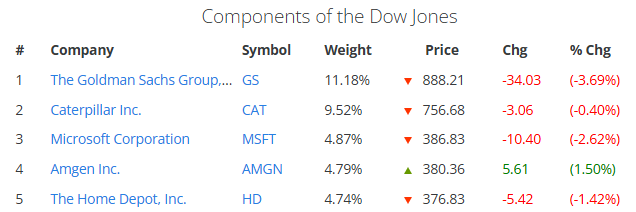
Source: Slickcharts
The impact extends beyond sentiment. A broad 15% tariff could raise import costs and generate additional inflationary pressures, complicating the outlook for a Federal Reserve operating with lower rates. The market currently assigns a 96% probability that rates will remain unchanged in March, 82.1% in April, and for June the probability of a rate cut (46.8%) now closely competes with the probability of holding rates steady (44.7%). This suggests that the path toward a more flexible monetary policy is no longer as clear as it appeared weeks ago.
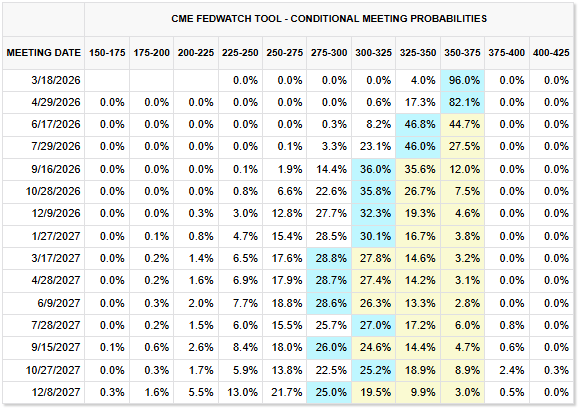
Source: CMEGROUP
This environment matters because a scenario without rate cuts removes one of the key structural supports for equity indices. If tariff tensions continue, they could further weaken the attractiveness of the Dow Jones and reinforce a dynamic of increased caution in the short term.
Confidence shows weakness
Uncertainty is also reflected in the Fear and Greed Index, which currently fluctuates around 37 points and remains in “fear” territory. The indicator’s negative slope suggests that market sentiment continues to deteriorate.
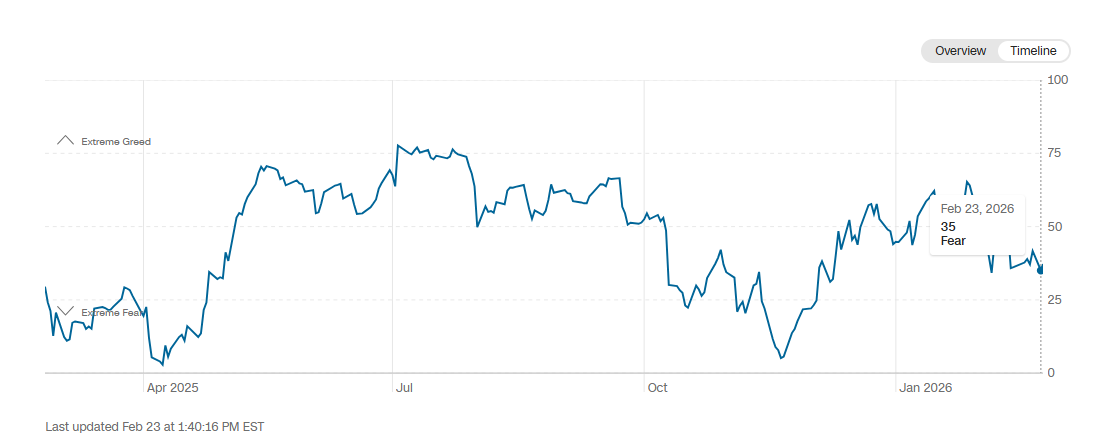
Source: CNN
If this weakness in confidence persists, it could hinder a sustained recovery in demand for risk assets. A move into “extreme fear” territory could intensify bearish pressure in upcoming Dow Jones sessions.
Technical outlook for the Dow Jones
Source: StoneX, Tradingview
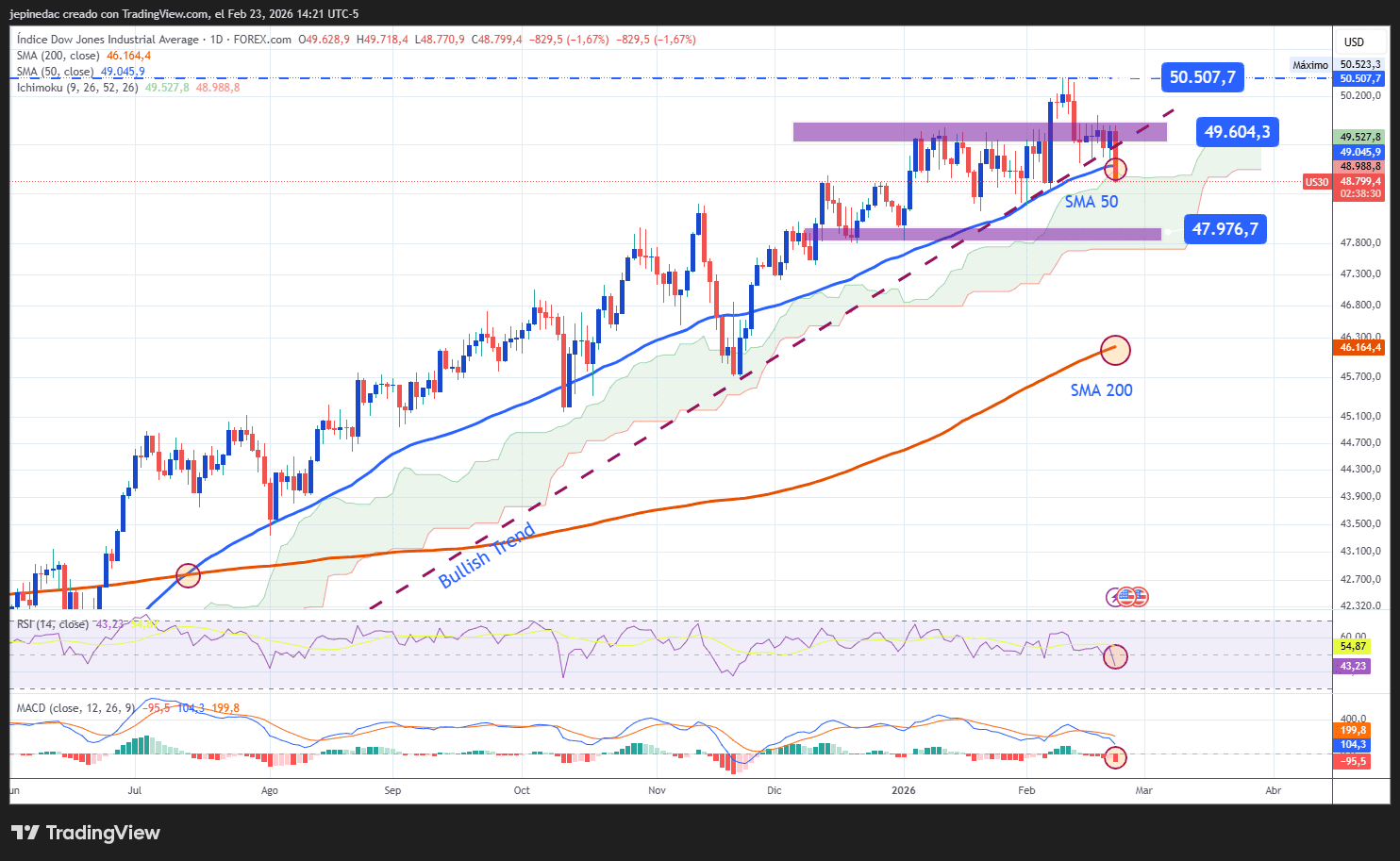
- Uptrend at risk: For several months, the Dow Jones maintained a consistent upward trendline. However, amid the current selling pressure, price has begun attempting to break below this structure in the short term. A confirmed breakdown could signal the end of the dominant pattern and open the door to a prolonged sideways phase or even the formation of a short-term downtrend.
- RSI: The indicator is positioned below the neutral 50 level, suggesting that the average momentum over the past 14 sessions favors a bearish bias. As long as the RSI continues forming lower lows, downward pressure could gain further relevance.
- MACD: The histogram remains below the zero line, reflecting that short-term moving averages maintain bearish dominance. If this dynamic persists, the current negative bias could intensify in the coming sessions.
Key levels:
- 50,500 points – Relevant resistance: Level near historical highs and the main bullish barrier. A sustained move toward this zone could reactivate a structural buying bias and restore strength to the prior trend.
- 49,600 points – Near-term barrier: Relevant neutral zone from recent sessions. If price fails to move decisively away from this level, a short-term sideways indecision scenario could consolidate.
- 47,900 points – Key support: Level located below the 50-period moving average. A sustained break below this zone would confirm a dominant bearish bias and open space for a clearer downward structure.
Written by Julian Pineda, CFA, CMT – Market Analyst
Follow him on: @julianpineda25