Key Events
- Dow Jones and Nasdaq are tracing bullish rebounds, yet remain in bearish territory relative to their 2025 peaks near 48,600 and 24,800
- Inflation concerns lifted the DXY toward key resistance, potentially easing on renewed US–Iran peace talks, stabilizing index setups as well
- Major drawdowns were recorded across the FTSE, DAX, Nikkei, KOSPI, and UAE MSCI, given their ties and sensitivity to the energy sector
As of Wednesday, March 4th, global indices including the Dow Jones and Nasdaq are stabilizing following steep drawdowns from the week’s open. Concerns around AI capex expenditures and job displacement triggered the first phase of the selloff, pushing the Dow below 50,000 and the Nasdaq below 26,000 from their 2026 peaks. The recent Middle East conflict and energy disruptions pressured the second leg, dragging the Dow below 49,000 and the Nasdaq below 25,000, with inflationary implications and potential hawkish central bank stances should tensions persist.

The Strait of Hormuz, mentioned in my crude oil article, channels 20–30% of global crude and gas flows. With its recent closure during the Iranian war — allowing only limited vessel entry — crude prices spiked sharply, with WTI above 75 and Brent above 83. That revived inflationary pressures and dollar strength, capped gains across precious metals, and deepened drawdowns across energy-sensitive global indices.
In terms of global indices:
- FTSE dropped over 4.8% from Monday’s highs to 10,400 and is currently stabilizing above 10,500. A close above 10,800 is needed to reassert bullish bias.
- DAX dropped over 5% from Monday’s highs to 23,600 and is now stabilizing above 24,200. A close above 24,600 is needed to reassert bullish bias.
- KOSPI dropped over 20% from Monday’s highs to 5,060. A close above 5,800 is needed to reassert bullish bias.
- UAE MSCI dropped over 10% from Friday’s close (considering the exchange closure ) to 19.19. A close above 20.80 is needed to reassert bullish bias.
Peace deal negotiations between Iran and the US are now taking center stage, keeping key levels in focus for both dip-buying opportunities and potential extended bearish breakouts that may deepen drawdowns before a confirmed bullish reversal emerges.
Technical Analysis: Quantifying Uncertainties
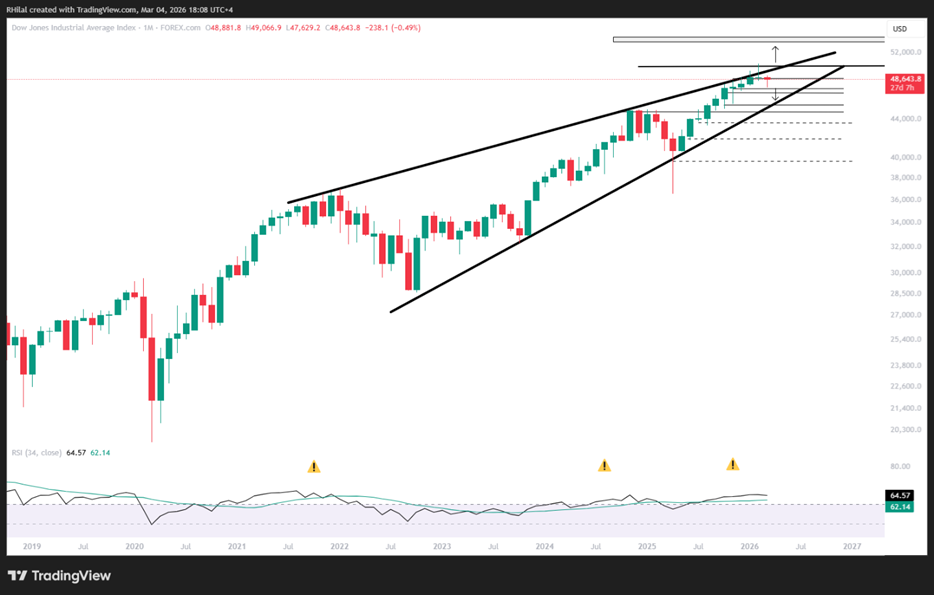
Dow Jones Outlook: Monthly Time Frame – Log Scale
Source: Trading view
From a monthly perspective, the Dow’s structure between 2020 and 2026, alongside overbought momentum last seen in 2021, which preceded an extended drawdown, was flashing caution signals at the beginning of this year. This aligned with Nasdaq’s inability to break above its 2025 highs. Diagonal formations often precede extended corrections, a scenario that could materialize amid persistent AI pressures, prolonged rate-hold expectations, and geopolitical escalation.
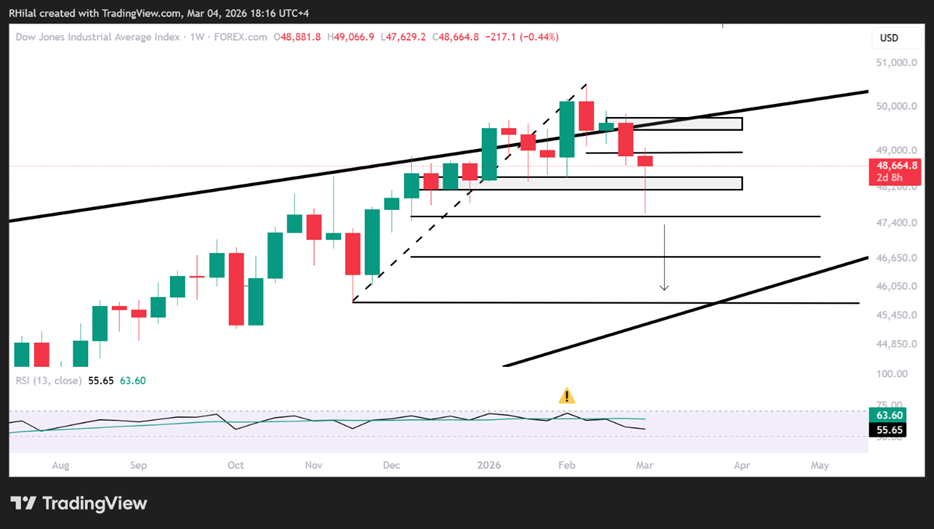
Dow Jones Outlook: Weekly Time Frame – Log Scale
Source: Trading view
From a weekly angle, the shorter-term setup highlights the trend between the November 2025 lows (45,700) and the 2026 highs (50,520). Current price action is respecting Fibonacci retracement levels of that move.
• The weekly low at 47,600 coincides with the 0.618 retracement
• A close below 47,600 exposes 46,700 and 45,700 respectively for potential dip-buying zones
Should prices reclaim 49,000 and 49,700, bullish bias toward new highs above the 50,000 zone would be expected, effectively invalidating the diagonal concern.
Nasdaq Outlook: Daily Time Frame – Log Scale
Source: Trading view
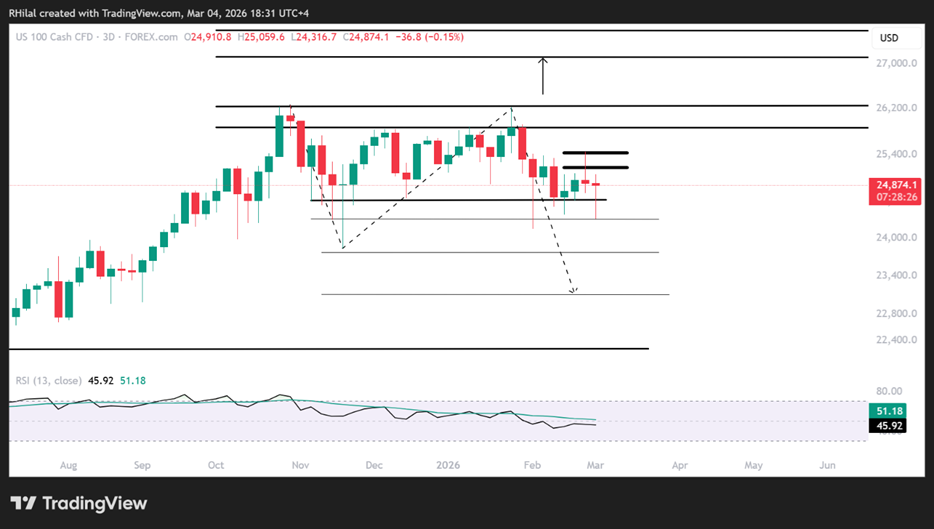
Despite the latest rebound from 24,300, price action continues to reject the 25,000 zone, in line with the extended consolidation below 26,300 since October 2025, reflecting persistent bearish caution. RSI remains below the 50 neutral level, leaning toward downside momentum.
A close below 24,300 exposes deeper losses toward 23,700, 23,200, and in more extreme scenarios, 22,200, the 2024 highs, which could present dip-buying opportunities and a broader momentum reset.
On the upside, reclaiming 25,200 and 25,800 would reassert bullish bias, challenging 26,300 before extending the rally toward 27,000.
Written by Razan Hilal, CMT
Follow on X: @Rh_waves