
It looks like markets no longer appear to be taking Donald Trump entirely at his word after the US president claimed that “serious negotiations” with Iran are under way and that planned strikes have therefore been paused. Investors, however, remain unconvinced. Oil prices gave given back very little from their recent highs, as the ongoing US-Iran stalemate keeps traders on edge. It is unlikely we will see any meaningful moves against the prevailing trends until we get a real breakthrough in negotiations that allows for the reopening of the Strait of Hormuz. For now, oil prices have held relatively steady, helping the dollar recover after yesterday’s jawboning from Trump. Energy-sensitive currencies have come back under pressure, with EUR/USD slipping into the low 1.16s, while USD/JPY has pushed back above 159.00, once again testing the Bank of Japan’s tolerance for yen weakness. Gold has also slipped, alongside softer US equity futures. For now, the EUR/USD forecast remains modestly bearish.
Markets await progress on US-Iran
The market reaction suggests investors are waiting for tangible progress rather than rhetoric. Trump has struck an optimistic tone before, insisting a deal with Iran was close, only for negotiations to stall and markets to be caught out. For now, the sense in the market is that the White House is attempting to buy time in the hope that Tehran presents terms that Trump can ultimately frame as a political win.
In the absence of tangible progress, the dollar looks well placed to regain the strong footing seen late last week, and that motion was already underway at the time of writing. So, it is quite possible the EUR/USD could quickly drift back below 1.160, while USD/JPY may once again challenge the closely watched 160.00 threshold.
For now, this remains a dollar-positive environment. Rising global and US Treasury yields are once again underpinning the dollar, but unlike previous episodes driven by fiscal anxiety, the current move reflects renewed concern around inflation pressures. Markets appear increasingly convinced that sticky price dynamics will keep US rates elevated for longer, reinforcing demand for the dollar.
What will investors watch out for this week?
With the US economic calendar relatively light over the coming sessions, geopolitical headlines are likely to remain the dominant market driver. Trump indicated yesterday that a planned strike on Iran had been postponed following appeals from Gulf states and ongoing diplomatic discussions. However, reports continue to suggest significant divisions remain between Washington and Tehran over nuclear conditions and ceasefire terms.
Much will also depend on whether Nvidia’s results tomorrow can help stabilise broader market sentiment. A strong print could see the US major US indices climb back towards ATHs, while a weak set of results could be bad for risk assets, and good for the dollar.
Meanwhile, keep an eye on the yen as it could impact the dollar indirectly. The currency has struggled despite periods of softer dollar trading, reinforcing concerns that markets are becoming increasingly comfortable testing Japanese authorities’ tolerance for further weakness.
There will be some attention on the G7 summit in Paris, although expectations for any market-moving breakthroughs remain limited.
Technical EUR/USD forecast: Path of least resistance lower
The EUR/USD remains range-bound, although the recent bias has turned modestly bearish, with the pair declining in six of the past seven trading sessions.
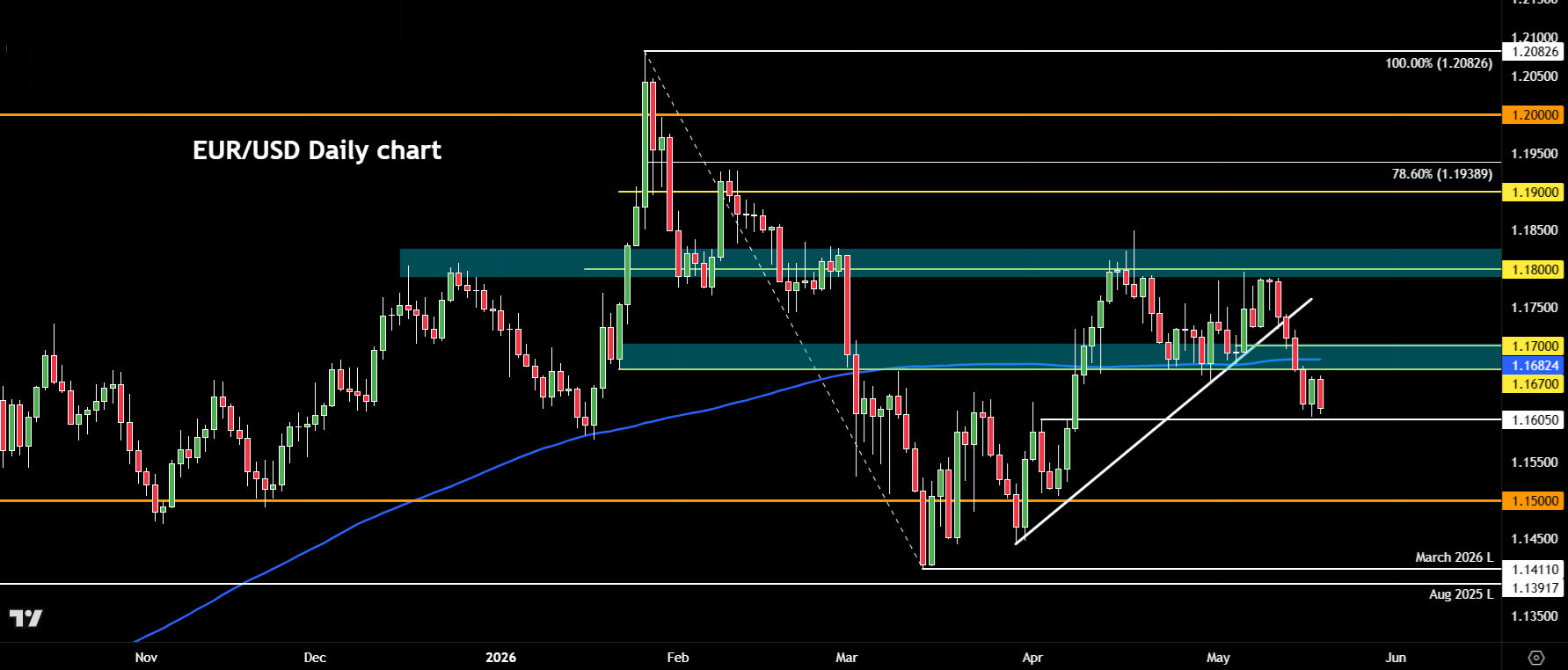
More importantly, EUR/USD has now broken below a key support zone around 1.1670 to 1.1700 — an area that had previously acted as support and was reinforced by the 200-day moving average. As long as the pair remains below that region, the path of least resistance is likely to remain to the downside.
The next area of support comes in around 1.1600 to 1.1605, which marks the base of the rally seen in early April. Beneath that, there is relatively little in the way of notable support until 1.1500. Should that level give way, the market could begin targeting fresh yearly lows, with the March trough around 1.1411 coming back into focus.
On the upside, a move back above 1.1700 would improve the near-term technical picture and could allow EUR/USD to retest 1.1800.
However, for the pair to sustain a break higher, markets would likely need to see meaningful progress on the US-Iran situation. As long as oil prices remain elevated, investors may struggle to gain confidence in a stronger Eurozone outlook, limiting appetite for European assets and keeping the risks to our EUR/USD forecast titled to the downside.

-- Written by Fawad Razaqzada, Market Analyst
Follow Fawad on Twitter @Trader_F_R