



EUR/USD forecast: Forex Friday, August 21, 2026
This week’s main theme has been a drive away from the dollar and into currencies of economies with better fiscal discipline and lower debt levels. The short-lived rally in US long-dated bonds fuelled rallies in gold and silver prices, which, along with the like of Swiss franc, benefitted further from increased haven flows.
Share this:

This week’s main theme has been a drive away from the dollar and into currencies of economies with better fiscal discipline and lower debt levels. The short-lived rally in US long-dated bonds fuelled rallies in gold and silver prices, which, along with the like of Swiss franc, benefitted further from increased haven flows. In the Eurozone the economy continued to grow modestly so far this year, despite the Middle East situation and the sustained increases in energy prices. Still, investors are continuing to favour the euro over the US dollar. The EUR/USD forecast remain mildly positive for now.
Analysis: what’s going on?
There has been flight to quality in the last several days, with investors preferring gold instead of stocks, while in the FX space, currencies of countries with a better fiscal position have outperformed those where debt levels are very high and on potentially unsustainable path. The US and Japanese economies and their currencies come to mind. In contrast, the likes of the Norwegian Krone, Canadian dollar, Swiss franc and the euro have all performed quite reasonably.
The big concern is the steady climb in bond yields across the developed economies, and most notably in the US. So much so that the US Treasury has now tried to stop that trend with the announcement of increased long-dated Treasury buybacks. While the move has had a sizable impact in the FX and crypto markets, bond yields have returned to levels there were trading before the announcement after their initial dip. Equally, stock markets have shrugged off the move, remaining largely in a holding pattern amid quiet summer conditions.
Will the US Treasury’s intervention succeed?
This week’s US Treasury intervention in the bond market has caused lots of volatility. While buybacks were originally intended to improve liquidity, the timing and scale of the operations suggest that rising longer-dated Treasury yields are now firmly on policymakers’ radar. Treasury Secretary Scott Bessent has also hinted at further fiscal consolidation measures, although few expect any initiatives to make a meaningful dent in the near-6% budget deficit.
For the dollar, the key question is whether this marks another blow to US policy credibility. The latest developments have so far proven mildly bearish for the dollar while supporting risk appetite. If Treasury becomes more willing to contain long-end yields, this should keep risk appetite firm and keep the dollar undermined. Their decision to double long-dated buybacks to at least $4bn per operation, with scope for more, reinforces that message.
However, Bessent’s suggestion that long-bond yields do not reflect fundamentals is particularly striking given America’s fiscal position.
If intervention becomes broader, it could undermine confidence in the dollar’s safe-haven status. That would favour haven currencies like the Swiss franc, while also potentially supporting the euro and higher-beta currencies.
Eurozone PMIs suggest Middle East concerns shrugged off
The continued uncertainty in the Middle East and the sustained rise in energy prices has largely been shrugged off by the markets. So far, the economic impact has been quite mild, as reflected in both hard data and survey based numbers such as the PMIs. This morning’s release of Eurozone PMI data were largely in line with the expectations or better than expected in the case of manufacturing sector activity. The composite eurozone PMI edged higher as the manufacturing improved to 52.8 from 51.9, while the services sector PMI stayed unchanged at 51.7 in August.
EUR/USD technical analysis
From a technical analysis point of view, the EUR/USD forecast has certainly turned bullish following the break of the bear trend and the subsequent upside follow-through. Key support now sit at around the 1.1600 area, inside the broader 1.1575 to 1.1625 range. The upper end of this range is where the 200-day average comes into play, while the lower end marks the point of origin of the breakout. It would be a bearish development if the EUR/USD were to break below 1.1575 now.
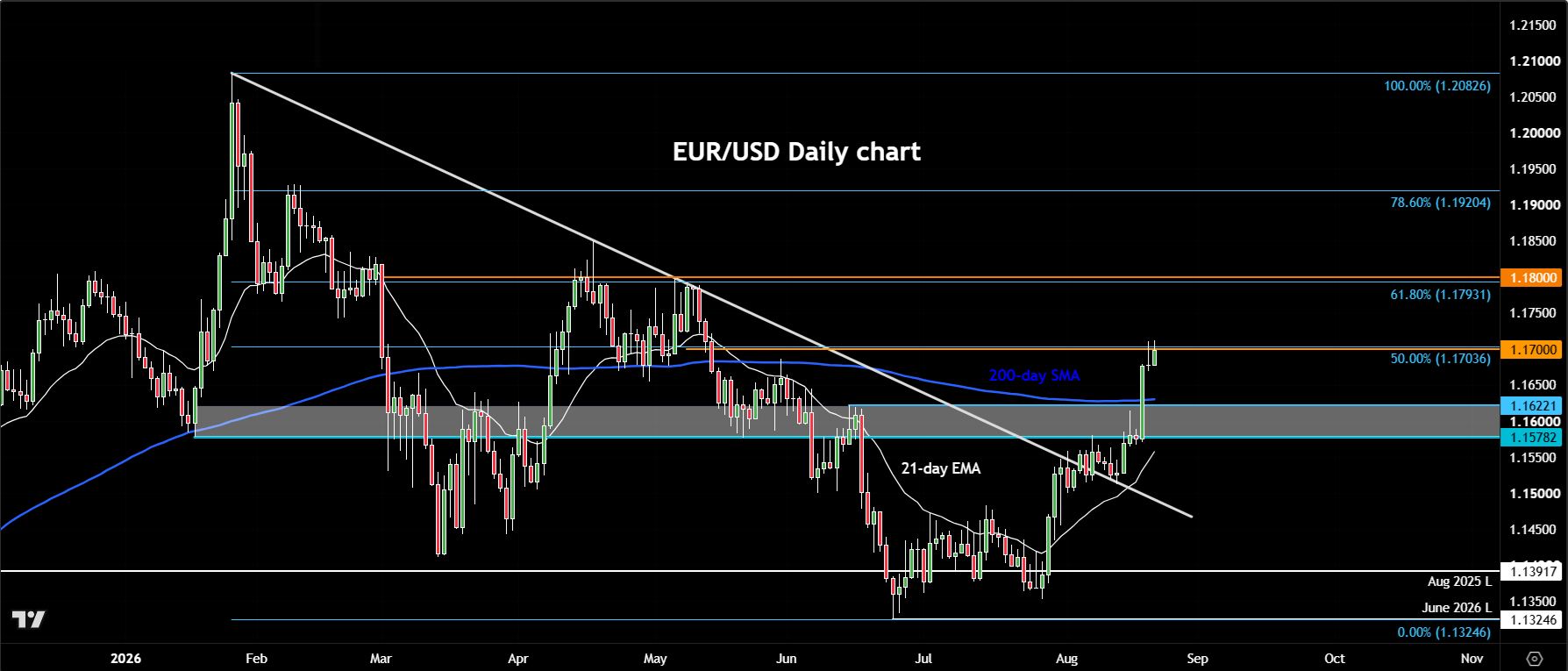
In terms of upside targets on the EUR/USD chart, the first one around 1.1700 area has already been achieved. Here, the 50% retracement of the entire downswing from the January peak to June trough comes into play. The 61.8% Fibonacci retracement level of the same swing comes in at just below the 1.1800 handle, making that the next upside target.

Related tags:

Open an account today
Experience award-winning platforms with fast and secure execution.
Economic calendar
Web Trader platform
Our sophisticated web-based platform is packed with features.
Related articles

Nasdaq 100 forecast: Stocks rebound, but have markets found a floor?
US equities have recovered sharply after last week’s bruising sell-off, as confidence in Nvidia draws investors back into technology stocks. But a busy economic calendar, led by the November jobs report, will test whether the rebound has legs.

US dollar outlook: Fed hike priced | FOREX Friday
A December Fed rate hike looks fully priced in, as the dollar stays below this week's highs despite strong US data, while gold, silver and the EUR/USD rebound. Fawad Razaqzada explains why next week's jobs report is the main event, and the Dollar Index levels to watch.

EUR/USD Recovers as Markets Fully Price in Fed Hike
EUR/USD outlook turns on Fed pricing, as the euro recovers while strong U.S. data fails to lift a dollar that has already priced in Fed tightening.
From time to time, StoneX Financial Pty Ltd (“we”, “our”) website may contain links to other sites and/or resources provided by third parties. These links and/or resources are provided for your information only and we have no control over the contents of those materials, and in no way endorse their content. Any analysis, opinion, commentary or research-based material on our website is for information and educational purposes only and is not, in any circumstances, intended to be an offer, recommendation or solicitation to buy or sell. You should always seek independent advice as to your suitability to speculate in any related markets and your ability to assume the associated risks, if you are at all unsure. No representation or warranty is made, express or implied, that the materials on our website are complete or accurate. We are not under any obligation to update any such material.
As such, we (and/or our associated companies) will not be responsible or liable for any loss or damage incurred by you or any third party arising out of, or in connection with, any use of the information on our website (other than with regards to any duty or liability that we are unable to limit or exclude by law or under the applicable regulatory system) and any such liability is hereby expressly disclaimed.