
- EUR/USD forecast hinges on continued weakness in US dollar than necessary euro strength
- Core PCE and Fed speakers in focus as rate cut speculation lingers
- Busy calendar in week ahead
At above the $1.17 handle now, the EUR/USD certainly has its eye on the $1.20 mark. But make no mistake, this is less about European strength and more about the mounting cracks under the surface of the US dollar. Yesterday’s raft of US data offered no clean read on policy direction, but the prevailing theme was clear: the Fed remains cornered, and the dollar continues to look vulnerable amid mounting concerns over the mounting debt pile and Trump’s inability to secure faster trade deals with important trading partners. Against this backdrop, the EUR/USD forecast remains bullish for now.
Dollar remains on backfoot amid soft macro signals
The greenback stumbled again on Thursday, as the latest string of economic releases this week failed to inspire confidence in the US economy. Q1 GDP was revised sharply lower to an annualised -0.5%, while the CB’s gauge of consumer confidence tumbled to 93.0 from 98.4 and the goods trade deficit ballooned to $96.6bn compared to 87.0bn last. However, there were a few bright spots in the US economy. For example, orders for durable goods jumped 16.4%, but this was largely thanks to a surge in aircraft orders. Jobless claims were a mixed bag too: initial filings fell, but continuing claims rose, hinting that workers are staying unemployed longer. Sales of new homes fell sharply by 13.7% in May, while existing home sales grew slightly, albeit at 4.03 million annualised units this was the slowest reading for May since 2009. At least, the flash services (51.3) and manufacturing (52.0) PMIs came in better.
Today’s highlight is the core PCE for May. This is the Fed’s favourite inflation measure and is expected at 0.1% month-on-month. If we see a surprisingly weak number then that should hit the dollar, while a positive number should be slightly positive.
Uncertainty over Powell’s future undermines confidence further
The Fed has been keen to highlight its independence, but after fresh reports hinted that Trump may look to replace Powell sooner than expected, this again underscores both government interference in monetary policy and the dilemma to lower rates because of high borrowing costs without stoking inflation. Meanwhile, Fed commentary has been neutral in recent days with a slight hint of a dovish tilt, not least from the Chairman himself.
More commentary is expected today from Kashkari, Williams and Hammack. With inflation cooling but still sticky, and growth patchy at best, the Fed is stuck in the middle. It’s no wonder the dollar continues to come under pressure in this environment, keeping the EUR/USD forecast supported.
Tariffs and fiscal drama brewing in the background
Beyond data and the Fed, two simmering risks could weigh further on the dollar. First is the ever-looming US fiscal showdown. Trump’s much-touted spending bill—nicknamed the “One Big Beautiful Bill”—is targeting a Senate vote by the 4th of July. If passed, it could reignite concerns about ballooning deficits and inflationary pressure.
Secondly, there’s the upcoming 9 July deadline, when the current reciprocal tariff truce is due to expire. Unless it’s extended—or replaced by something more concrete—we could be in for another wave of trade tensions. Both of these could put more downward pressure on the dollar and feed into bullish EUR/USD forecast scenarios.
What lies ahead for EUR/USD forecast next week?
Markets will stay glued to US economic updates in the week ahead. The European side of the EUR/USD equation remains mostly quiet for now, with little to steer direction unless something unexpected crops up at the ECB Forum.
- ECB Forum on Central Banking (Tuesday, 1 July)
Central bank heads including Powell, Lagarde, Bailey and Ueda will speak on a policy panel in Sintra. Any dovish shift from Powell—or hawkish hints from Lagarde—could tilt EUR/USD further in the euro’s favour.
- US JOLTS Job Openings (Tuesday, 1 July)
Job openings data has become a proxy for labour market health. A strong print could offer the dollar some relief; a weak one, and the euro might seize more ground.
- US Non-Farm Payrolls (Thursday, 3 July)
The big one. With ISM services and jobless claims also on deck the same day, this could be the make-or-break moment for July rate cut expectations. Another downward surprise, meanwhile, would further boost the EUR/USD forecast may finally begin to cement a firm break towards 1.20.
Technical EUR/USD forecast: key levels to watch
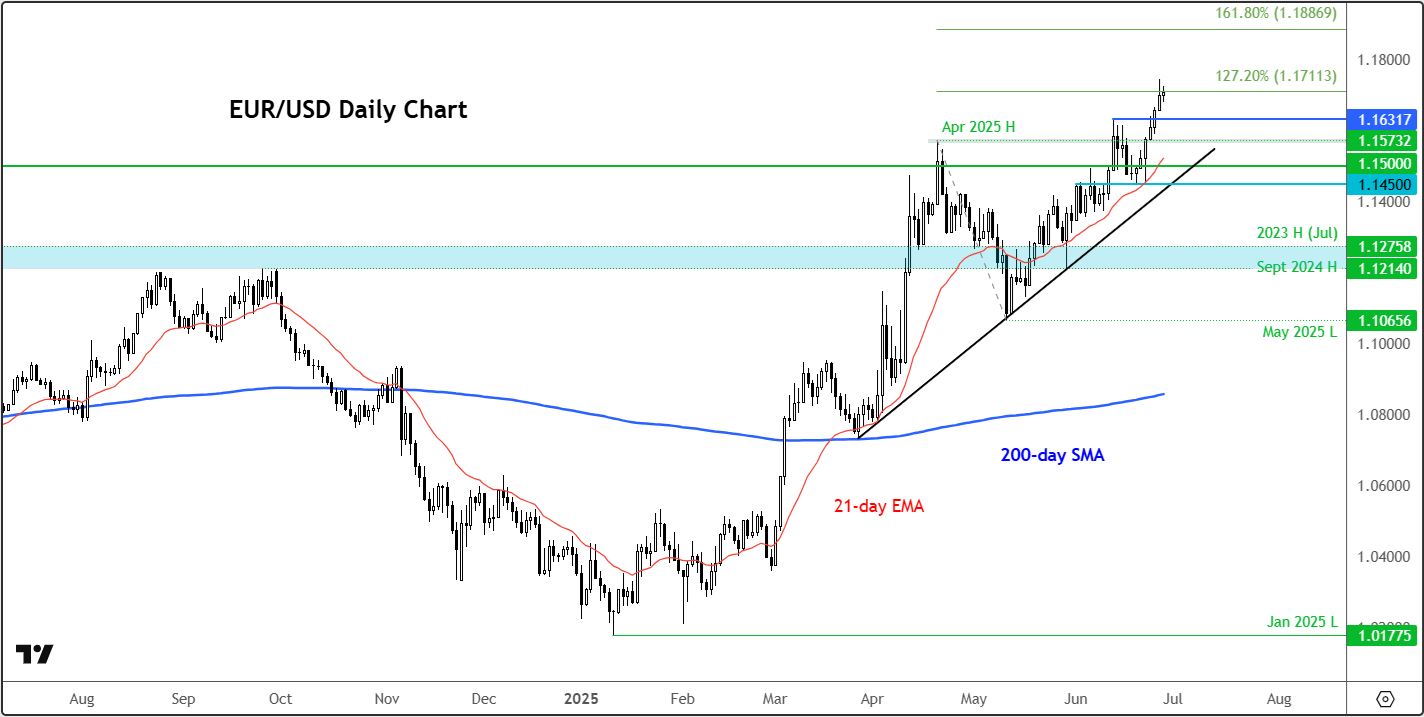
Source: TradingView.com
With higher highs still in place, the path of least resistance for the EUR/USD chart is to the upside. Support is now seen around 1.1650 area, followed by the now-broken April’s high of 1.1573. Other important support levels include Monday’s high of 1.1544 and then the psychologically important 1.15 level.
Some resistance is expected around the next round handles of 1.18 and 1.19, should we get to those levels. I say that because at the time of writing, the EUR/USD was testing the 127.2% Fibonacci extension level of the April downswing at 1.1710 area. This level may offer some resistance, too.
All told, the EUR/USD forecast, and trend, is still mostly a story of dollar weakness. But with Fed credibility in question, policy risks looming, and the data fog thickening, the pair may have enough tailwind to retest higher levels.
-- Written by Fawad Razaqzada, Market Analyst
Follow Fawad on Twitter @Trader_F_R