
- EUR/USD forecast stays cautiously supported as trade war reignites
- Trump cites recent hostile export controls on rare-earth minerals
- Weak German data, French politics had held the euro back all week
The markets badly needed something to trigger a bit of volatility and it looked like nothing was to happen heading towards the weekend. But then, bam! Judging by market’s reaction to a lengthy social media post by Donald Trump, it looks like the trade war has officially re-started with China. Trump threatened a "massive increase of tariffs" on China, pointing to the recent hostile export controls on rare-earth minerals. The news triggered a plunge in stock markets and crude oil prices, while the dollar nosedived against the yen but rallied against the more risk sensitive commodity dollars like the Aussie. The euro, which had outperformed during the height of the trade war earlier this year, before everything bottoming in April, again showed strength, causing the EUR/USD to climb back above 1.1600 handle. Heading into the week ahead, the EUR/USD forecast will be in spotlight as traders watch trade war developments.
Has the trade war restarted?
Apparently, China has sent letters worldwide signalling its intent to impose export controls on rare earths and other production elements, even those not manufactured in China. This has angered the US and other countries, in a move Trump described as China planning to build a monopoly over rare earths and magnets, holding the world “captive.” Trump added that the US also holds stronger monopoly positions in other areas, which haven’t been used, but now may be deployed in response to China’s move.
French political and Eurozone economic uncertainties
The EUR/USD forecast had turned bullish after the recent run of weak US data releases, but during the past couple of weeks the pair slipped below a few short-term support levels as it felt the weight of weak German data and lingering political instability in France. Meanwhile, the dollar’s renewed strength during the government shutdown also added some pressure. Even so, the greenback’s recovery appears overdone, with short-term rate differentials no longer fully justifying current levels. Some consolidation is possible, but sustained gains from here may be difficult unless new catalysts emerge. The resumption of the trade war should be net negative for the dollar, as was the case earlier this year.
ECB’s policy stance should provide support for EUR/USD forecast
The European Central Bank’s rate cutting cycle is potentially over, although if incoming data weakens again then we may see another cut in the coming meetings. According to the minutes of the central bank’s September meeting, the ECB still sees inflation risks as balanced but leaning slightly to the downside. Several members flagged the risk of undershooting, while only a few warned about possible overshoots. The hawks will be watching the trade developments closely, as the potential for more tariffs from the US could reignite global inflation worries. Still, the ECB has left the door open to react swiftly if the macro backdrop shifts, as you would expect.
Macron set to nominate new French prime minister
The political turmoil in France held the euro back and while markets await the appointment of a new prime minister, uncertainty is not going to go away quickly. While outgoing PM Lecornu’s pledge to meet budget commitments have for the time being calmed some nerves, concerns about fiscal discipline won’t go away with the appointment of the new PM. Still, the announcement of a new leader could offer a brief reprieve for the euro, but without deeper reforms or stronger political cohesion, any relief may prove temporary.
US CPI to be release on October 24
Meanwhile, across the Atlantic, the US government shutdown continues with no resolution in sight. Ironically, this may be doing the dollar a favour — fewer economic releases mean fewer chances for weak data to dent sentiment. Reports suggest the Bureau of Labor Statistics is recalling staff to prepare the monthly CPI report, which is now expected to be released on Friday, October 24 at 8:30 AM ET instead of next week. Markets expect a 0.3% month-on-month core inflation reading. Such a result could reinforce expectations for a Fed rate cut on October 29.
EUR/USD technical analysis
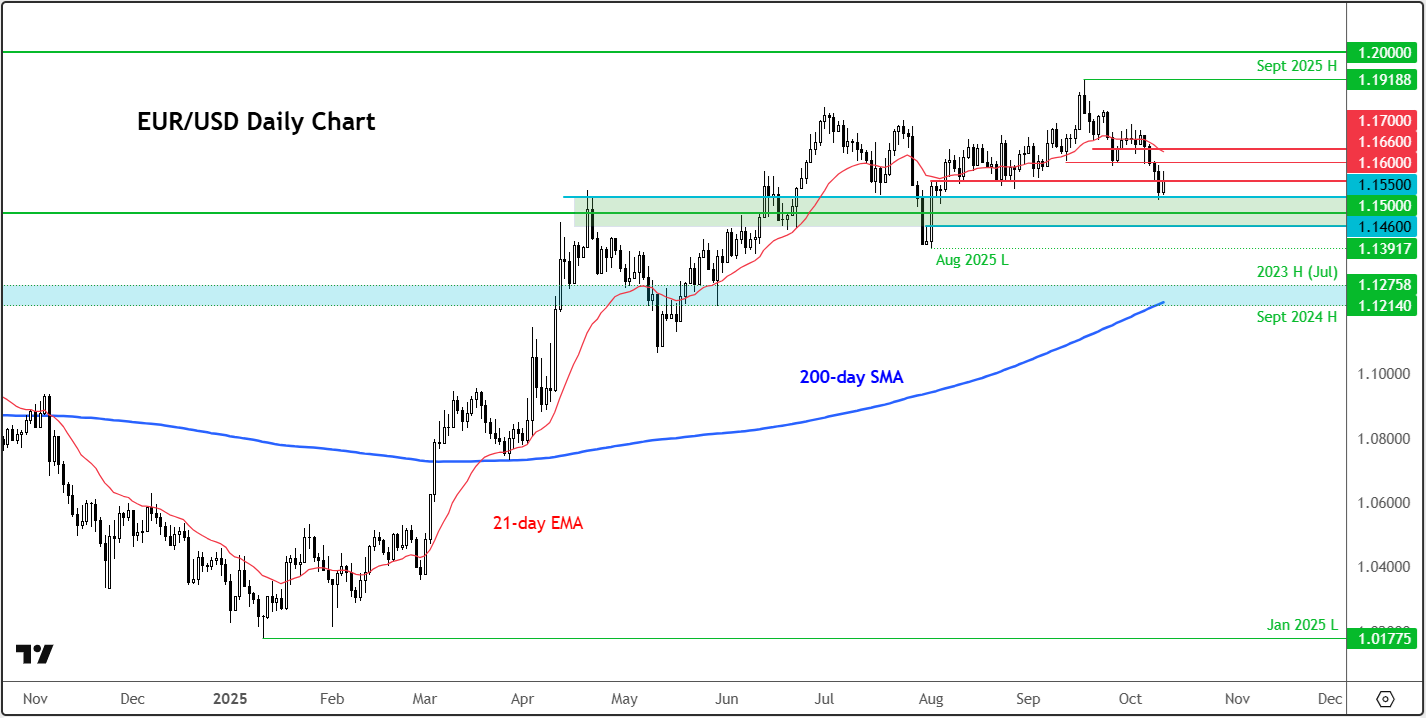
For now, the EUR/USD chart remains under pressure but today’s recovery back above 1.1600 handle is a positive sign. The pair will need to break above a few more short-term resistance levels to turn technically bullish again, after the recent loss of momentum. Next short-term resistance is seen around 1.1660, followed by 1.1700. Next key support is around 1.1500 then 1.1460.

-- Written by Fawad Razaqzada, Market Analyst
Follow Fawad on Twitter @Trader_F_R