
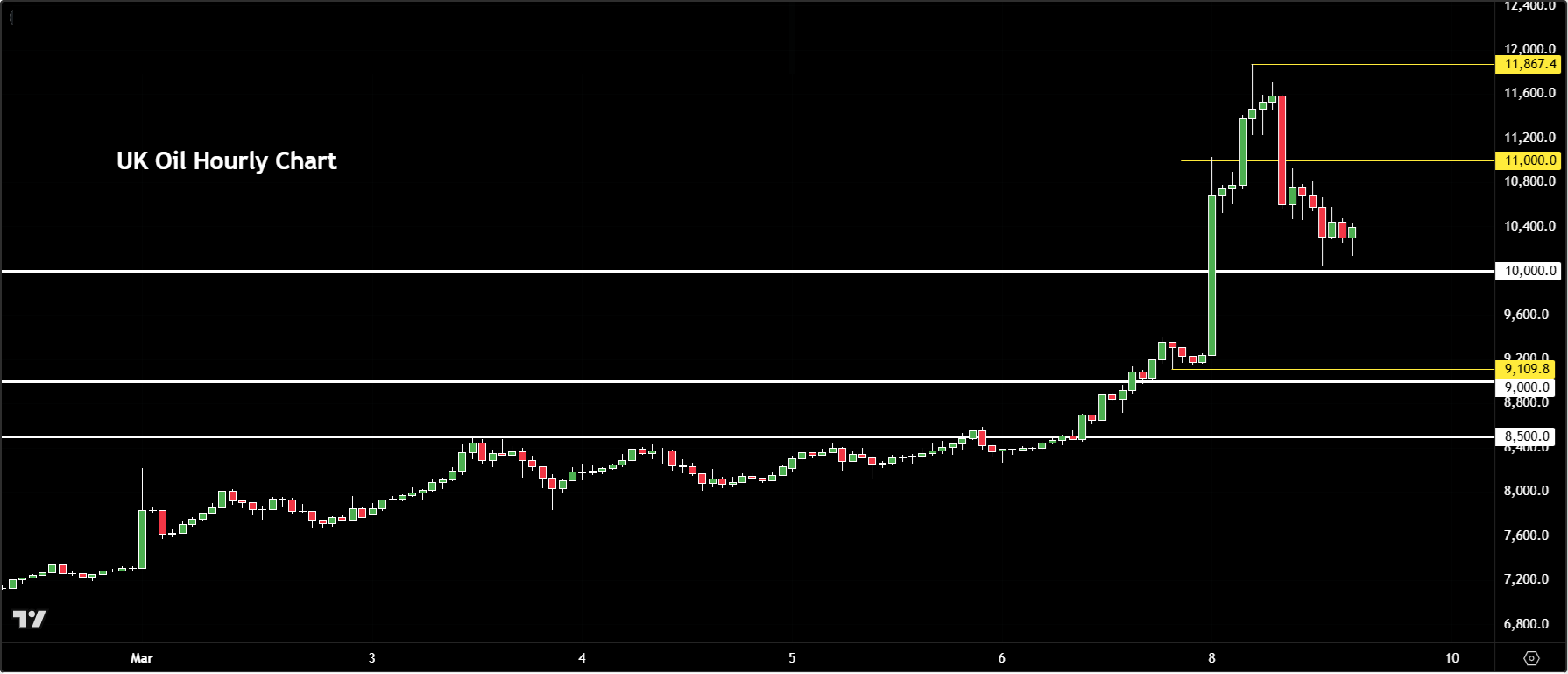
Rather than easing over the weekend, tensions in the Middle East intensified, and that caused oil to gap sharply higher and stocks and EUR/USD lower. The moves have since unwound a little as investors price in the possibility of a coordinated emergency release of oil reserves by major economies. This is unlikely to provide more than temporary relief, which should keep the US dollar well supported on the dips until there is meaningful progress towards peace in the Middle East. With oil prices soaring and stoking fresh inflation concerns, this is particularly bad news for economic regions that rely on energy imports, such as the Eurozone. This makes the EUR/USD forecast particularly vulnerable as oil prices surge beyond $100 a barrel.
It is all about oil prices for EUR/USD forecast
Israel and the US have widened their strikes within Iran, while Tehran continues targeting economic infrastructure across Gulf states. This is causing all sorts of issues for the global economy, from crippling economies of oil importers to raising price pressures across the globe. The longer oil prices remain elevated around these levels, the more damaging it is to the global economy. With no obvious signs of de-escalation in the Middle East, the EUR/USD forecast thus remains bearish. This is the key theme to watch this, and you can almost forget about everything else.
Oil reserve release may only offer brief respite
The sharp jump in energy prices during early Asian trading reflects the growing threat to global oil supply. Saudi Arabia became the latest Gulf producer to cut its output. As long as the conflict drags on, more production risks being taken offline, and that keeps upward pressure on energy prices. However, prices pulled back slightly in early European trade following a report in the Financial Times that the G7 is expected to meet today to discuss a coordinated release of energy reserves via the IEA, which represents 32 member countries. This also helped to lift the EUR/USD and stock indices off their lows.
Will any the release of oil reserves help ease pressure on prices? I think it does, if it is big enough. But in any case, this will be a temporary respite if there are no signs of the war ending. In 2022, the IEA released 62 million barrels in March and a further 120 million barrels in April to ease the price spike triggered by Russia’s invasion of Ukraine. This time, the US is reportedly pushing for a much larger release—somewhere in the region of 300–400 million barrels, equivalent to roughly 25–30% of the IEA’s stockpiles. It is difficult to see countries agreeing to this, as clearly no one knows how long the conflict will last.
The higher oil prices climb, the more pressure builds across financial markets. Rising energy costs tend to push short-term interest rate expectations higher, putting pressure on global equities, and that is also not good news for risk-sensitive currencies like the euro, pound or Aussie.
Economic data may take a back seat this week, even though January’s US jobs report came in much softer than expected. Attention will turn to inflation. February CPI data is due on Wednesday, followed by the core PCE deflator on Friday. If the February inflation data was already higher than expected, then that outcome would reinforce the view that the Federal Reserve may delay any rate cuts in light of the oil price shock.
Technical EUR/USD forecast: Pressure building near 1.15
There may be scope for a short-term bounce in EUR/USD if the IEA does move ahead with a large-scale reserve release—though the reported 300–400 million barrel figure still looks ambitious. Even then, positioning adjustments could limit the upside. If EUR/USD breaks below the 1.1500 region, volatility could quickly increase, opening the door for a sharper move towards 1.1400 in fast market conditions.
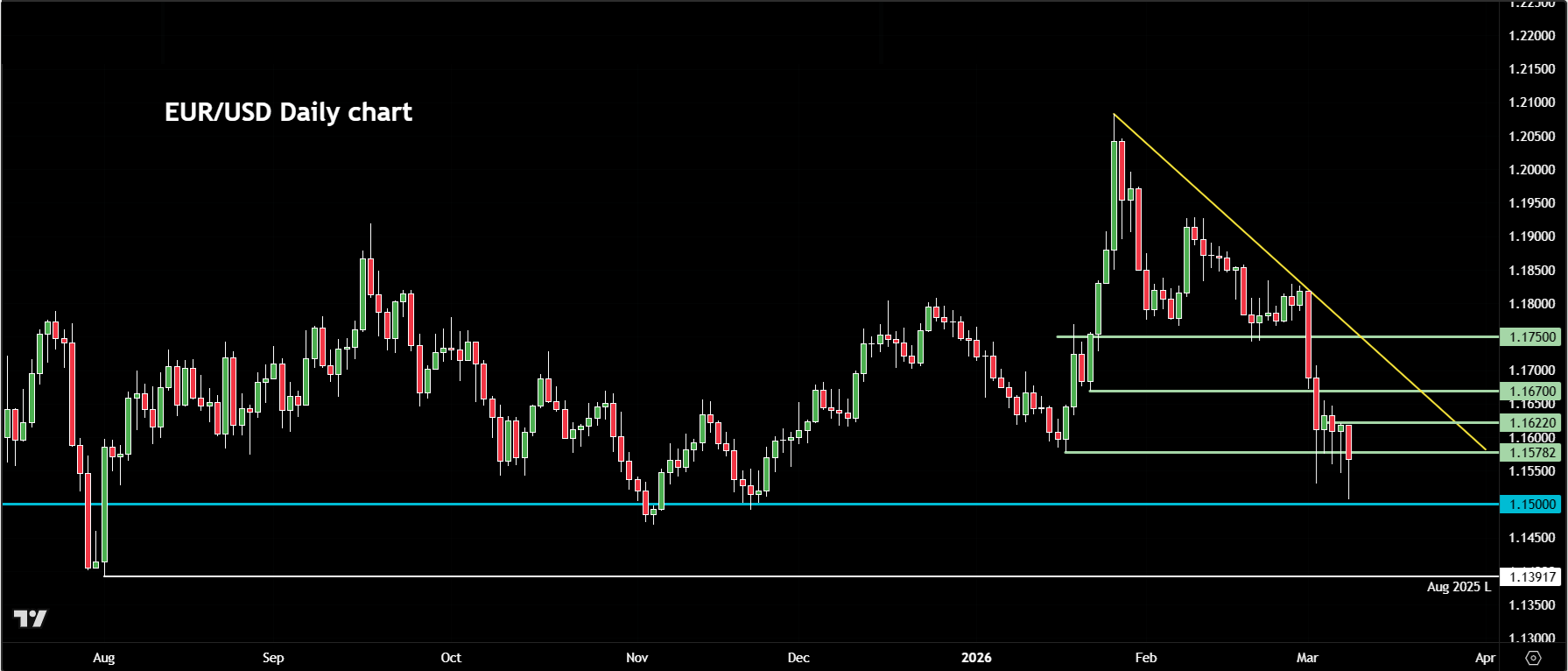
The key level to watch today is around 1.1578 area, marking the January low. Price has been testing this level for a few days now and until today, it had been able to hold above it on a daily closing basis. On Friday, we had the US jobs report, which caused the EUR/USD to rally as the US dollar fell on the back of that big disappointment. However, today we can see that price has gapped lower below that level and, at the time of writing, it is holding below it.
The 1.1578 level is therefore a very important to watch. For as long as this area now holds as resistance, the path of least resistance remains to the downside. Above that, the next level to watch is around 1.1620, marking the highs from Friday. Then 1.1670 will come into focus next should we see some upward momentum.
All told, the path of least resistance remains to the downside for as long as the energy price shock remains in focus. Unless we see a sharp drop in oil prices, the EUR/USD forecast should remain under pressure for a while yet.
Source for all charts used in this article: TradingView.com

-- Written by Fawad Razaqzada, Market Analyst
Follow Fawad on Twitter @Trader_F_R