
EUR/USD rises on USD weakness and as Eurozone inflation hits 4%
The EUR/USD is rising towards 1.1250 as the U.S. dollar weakens following the results of the U.S. midterm elections, which showed Democrats had taken full control of Congress.
The broad expectation is that a Democratic sweep is likely to limit government spending over Trump's remaining two years.
Meanwhile, the euro is capitalising on the weaker U.S. dollar, but is also reacting to Eurozone inflation, which climbed to a three-year high of 4% in October, as surging oil and gas prices feed into the economy.
Annual CPI rose to 4%, up from 3.8% in September and in line with forecasts. Annual energy inflation continued to rise to 20.8%, the highest level since January 2023, and above the 18.9% recorded in September.
October marks the eighth straight month that annual inflation has been above the ECB's 2% target.
Core inflation, which excludes more volatile items such as food and fuel, was unchanged at 2.5%, while services inflation also remains an important measure to watch.
The ECB left interest rates unchanged last week but warned that inflation risks were tilted to the upside. The ECB stands ready to hike rates by 25 basis points in December.
The euro has also received support from increasingly hawkish rhetoric among ECB policymakers.
Looking ahead, U.S. ISM services PMI is due later today, ahead of the U.S. nonfarm payroll report on Friday.
EUR/USD forecast – technical analysis
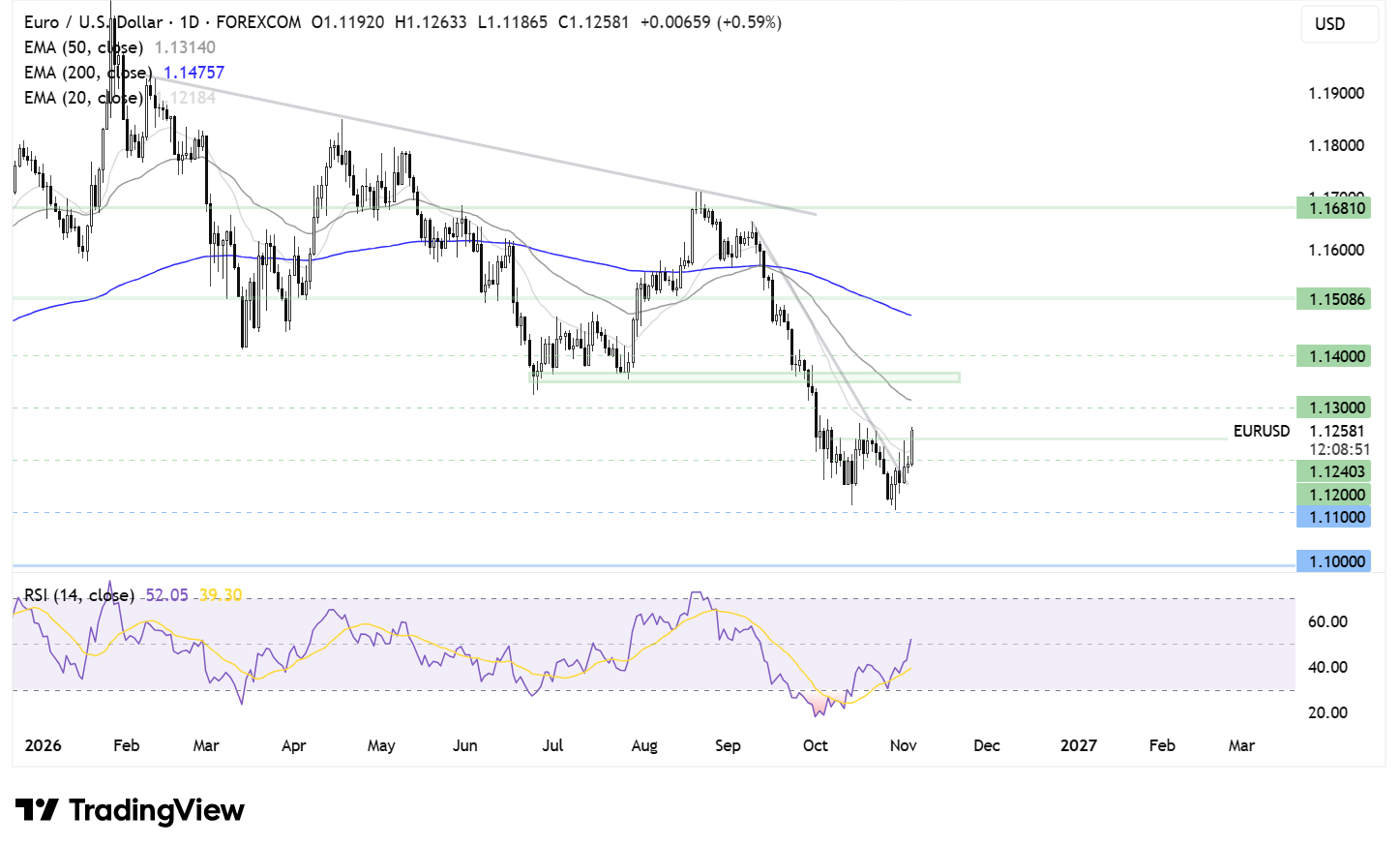
Euro/U.S. dollar has recovered from just above the 1.1120 2026 low, rising above 1.1250 to a three-week high. The price has risen above the 20 EMA but still trades below the 50 and 200 EMAs, turning the near-term outlook constructive. However, the broader technical picture remains bearish.
Bulls would need to extend gains above the 1.13 and 1.1350 resistance zone in order for the picture to become more stable. A rise above the 200 EMA at 1.1480 and resistance at 1.15 would turn the outlook more constructive.
On the downside, a break below the 20 EMA at 1.12 would open the door to 1.11 support.
Gold – U.S. midterms lift precious metal above $4,000
Gold is pushing above $4,000, and silver has jumped over 4.4% as investors react to the U.S. midterm election results.
The Democrats have won control of Congress, securing a House majority of at least 332 seats and 54 in the Senate. As a result, Trump could be far more constrained than in the first two years of his second term, when Republican control of Congress left few checks on his power.
The Democratic wave should reduce the likelihood of major fiscal expansion. Greater uncertainty over government funding and debt ceiling negotiations, alongside concerns over technology sector regulation, is pulling Treasury yields and the U.S. dollar lower. The greenback has fallen to a monthly low against its major peers.
A falling U.S. dollar and Treasury yields are good news for non-yielding, U.S. dollar-denominated gold.
However, the election-driven moves could be short-lived, with Federal Reserve policy remaining a key influence on the U.S. dollar's direction and, therefore, gold's direction ahead of Friday's nonfarm payroll report.
The market is pricing in a 79% probability of a rate hike in December. Stronger-than-expected U.S. nonfarm payrolls could help cement those expectations, lifting the U.S. dollar and pulling gold lower once again.
Gold forecast – technical analysis
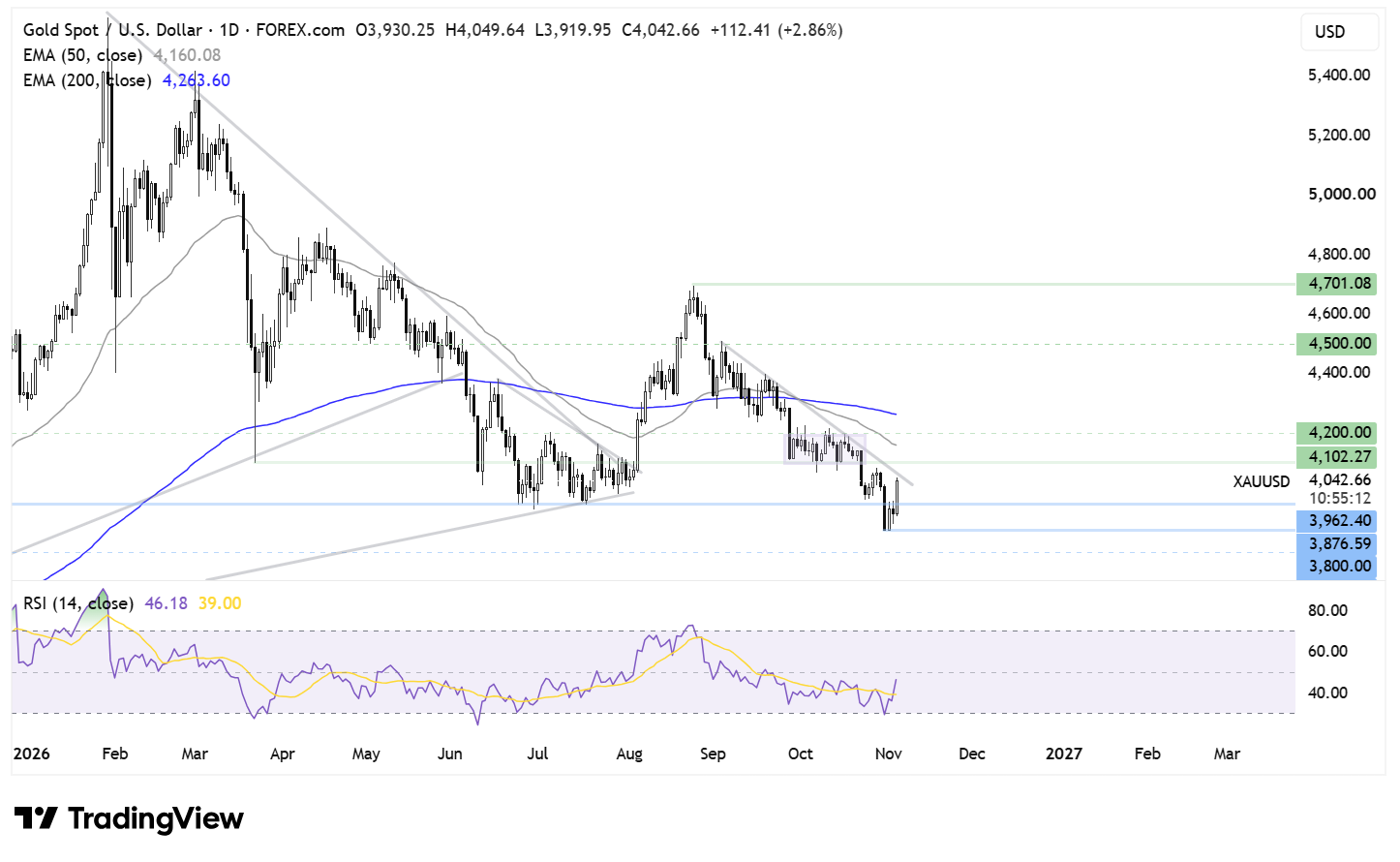
Gold has recovered from the 2026 low of $3,870, rising above $4,000 to $4,040. However, the downtrend remains intact, with the price still trading below its 20, 50 and 200 EMAs.
Buyers would need to reclaim $4,060, the 20 EMA, and $4,100 in order to bring $4,200 into focus. A rise above here would put the price on a firmer footing, exposing the 200 EMA at $4,263. From here, attention turns to $4,500.
On the downside, sellers would need to take out support at $3,960, the July low, as well as $3,870, to create a lower low and turn attention towards $3,800.