
- EUR/USD outlook: German-US yield spread hits May 2022 levels
- EUR/USD technical analysis: 1.0580 key short-term resistance being tested
- ECB, US GDP and global PMIs among key macro events to watch next week
Despite ongoing volatility in stocks, where any recovery attempts continue to fail the bulls, and the renewed rise to almost 5% in US 10-year bond yields, the EUR/USD, which has shown a notably strong positive correlation with the S&P 500 in recent months, has stayed quite contained for the past couple of weeks. It could be that traders are wafting for Powell’s speech later or bigger macro events taking place next week, when we have global PMIs, ECB’s policy decision and US GDP among other things, before committing to a particular direction.
More on that later, but the recent FX correlations with the stock markets suggest that a sell-off could lead to the dollar maintaining gains at the expense of the euro, and especially commodity currencies. Among the ComDolls, the Aussie dollar, despite being undervalued from a macro perspective, might face substantial impact as a high-beta victim during an equity sell-off, possibly dragging down cross rates like AUD/JPY. It is also worth pointing out that GBP/USD has shown a notably strong positive correlation with the S&P 500, compared to the EUR/USD. Indeed, today saw another commodity dollar, the NZD drop to a fresh 2023 low against USD.
EUR/USD outlook: German-US yield spread hits May 2022 levels
But the EUR/USD hasn’t moved much. If anything, it was holding in the positive territory at the time of writing. What makes the EUR/USD strength even more remarkable is the fact that the spread between German and US 10-year bond yields have fallen to reach levels last seen in May 2022, after breaking below the October 2022 low:
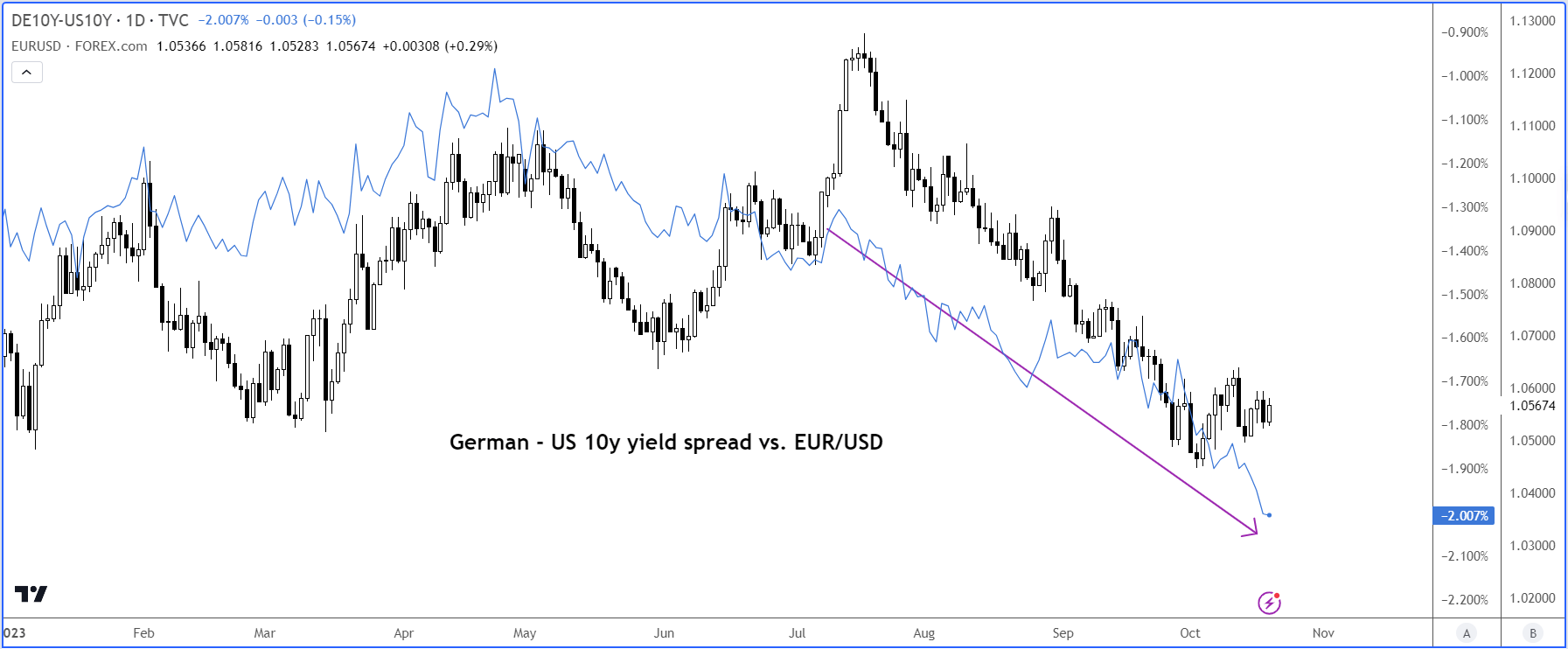
But the EUR/USD remains comfortably above its corresponding September 2022 low, suggesting that either the EUR/USD has a lot of room to the downside, or bond investors are over-hyping the Fed’s hawkish stance. So, something’s got to give.
Before discussing next week’s macro events, let’s have a look at the chart of the EUR/USD first:
EUR/USD technical analysis
At the time of writing, testing a short-term resistance level around 1.0580ish, where we also have a short-term bearish trend line converging. A potential break above here could pave the way for another run towards the more significant resistance at 1.0635. The bears will be eyeing a break below the support trend of the triangle pattern before punishing the EUR/USD again. Key support lies around 1.05 handle.

EUR/USD outlook: key macro events to watch next week
There are plenty of economic data that could influence the EUR/USD outlook in the week ahead. Let’s focus on the three main ones.
Global PMIs
Tuesday, October 24
All day
The PMI data has been consistently very poor throughout much of this year, correctly highlighting a challenging macro backdrop with stagflation and high interest rates holding back the developed economies, most notably the Eurozone. Add the raised geopolitical risks to the equation, sentiment in the services sector is likely to have remained downbeat in October. The PMI is a leading indicator of economic health as purchasing managers possibly hold the most current and relevant insight into the company's view of the economy. Unless we see a surprise improvement in the PMI readings for the Eurozone, expect the pressure to remain on the EUR/USD.
ECB policy decision
Thursday, October 26
Following the ECB’s September meeting, the central bank made it clear that they won’t be hiking rates in October, as the central bank will want to get fresh information on Bank Lending Survey, Q3 GDP and a new round of staff projections. But soft data and the flare up in Middle East tensions have made it even easier for the ECB to pause its hiking. So, the focus will be on clues about the ECB’s December meeting, and beyond. All told, we don’t expect to see any support coming for the euro from this meeting.
US Advance GDP estimate
Thursday, October 26
We will have lots of important data from the US next week, including PMIs from the manufacturing and services sectors (Tuesday), GDP (Thursday) and Core PCE Price Index (Friday). Among these, GDP is likely to garner most of the attention as investors assess the likelihood for one more rate increase from the Fed. If GDP and most other US macro pointers in the week come in higher, then at the very least it would boost the “higher for longer” narrative, while data disappointment could finally send US dollar and yields lower.
Source for all charts used in this article: TradingView.com
-- Written by Fawad Razaqzada, Market Analyst
Follow Fawad on Twitter @Trader_F_R