

My top surprise from last year is actually two different items in the same market; and really, there’s a surprising item behind the move(s), as well.
Perhaps what was most surprising to me from 2025 was just how aggressively President Trump pushed into the rate cut conversation. Given his first term, I did expect some commentary on where he wanted rates to go, but in his second term this has seemed to take on an entirely new life where he was vociferously pushing for what could best be described as radical monetary policy. Towards the end of the year, Trump opined that he thought rates should go below 1%, which is far cry from the 3.5-3.75% range that we have into the end of 2025. At multiple points throughout the year, he threatened to fire Jerome Powell for not having cut rates more aggressively – and sooner.
In his first term, in which he originally nominated Powell for the position, some commentary or remarks around dissatisfaction from the Fed hiking rates were not abnormal. This would usually receive some condemnation from the media, usually around threats of Fed independence, but by and large those comments seemed somewhat distant and at least partially innocuous. It was out of the norm, however, by a traditional Presidential standard.
In his second term, however, he resorted to name calling and threats to fire Powell, even though it remains questionable as to whether a President can actually fire a Fed chair. And perhaps more interesting is the fact that Trump was soon going to get the chance to replace him anyways as Powell’s term atop the bank is set to end next year.
This had a big impact in the US Dollar and in-turn, EUR/USD. As we came into 2025 it seemed almost a foregone conclusion that EUR/USD would revisit the parity handle. US Treasury rates were skyrocketing and the Euro had fallen by 1,000 pips from the Q3 2024 high down to the lows in early 2025 trade. But that’s around the time a major Fibonacci level came into play to soften the bleeding. In February it was all about bears getting pushed back as an ascending triangle formed – and then in March, as threats of a recession in the U.S. took over and drove rate expectations lower, EUR/USD broke out in a very big way.
This is my first surprise on EUR/USD for 2025.
EUR/USD Weekly Chart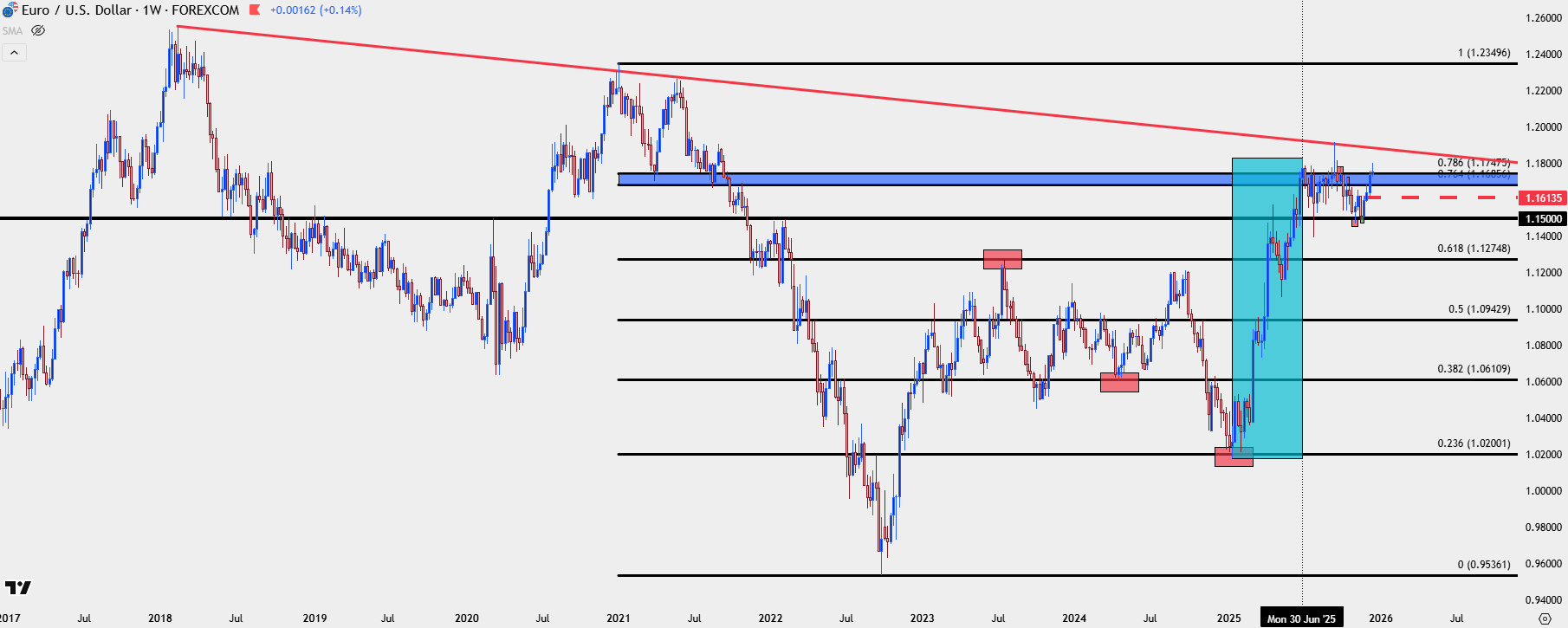
Chart prepared by James Stanley; data derived from Tradingview
My second surprise on EUR/USD is what happened in the second half of the year, or perhaps more accurately – what did not happen. The pair found resistance at a familiar Fibonacci level in early Q3 trade and that resistance has largely remained in place ever since.
That rally in EUR/USD was largely relegated to the first half of the year. That’s when the 76.4-78.6% retracements from the same Fibonacci setup came into play to mark the highs and for most of the second half of the year this remained a stumbling block for bulls.
On the fundamental side, it was as the Fed was opening the door for cuts that the backdrop for EUR/USD seemingly opened for bullish continuation. But after pushing up to a fresh three-year-high on the initial rate cut announcement, the pair stalled, and then actually started to sell-off, all the way until the 1.1500 level came into play and held the lows over two instances in November.
On the other side, the ECB opened the door to hikes in Q4, thereby increasing the potential for rate compression between the two economies but as of right now, the pair still has yet to take out that swing high from September 17th. At this point the trend on the daily chart remains bullish, even if the weekly chart shows digestion at a major level of longer-term resistance.
But a key fact to remember as we move into 2026 is that the pricing in of rate cuts can be very bearish, as we saw in the first half of 2025. But rate cuts themselves don’t necessarily have to carry that same negative connotation for trend as perhaps the more important factor is ‘what’s next.’ This is like what we saw in the final four months of 2024 when the US Dollar rallied, EUR/USD dropped and Treasury yields jumped even as the Fed was cutting rates.
Don’t be surprised if the fundamental drivers don’t lead directly to logical price movements, as the bigger factor for market behavior is positioning and sentiment.
EUR/USD Daily Chart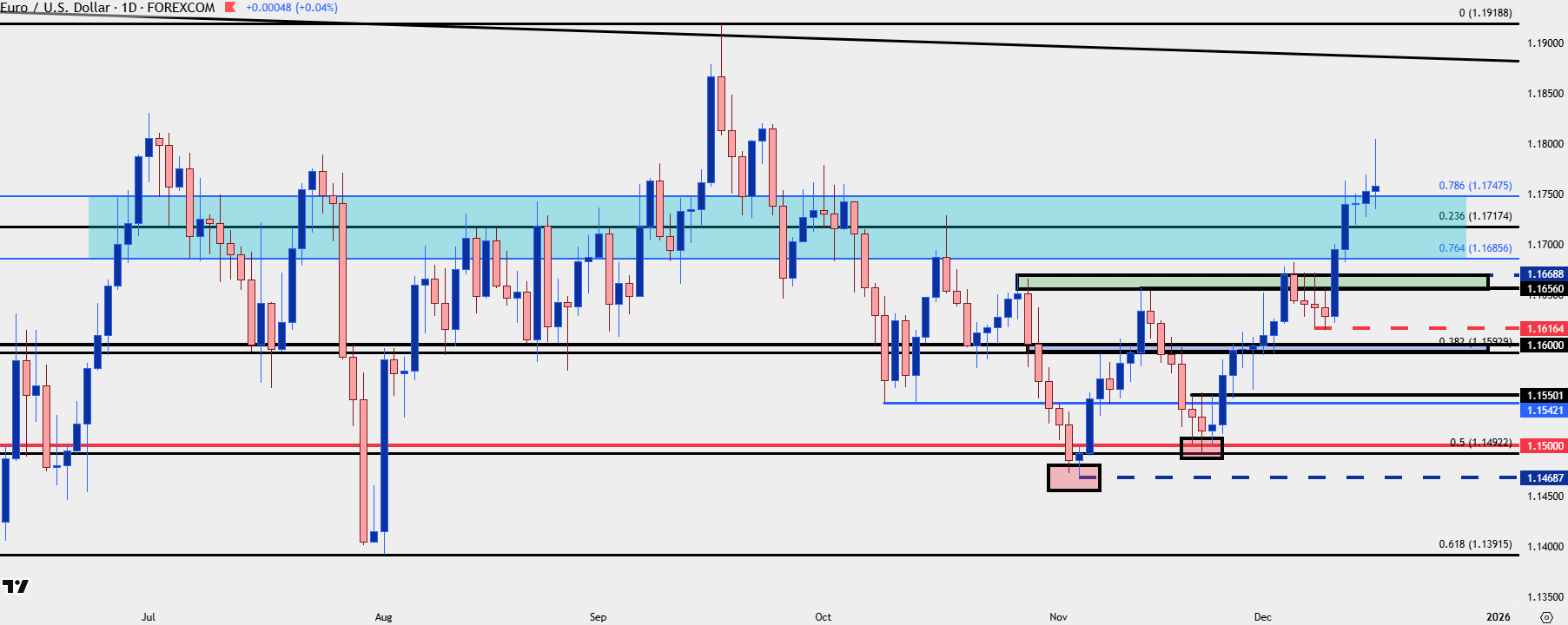
Chart prepared by James Stanley; data derived from Tradingview
--- written by James Stanley, Senior Market Analyst, Global Macro