



EUR/USD weekly outlook: Dollar weakness ahead of Jackson Hole
Last week’s main theme has been a shift away from the US dollar towards currencies of economies with stronger fiscal positions and lower debt levels. The brief rally in long-dated US Treasuries helped fuel gains in gold and silver, while the Swiss franc also benefited from increased haven demand. The euro has performed reasonably well too, with the Eurozone economy continuing to expand modestly despite geopolitical uncertainty and higher energy prices.
Share this:

Last week’s main theme has been a shift away from the US dollar towards currencies of economies with stronger fiscal positions and lower debt levels. The brief rally in long-dated US Treasuries helped fuel gains in gold and silver, while the Swiss franc also benefited from increased haven demand. The euro has performed reasonably well too, with the Eurozone economy continuing to expand modestly despite geopolitical uncertainty and higher energy prices. For now, the EUR/USD outlook remains mildly bullish. Investors are looking forward to some US inflation data and the Jackson Hole symposium in the week ahead.
What’s driving EUR/USD?
There has been a noticeable flight to quality in recent days, with investors favouring gold over equities and, in FX, seeking currencies backed by relatively stronger fiscal positions. The Norwegian krone, Canadian dollar, Swiss franc and euro have all held up reasonably well, while the US dollar and Japanese yen have struggled.
The bigger concern is the continued rise in bond yields across developed markets, particularly in the US. The US Treasury has responded with increased purchases of longer-dated Treasuries, initially triggering a sharp reaction across FX and crypto markets. However, yields have since returned to roughly their pre-announcement levels, suggesting the intervention has so far failed to produce a lasting decline in borrowing costs.
The intervention remains important for the dollar outlook. Although Treasury buybacks were originally intended to improve market liquidity, their timing and increased size suggest that policymakers are becoming increasingly uncomfortable with the rise in longer-dated yields. The decision to double long-dated buybacks to at least $4bn per operation, with scope for further increases, reinforces that impression.
For EUR/USD outlook, the key question is whether these developments further undermine confidence in US policy credibility. So far, the answer appears to be yes, albeit only modestly. If Treasury becomes increasingly willing to contain long-end yields, that could leave the dollar under pressure. A broader intervention programme could also weaken the dollar’s traditional safe-haven appeal, potentially benefiting both the euro and other major currencies.
Technical EUR/USD outlook and key levels to watch
Technically, the EUR/USD outlook has turned bullish following the break above the previous bearish trend and the subsequent upside follow-through. The pair has already reached the first major target around 1.1700, where the 50% Fibonacci retracement of the January-to-June downswing comes into play. Here, the pair has formed two doji candles in as many days. Usually a bearish sign this is. However, in the context of the larger breakout, this could be a bear trap. So, watch for a modest move lower, before the pair potentially breaks higher again, once the sellers are trapped.
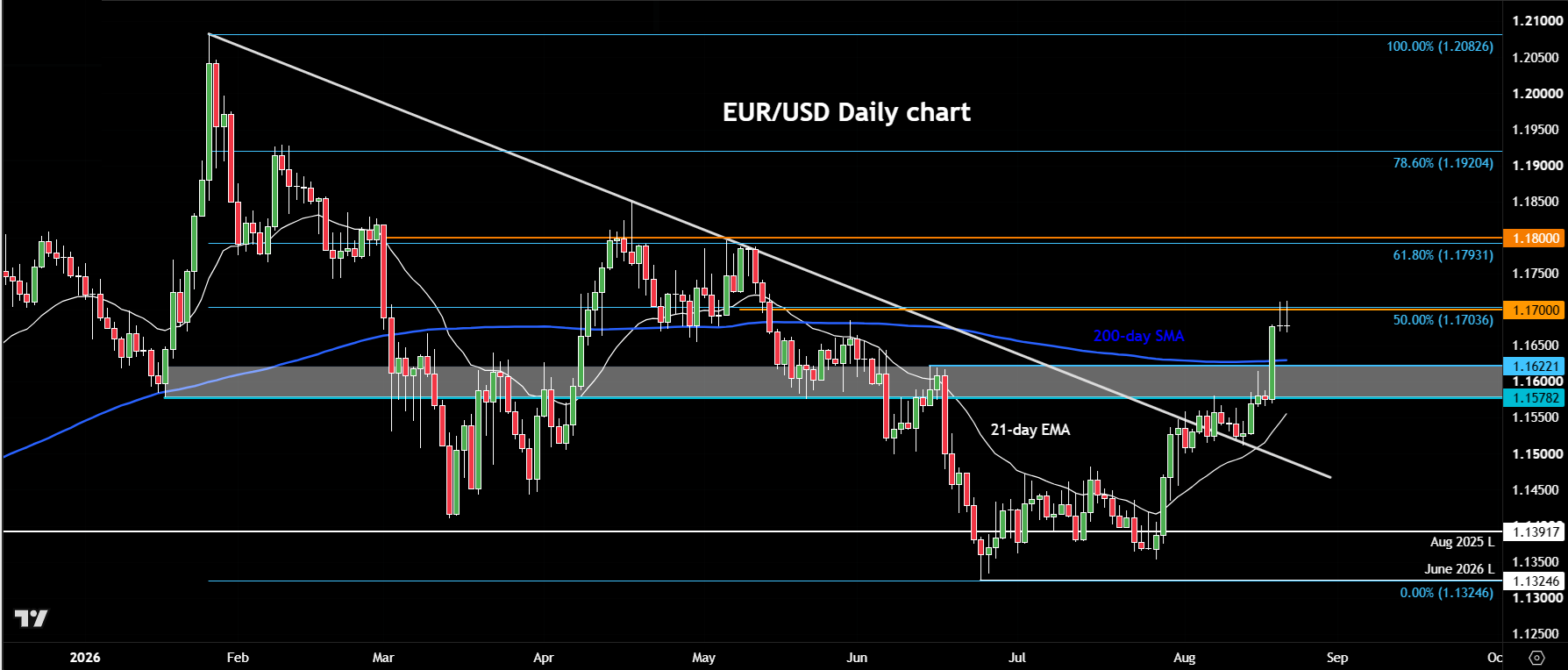
On the downside, the 1.1575-1.1625 region is now the key support zone. The upper end of this range coincides with the 200-day average, while the lower end marks the origin of the recent breakout.
As long as EUR/USD holds above 1.1575, the technical bias remains bullish. A sustained break back below that level, however, would undermine the current bullish structure and suggest that the recent breakout may have been a false one.
Meanwhile, the next significant upside objective is around 1.1800, where the 61.8% Fibonacci retracement sits.
EUR/USD look ahead: Core PCE and Jackson Hole
The next major test for the dollar comes on Wednesday, with the release of the US core PCE price index at 13:30 BST. If the recent CPI and PPI inflation readings are anything to go by, there is a reasonable chance that core PCE will also come in softer than expected. That would reinforce the argument that underlying US inflation pressures are easing.
However, this is the Federal Reserve’s preferred inflation gauge, so the market reaction could be significant in either direction. A surprisingly soft reading would probably reinforce expectations of a less restrictive Fed and could provide another leg higher for EUR/USD. Conversely, a hotter-than-expected figure could revive concerns about inflation and put renewed upward pressure on US yields and the dollar.
Then comes the Jackson Hole symposium on Friday, where Kevin Warsh will deliver his first major speech as Fed Chair. His comments will be closely watched, although he is unlikely to offer much in the way of explicit forward guidance given his well-known reluctance to do so.
Even so, Warsh could still influence markets by acknowledging the recent weakness in US economic data. Any suggestion that the Fed is becoming more comfortable with the inflation outlook could help alleviate some of the pressure from rising Treasury yields and, in turn, weigh on the dollar.
For EUR/USD, therefore, the near-term backdrop remains constructive. The technical trend is bullish, Eurozone data have been reasonably resilient, while questions over US fiscal policy, Treasury intervention and the direction of Fed policy continue to hang over the dollar. The key risk to this view is a renewed rise in crude oil prices in recent weeks.

-- Written by Fawad Razaqzada, Market Analyst
Follow Fawad on Twitter @Trader_F_R

Open an account today
Experience award-winning platforms with fast and secure execution.
Economic calendar
Web Trader platform
Our sophisticated web-based platform is packed with features.
Related articles

Nasdaq 100 forecast: Stocks rebound, but have markets found a floor?
US equities have recovered sharply after last week’s bruising sell-off, as confidence in Nvidia draws investors back into technology stocks. But a busy economic calendar, led by the November jobs report, will test whether the rebound has legs.

US dollar outlook: Fed hike priced | FOREX Friday
A December Fed rate hike looks fully priced in, as the dollar stays below this week's highs despite strong US data, while gold, silver and the EUR/USD rebound. Fawad Razaqzada explains why next week's jobs report is the main event, and the Dollar Index levels to watch.

EUR/USD Recovers as Markets Fully Price in Fed Hike
EUR/USD outlook turns on Fed pricing, as the euro recovers while strong U.S. data fails to lift a dollar that has already priced in Fed tightening.
From time to time, StoneX Financial Pty Ltd (“we”, “our”) website may contain links to other sites and/or resources provided by third parties. These links and/or resources are provided for your information only and we have no control over the contents of those materials, and in no way endorse their content. Any analysis, opinion, commentary or research-based material on our website is for information and educational purposes only and is not, in any circumstances, intended to be an offer, recommendation or solicitation to buy or sell. You should always seek independent advice as to your suitability to speculate in any related markets and your ability to assume the associated risks, if you are at all unsure. No representation or warranty is made, express or implied, that the materials on our website are complete or accurate. We are not under any obligation to update any such material.
As such, we (and/or our associated companies) will not be responsible or liable for any loss or damage incurred by you or any third party arising out of, or in connection with, any use of the information on our website (other than with regards to any duty or liability that we are unable to limit or exclude by law or under the applicable regulatory system) and any such liability is hereby expressly disclaimed.