



EUR/USD Analysis: Euro struggles to gain ground after ECB decision
As the trading week approaches its close, one of the main short-term developments is the euro’s loss of momentum. This is reflected in EUR/USD price action, with the pair down around -0.2% on the day and moving back toward the 1.15 area.
Share this:

As the trading week approaches its close, one of the main short-term developments is the euro’s loss of momentum. This is reflected in EUR/USD price action, with the pair down around -0.2% on the day and moving back toward the 1.15 area.
This suggests that fresh selling pressure has started to affect the pair, even after the European Central Bank decided to raise interest rates in the region. For now, US dollar strength remains an important driver and could keep pressure on EUR/USD over the coming sessions.


Was the European Central Bank decision not enough?
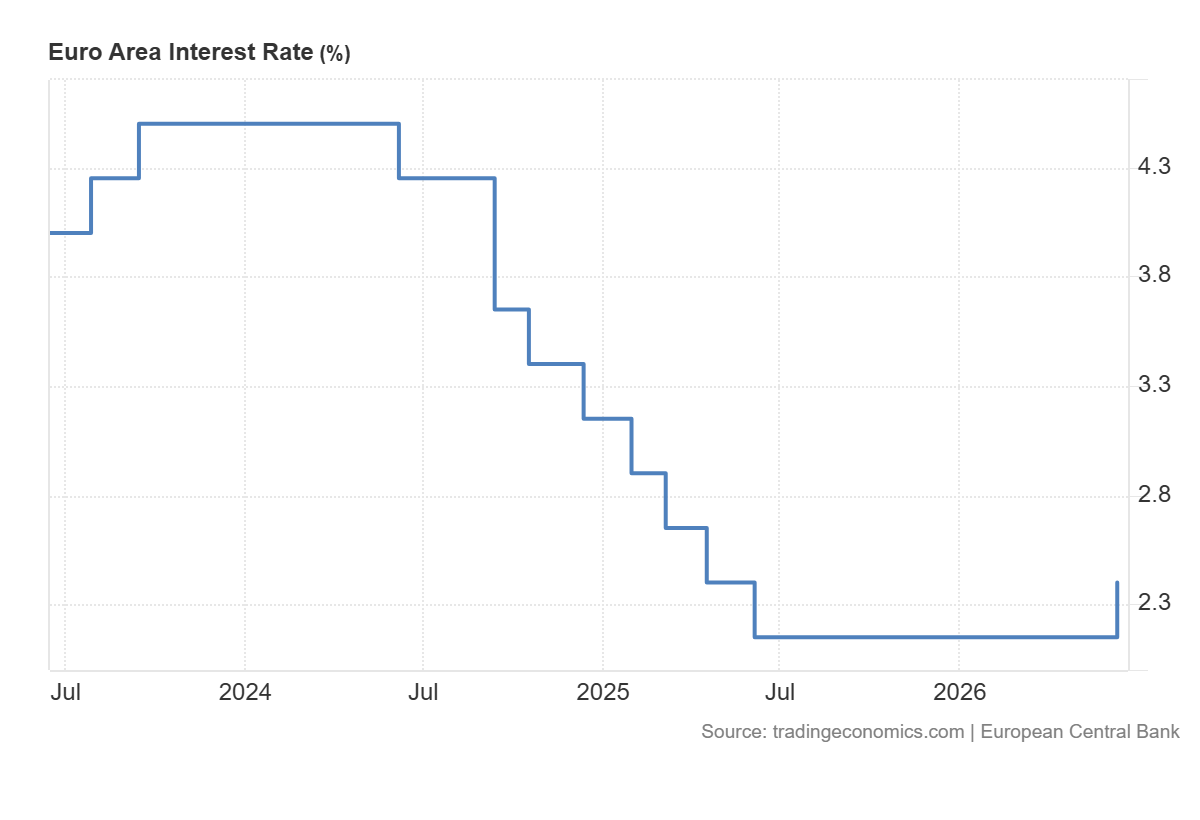
One of the most important economic events during today’s session was the European Central Bank interest rate decision. For the first time in months, the ECB raised rates from 2.15% to 2.4%, in line with market expectations. This was the first rate increase in Europe since 2023 and suggests that the central bank is starting to move away from the long period of unchanged rates seen over the past several months.
Source: TradingEconomics
The central bank pointed to persistent inflation pressures as one of the main reasons behind the rate hike, especially due to the energy price shock linked to the conflict in the Middle East. Still, the ECB also flagged concerns over eurozone growth and revised its 2027 growth projections lower. Inflation has become a more relevant problem, but weaker economic growth could limit the room for additional rate hikes later on.
The key point is that the ECB decision was already expected by markets and came in line with forecasts. More importantly, the comments that followed did not clearly suggest that the bank is entering a sustained rate-hiking cycle, as overly restrictive policy could weigh on economic growth. This may help explain why euro-denominated assets have not gained strong appeal in the short term. European bond yields also failed to react strongly, suggesting that demand for the euro remains unconvinced for now.
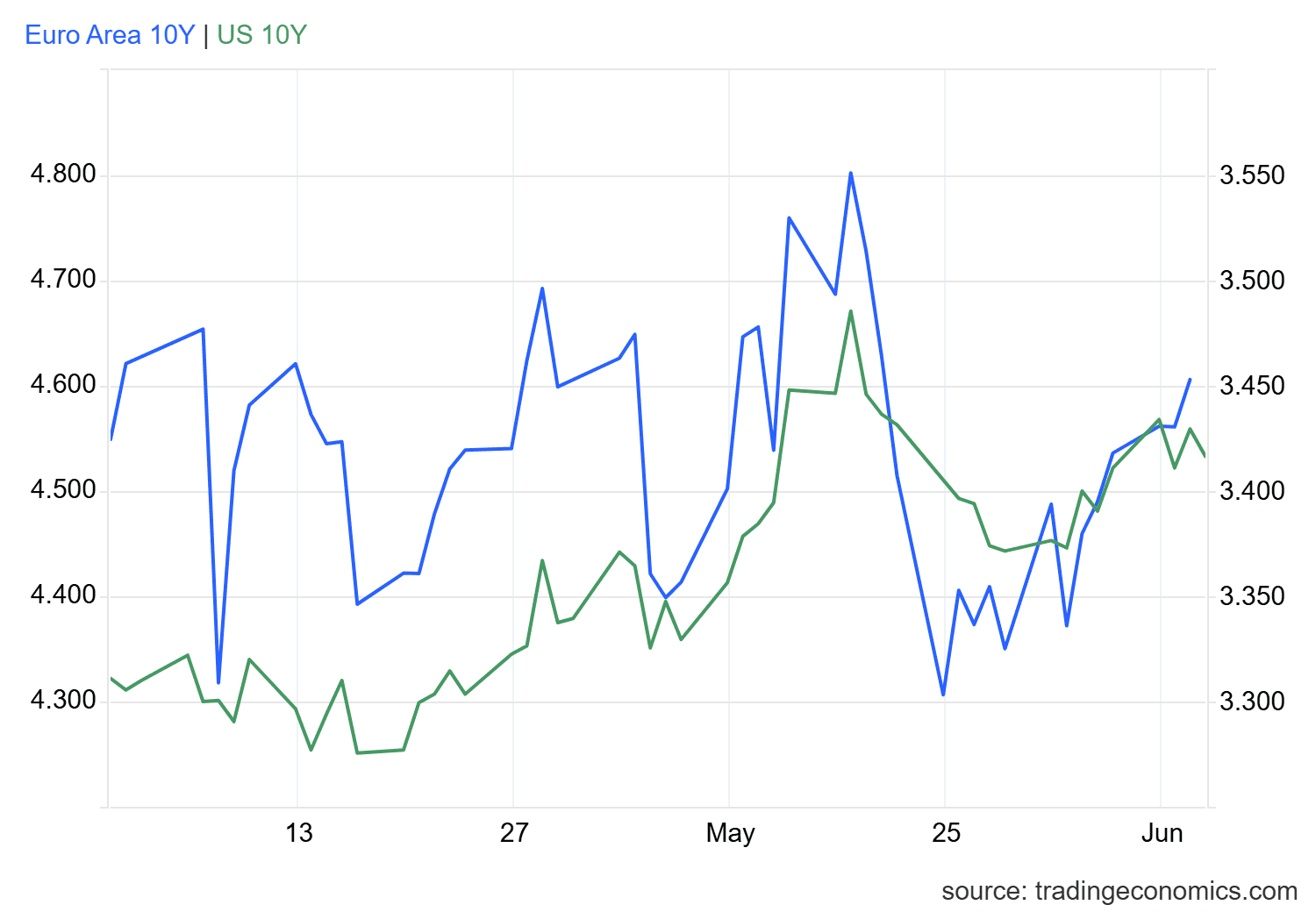
Looking at European 10-year bond yields compared with US 10-year Treasury yields, the move in European yields was limited after the ECB decision, rising only +0.6% and remaining below the 3.5% area. This suggests that the decision may have already been priced in by the market. Meanwhile, although US yields have pulled back slightly in recent sessions, they remain above 4.5%, still holding a meaningful advantage over European yields. This gap may continue to support the perception that dollar-denominated investments are more attractive than euro-denominated ones.
Source: TradingEconomics
Overall, the rate hike was not accompanied by a clear signal that this will become the ECB’s new path for future decisions. The lack of stronger guidance on higher rates may not have been enough to restore short-term demand for the euro. As long as dollar-denominated assets continue to look more attractive, the euro may struggle to recover consistently, keeping selling pressure relevant in EUR/USD over the coming sessions.
Technical outlook for EUR/USD
Source: StoneX, Tradingview
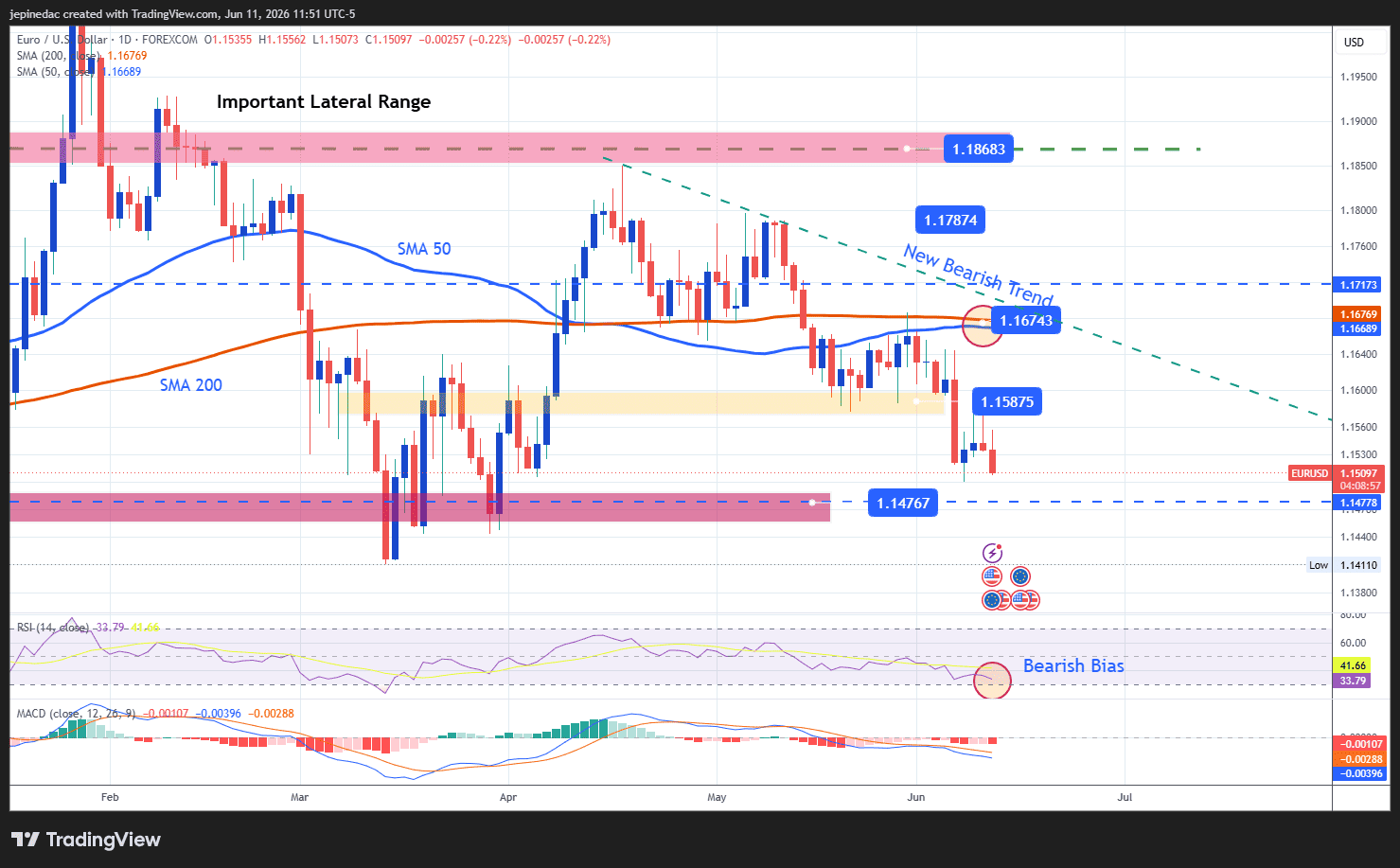
- A possible bearish trendline becomes relevant again: Since the second half of April, bearish movements in EUR/USD have been trying to form a possible short-term bearish trendline inside a wider sideways range that has remained important over the past few months. What matters now is that selling pressure is once again approaching key downside barriers on the chart. If this pressure holds over the coming sessions, the possible short-term bearish trendline could gain more relevance over the next few weeks.
- RSI: At the moment, RSI continues to move consistently below the neutral 50 level, suggesting that the average bearish momentum over the last 14 sessions remains relevant. If this behavior continues, a selling bias could keep dominating price action on the chart.
- MACD: A similar picture can be seen in MACD, as the histogram remains below the neutral 0 area. This shows that the average strength of short-term moving averages remains in bearish territory and also highlights the importance of a possible selling bias over the coming sessions.
Key levels:
- 1.16743 – Relevant resistance: Important upside barrier that coincides with the possible bearish trendline and the 50- and 200-period moving averages. Price action returning to this level could put the current bearish structure at risk and open the door to a dominant buying bias over the next few weeks.
- 1.15875 – Near-term barrier: Recent neutral and pullback level that matches an important area from the past few weeks. This point could act as a key barrier if the pair starts to form bullish corrections over the coming sessions.
- 1.14767 – Definitive support: Level located below the moving averages and aligned with the support of the broad sideways range that has dominated recent months. This is the most important downside barrier on the chart. Sustained moves below this level would reinforce the importance of a dominant selling bias and could open the door to a stronger bearish trendline in the short term.
Written by Julian Pineda, CFA, CMT – Market Analyst
Follow him on: @julianpineda25

Open an account today
Experience award-winning platforms with fast and secure execution.
Economic calendar
Web Trader platform
Our sophisticated web-based platform is packed with features.
Related articles

How FX Majors Stack Up Against US Dollar Weakness in December
December has historically favoured a weaker US dollar. We compare the seasonal performance and timing of the major currency pairs.


USD/JPY Weekly Outlook: Fed Hikes, AI Volatility and a Sleeping Yen
USD/JPY is tracking the direction of US rates without responding with its usual magnitude. Can Jensen Huang and the payrolls lottery wake the pair from its slumber?

USD/MXN Forecast: Mexican Peso Weakness Persists as Year-End Approaches
These continue to be challenging sessions for the Mexican peso. The currency has remained under pressure in recent weeks, a trend clearly reflected in USD/MXN, which has now posted seven consecutive bullish sessions, gaining more than 7.0% over that period.
From time to time, StoneX Financial Pty Ltd (“we”, “our”) website may contain links to other sites and/or resources provided by third parties. These links and/or resources are provided for your information only and we have no control over the contents of those materials, and in no way endorse their content. Any analysis, opinion, commentary or research-based material on our website is for information and educational purposes only and is not, in any circumstances, intended to be an offer, recommendation or solicitation to buy or sell. You should always seek independent advice as to your suitability to speculate in any related markets and your ability to assume the associated risks, if you are at all unsure. No representation or warranty is made, express or implied, that the materials on our website are complete or accurate. We are not under any obligation to update any such material.
As such, we (and/or our associated companies) will not be responsible or liable for any loss or damage incurred by you or any third party arising out of, or in connection with, any use of the information on our website (other than with regards to any duty or liability that we are unable to limit or exclude by law or under the applicable regulatory system) and any such liability is hereby expressly disclaimed.