



EURUSD Coiled Like a Spring as Italian Political Situation Reaches Code Red
The political situation in Italy is reaching code red; EUR/USD poised for a big move
Share this:

While Brexit developments out of the UK are grabbing most of today’s headlines, the political situation in Italy is also reaching “code red.”
Political leaders are meeting today in a last-ditch effort to form a Parliamentary majority, with the historical rival Democratic party and Five Star Movement seeking to work together. The latest sticking point is around which party will control key cabinet positions. If the two sides are unable to come to terms, an early election will be called, with Matteo Salvini’s rightest League the heavy favorite (for once, your humble author appreciates the simplicity of the two-party system in the US!).
For now, traders are taking an optimistic view to the proceedings. The 10-year Italian BTP yield has fallen sharply to hit 1%, a record low. More to the point, the 10-year spread between Italy and safe haven Germany’s bonds has dropped 173bps, the tightest level in 15 months; put simply, bond traders are feeling for more confident in Italy’s outlook than they have any point in over a year. As of writing, Italy’s FTSE MIB index is trading down about 0.5%, though that’s outperforming regional rivals like Germany’s DAX and France’s CAC 40 on the day.
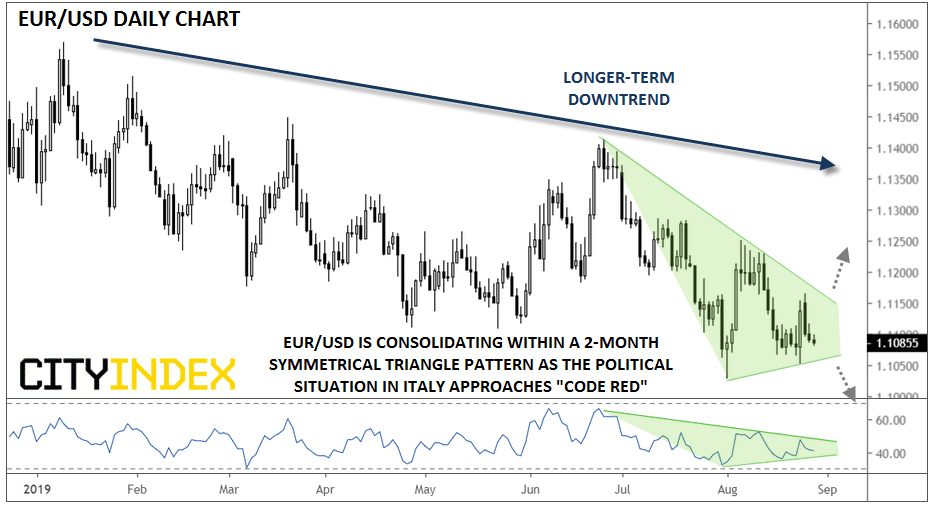
When it comes to FX, the impact has been relatively limited so far. The euro is trading near the middle of the major currency pack on the day, and the single currency is essentially flat against the greenback. Taking a step back, EUR/USD has been consolidating within a symmetrical triangle pattern for the last two months. For the uninitiated, this pattern is analogous to a person compressing a coiled spring: as the range continues to contract, energy builds up within the spring. When one of the pressure points is eventually removed, the spring will explode in that direction.
Source: TradingView, City Index
While it’s notoriously difficult to predict the direction of a symmetrical triangle breakout in advance, analysts will typically defer to the dominant trend heading into the formation, which in this case was clearly to the downside. In the case of a bearish breakdown (perhaps on the back of failed coalition discussions and a return of political uncertainty), EUR/USD could quickly drop to a new 2-year low below 1.1000. Of course, an upside breakout is certainly in play, in which case the rates could rally to retest the August highs near 1.1250 or beyond.
As we move into September, monetary policy will take center stage, with key central bank meetings from both the European Central Bank and Federal Reserve around the middle of the month. The relative amounts of easing (interest rate cuts and likely quantitative easing in the case of the ECB) will determine the longer-term outlook for the world’s most widely-traded currency pair.
While Brexit developments out of the UK are grabbing most of today’s headlines, the political situation in Italy is also reaching “code red.”
Political leaders are meeting today in a last-ditch effort to form a Parliamentary majority, with the historical rival Democratic party and Five Star Movement seeking to work together. The latest sticking point is around which party will control key cabinet positions. If the two sides are unable to come to terms, an early election will be called, with Matteo Salvini’s rightest League the heavy favorite (for once, your humble author appreciates the simplicity of the two-party system in the US!).
For now, traders are taking an optimistic view to the proceedings. The 10-year Italian BTP yield has fallen sharply to hit 1%, a record low. More to the point, the 10-year spread between Italy and safe haven Germany’s bonds has dropped 173bps, the tightest level in 15 months; put simply, bond traders are feeling for more confident in Italy’s outlook than they have any point in over a year. As of writing, Italy’s FTSE MIB index is trading down about 0.5%, though that’s outperforming regional rivals like Germany’s DAX and France’s CAC 40 on the day.
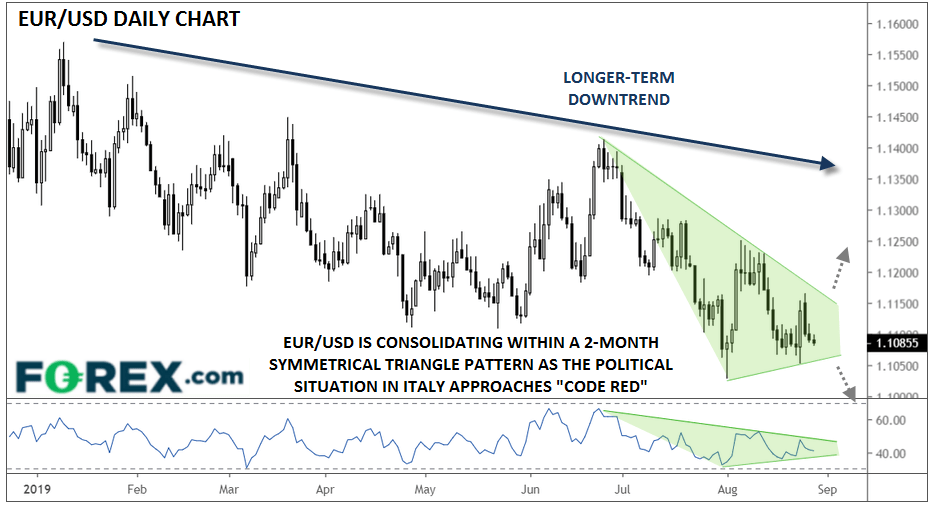
When it comes to FX, the impact has been relatively limited so far. The euro is trading near the middle of the major currency pack on the day, and the single currency is essentially flat against the greenback. Taking a step back, EUR/USD has been consolidating within a symmetrical triangle pattern for the last two months. For the uninitiated, this pattern is analogous to a person compressing a coiled spring: as the range continues to contract, energy builds up within the spring. When one of the pressure points is eventually removed, the spring will explode in that direction.
Source: TradingView, FOREX.com
While it’s notoriously difficult to predict the direction of a symmetrical triangle breakout in advance, analysts will typically defer to the dominant trend heading into the formation, which in this case was clearly to the downside. In the case of a bearish breakdown (perhaps on the back of failed coalition discussions and a return of political uncertainty), EUR/USD could quickly drop to a new 2-year low below 1.1000. Of course, an upside breakout is certainly in play, in which case the rates could rally to retest the August highs near 1.1250 or beyond.
As we move into September, monetary policy will take center stage, with key central bank meetings from both the European Central Bank and Federal Reserve around the middle of the month. The relative amounts of easing (interest rate cuts and likely quantitative easing in the case of the ECB) will determine the longer-term outlook for the world’s most widely-traded currency pair.

Open an account today
Experience award-winning platforms with fast and secure execution.
Economic calendar
Web Trader platform
Our sophisticated web-based platform is packed with features.
Related articles

How FX Majors Stack Up Against US Dollar Weakness in December
December has historically favoured a weaker US dollar. We compare the seasonal performance and timing of the major currency pairs.


USD/JPY Weekly Outlook: Fed Hikes, AI Volatility and a Sleeping Yen
USD/JPY is tracking the direction of US rates without responding with its usual magnitude. Can Jensen Huang and the payrolls lottery wake the pair from its slumber?

USD/MXN Forecast: Mexican Peso Weakness Persists as Year-End Approaches
These continue to be challenging sessions for the Mexican peso. The currency has remained under pressure in recent weeks, a trend clearly reflected in USD/MXN, which has now posted seven consecutive bullish sessions, gaining more than 7.0% over that period.

From time to time, StoneX Financial Pty Ltd (“we”, “our”) website may contain links to other sites and/or resources provided by third parties. These links and/or resources are provided for your information only and we have no control over the contents of those materials, and in no way endorse their content. Any analysis, opinion, commentary or research-based material on our website is for information and educational purposes only and is not, in any circumstances, intended to be an offer, recommendation or solicitation to buy or sell. You should always seek independent advice as to your suitability to speculate in any related markets and your ability to assume the associated risks, if you are at all unsure. No representation or warranty is made, express or implied, that the materials on our website are complete or accurate. We are not under any obligation to update any such material.
As such, we (and/or our associated companies) will not be responsible or liable for any loss or damage incurred by you or any third party arising out of, or in connection with, any use of the information on our website (other than with regards to any duty or liability that we are unable to limit or exclude by law or under the applicable regulatory system) and any such liability is hereby expressly disclaimed.