


EUR/USD Forecast: The Euro Fails to Recover Despite U.S. Political Uncertainty
The EUR/USD has posted two consecutive losing sessions, with a short-term decline of nearly 0.6% in favor of the U.S. dollar. For now, the pair shows a neutral bias, mainly due to political uncertainty in the U.S., which has pushed the market into a sideways pattern and prevented the formation of consistent directional moves.
Share this:
The EUR/USD has posted two consecutive losing sessions, with a short-term decline of nearly 0.6% in favor of the U.S. dollar. For now, the pair shows a neutral bias, mainly due to political uncertainty in the U.S., which has pushed the market into a sideways pattern and prevented the formation of consistent directional moves. As long as this situation persists, neutrality could continue to dominate in the coming trading sessions.


What’s Happening in the U.S.?
The government shutdown has entered its second day, and there is still no clarity on how it will be resolved or how long it might last. Non-essential government activities have been suspended, leaving hundreds of thousands of federal employees without pay or work, and so far neither the Executive nor the Senate has given clear signs that the situation will be resolved this week.
This event reflects a deterioration in political confidence and poses an institutional risk regarding government functionality. If prolonged, it could cause billions in losses to U.S. GDP due to the paralysis of key economic agencies. Although the impact has not yet been strongly reflected in the dollar, a longer shutdown—like the last one, which lasted more than a month—could significantly erode confidence in the currency.
Another point to consider is that among the agencies affected by the shutdown are those responsible for releasing employment data, meaning tomorrow’s scheduled Non-Farm Payrolls report could be delayed. Without such key economic indicators, the Federal Reserve would have fewer tools for decision-making, reinforcing expectations that there could still be two more rate cuts before the end of the year. Lower rates reduce the appeal of dollar-denominated assets and could, in the medium term, weaken the currency as an indirect consequence of the shutdown.
In conclusion, while the dollar has not yet shown a sharp decline in the face of political risk, if the shutdown continues for several weeks, it would heighten distrust in the greenback—both due to institutional instability and the lack of economic data. In that case, the euro could benefit from more consistent buying pressure in the short term.
What Does the European Central Bank Think?
There were also important ECB updates this week. President Christine Lagarde stated that inflation risks in the eurozone are under control and highlighted that the eurozone economy has held up well despite U.S. tariffs. However, she also noted that the central bank would likely maintain a neutral stance in upcoming decisions to prevent inflation from rising again.
Recent data shows that annual inflation for September rose to 2.2%, up from 2.0% in August, confirming that prices have started to climb again.
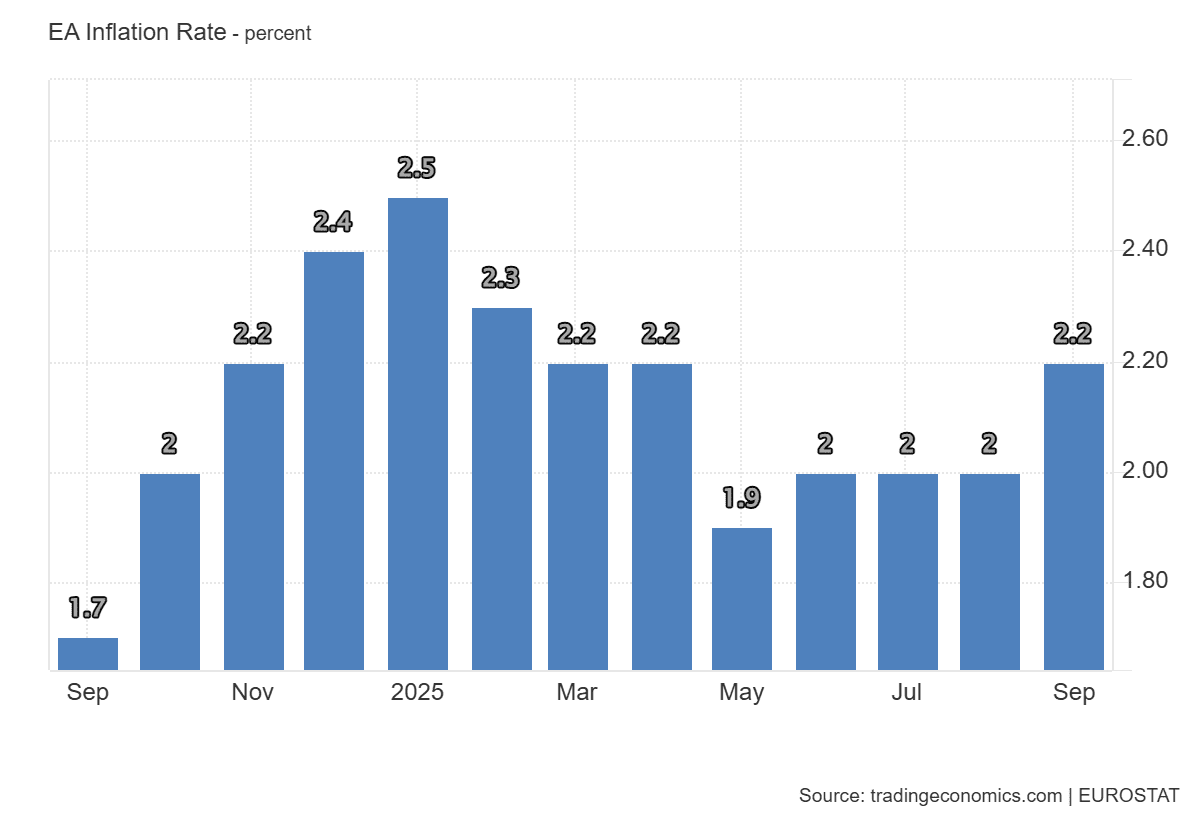
Source: TradingEconomics
Following these remarks, the ECB Watch tool now shows a 98.2% probability that the current 2.00% deposit rate will remain unchanged at the October 28 meeting. This is in line with the ECB’s rhetoric of prioritizing stability without resorting to rate cuts.
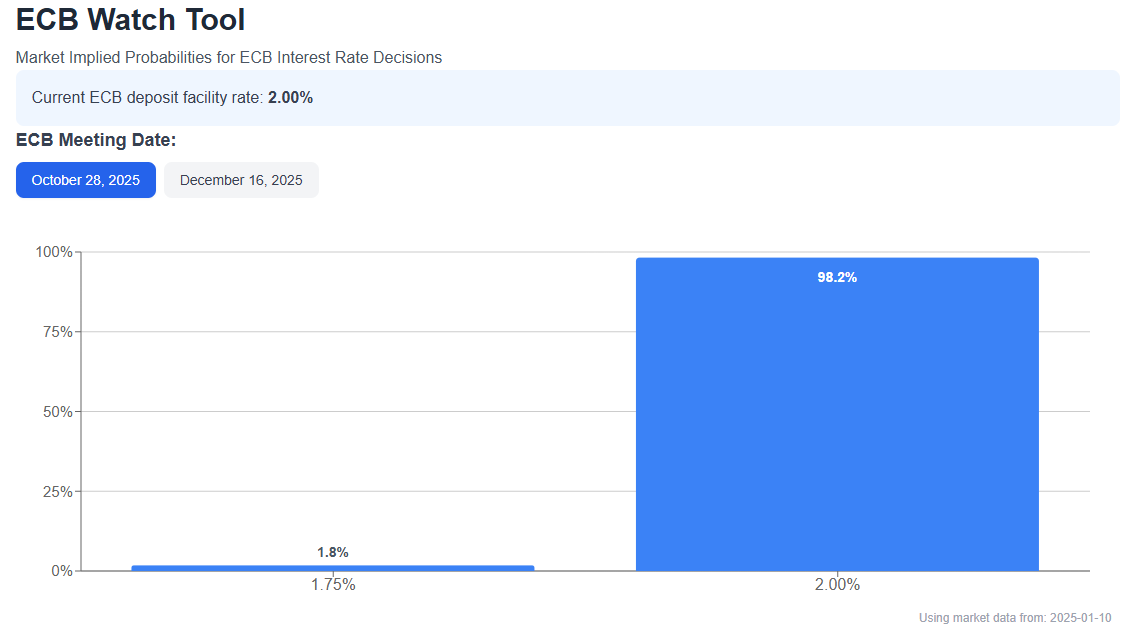
Source: ECBWATCH
In this context, it appears the ECB will remain neutral through the rest of the year. This stance contrasts with the more accommodative policy the Fed may adopt, which would reduce the interest rate differential between the two regions. Over time, this dynamic could make dollar investments less attractive while generating buying pressure on the euro, potentially paving the way for a relevant bullish bias in EUR/USD in the coming weeks.
EUR/USD Technical Outlook
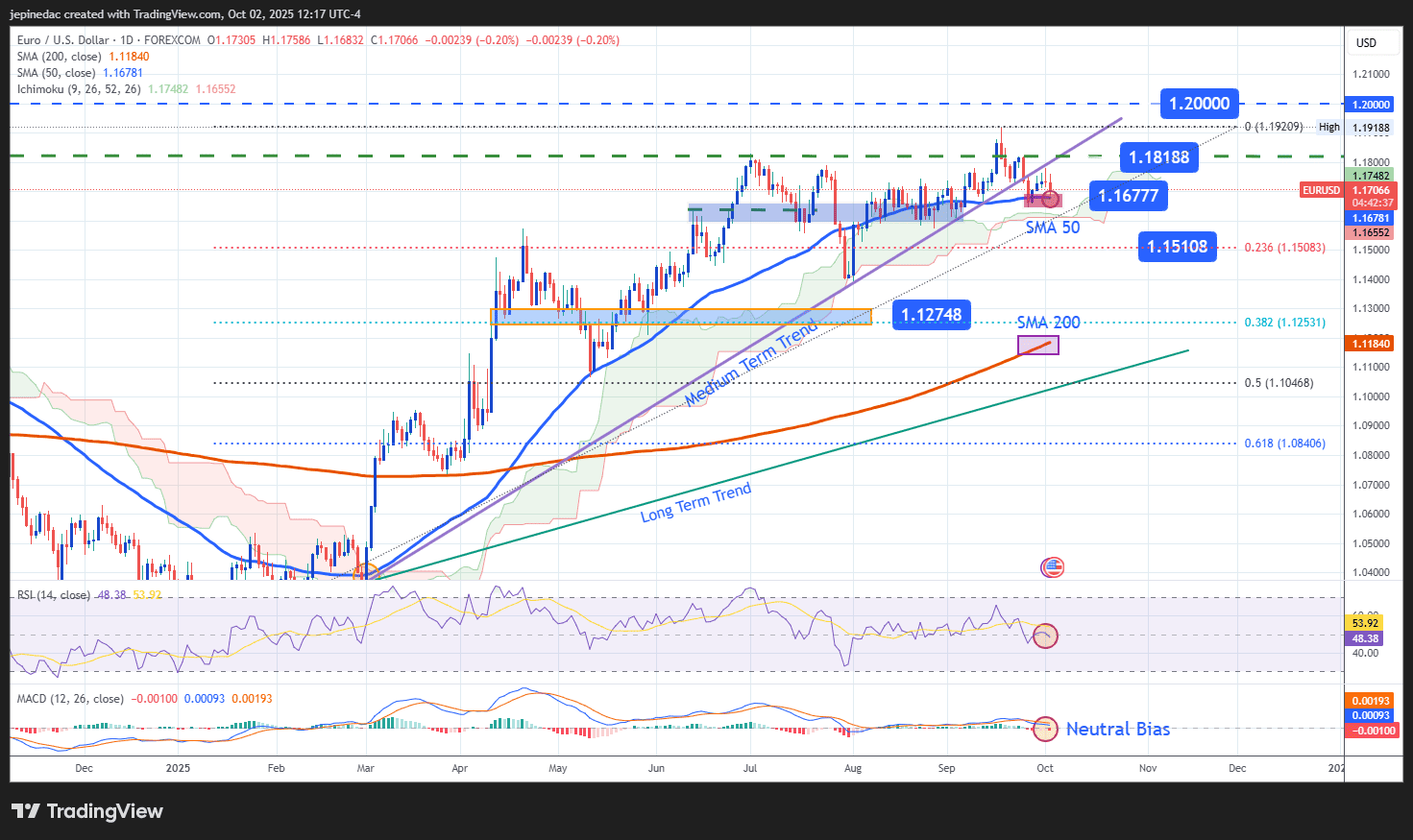
Source: StoneX, Tradingview
- Bearish momentum emerges: Since September 17, EUR/USD has been setting progressively lower lows, reinforcing a short-term bearish bias. However, the emergence of indecision candles around key support levels casts doubt on the strength of this move, which is not yet enough to establish a solid downtrend. Unless selling pressure breaks through key barriers, a neutral scenario could prevail in the short term.
- RSI: The RSI line has crossed below the 50 neutral level and continues to oscillate beneath it in recent sessions, signaling that bearish momentum has taken hold over the average of the last 14 sessions. As long as this downward slope persists, selling pressure could become more relevant in the coming days.
- MACD: The MACD shows a somewhat different picture. While the histogram continues to oscillate below the zero line, it remains close to neutrality, reflecting indecision in short-term moving averages. Unless the histogram pushes further into negative territory, this could indicate the formation of a neutral consolidation around the current EUR/USD support zone.
Key Levels:
- 1.16777 – Current Barrier: Corresponds to the zone marked by the 50-period simple moving average and is also near the Ichimoku cloud, making it the most important bearish barrier to watch. A sustained break below could mark a true reversal of the previous bullish trend and open the door to a new bearish phase.
- 1.18188 – Nearby Resistance: A zone of recent weekly highs where price has repeatedly retreated. As long as price action struggles to break this level, the pair could consolidate into a short-term sideways range.
- 1.20000 – Major Resistance: A key psychological level. A clean breakout above could trigger a more aggressive rally and reactivate the long-term bullish trendline that was broken in previous sessions.
Written by Julian Pineda, CFA – Market Analyst
Follow him: @julianpineda25
Related tags:


Open an account today
Experience award-winning platforms with fast and secure execution.
Economic calendar
Web Trader platform
Our sophisticated web-based platform is packed with features.
Related articles

US dollar outlook: Fed hike priced | FOREX Friday
A December Fed rate hike looks fully priced in, as the dollar stays below this week's highs despite strong US data, while gold, silver and the EUR/USD rebound. Fawad Razaqzada explains why next week's jobs report is the main event, and the Dollar Index levels to watch.


EUR/USD Recovers as Markets Fully Price in Fed Hike
EUR/USD outlook turns on Fed pricing, as the euro recovers while strong U.S. data fails to lift a dollar that has already priced in Fed tightening.

How FX Majors Stack Up Against US Dollar Weakness in December
December has historically favoured a weaker US dollar. We compare the seasonal performance and timing of the major currency pairs.

From time to time, StoneX Financial Pty Ltd (“we”, “our”) website may contain links to other sites and/or resources provided by third parties. These links and/or resources are provided for your information only and we have no control over the contents of those materials, and in no way endorse their content. Any analysis, opinion, commentary or research-based material on our website is for information and educational purposes only and is not, in any circumstances, intended to be an offer, recommendation or solicitation to buy or sell. You should always seek independent advice as to your suitability to speculate in any related markets and your ability to assume the associated risks, if you are at all unsure. No representation or warranty is made, express or implied, that the materials on our website are complete or accurate. We are not under any obligation to update any such material.
As such, we (and/or our associated companies) will not be responsible or liable for any loss or damage incurred by you or any third party arising out of, or in connection with, any use of the information on our website (other than with regards to any duty or liability that we are unable to limit or exclude by law or under the applicable regulatory system) and any such liability is hereby expressly disclaimed.