
The US dollar managed to rebound slightly amid the lack of any major news, with traders seemingly happy to book profit on their short dollar positions ahead of a data-packed next week. President Trump appointed Stephen Miran – a known dove – as an interim seat at the Fed, but this failed to weigh further on the dollar, at least for now. As a result, the GBP/USD eased back a tiny bit after Thursday’s rally when the Bank of England took a more hawkish turn. Threadneedle Street voted narrowly for a 25 basis point cut, with concerns over inflation keeping the split tight. Following that hawkish cut, the GBP/USD forecast will be in focus again in the week ahead with key data from both sides of the pond to come. Today, however, both the UK and US calendars are quiet, which should keep the cable largely in a holding pattern with the downside risks likely to be limited as sentiment towards the US dollar remains slightly negative.
US inflation in focus next week: CPI and PPI and UoM Inflation Expectations
In the week ahead, the GBP/USD forecast will be put to the test again, with key employment and growth data from the UK to come. Meanwhile, the US dollar will remain in focus with the release of inflation and retail sales data.
CPI will be released on Tuesday, followed by PPI data on Thursday before attention turns to the UoM Inflation Expectations survey on Friday, when we will also have the UoM Consumer Sentiment, the latest retail sales, Empire State Manufacturing Index and industrial production data.
Last week, it was the very soft jobs data which raised speculation that the Fed has little choice but to cut interest rates in September and follow that up with another one in October, with December meeting being a coin flip. Also applying pressure on the dollar has been the latest ISM services and manufacturing PMIs as well as jobless claims data. Accordingly, several Fed officials have talked up the prospects of more rate cuts this year, starting in September, despite lingering concerns about inflation.
As well as maximum employment, the Fed’s other mandate is to keep prices stable around the 2% long-term target. With investor concerns rising about inflation in the coming months, thanks to Trump’s tariffs raising import costs, let’s see if companies have started to pass on the higher costs onto consumer. Until now, this hasn’t been the case with CPI coming in below forecasts in the last 5 months. But has that changed?
It is also worth keeping an eye on the PPI data given that this feeds directly into the Fed’s favourite inflation gauge, the core PCE index, which will be released later this month. The UoM inflation expectations survey could also grab some attention on Friday, though the larger focus then will likely be on retail sales data. Any surprisingly weak consumer data, combined with stronger inflation data would give rise to stagflation concerns.
UK GDP among key UK data highlights for GBP/USD forecast
There will be a UK data dump on Thursday when we will have Q2 GDP as well as monthly data on construction output, manufacturing production and a few other indicators to look forward to. Ahead of it, wages and jobs data will be released on Tuesday. Following the surprisingly hawkish Bank of England rate cut this week, the MPC doves will be wanted to see evidence of an economic slowdown, otherwise the odds of a further rate cut this year will continue to tumble.
On Thursday, markets were caught off guard by the Bank of England’s unexpectedly divided vote on its interest rate decision. While a 25 basis point cut had been fully priced in by investors, the reality was that the decision came down to a narrow margin. The Bank Rate has now been lowered to 4%, but the overall tone of the announcement was anything but dovish. This was a textbook example of a “hawkish cut,” and the BoE’s cautious messaging has provided a boost for sterling bulls.
For GBP/USD forecast, this policy shift could be a turning point. The pair has broken through the key resistance level at 1.3370, and with rate differentials now likely to favour the pound—especially amid signs of a weakening U.S. economy, as reflected in recent ISM and employment data—further gains may be on the horizon.
Interestingly, the BoE appears relatively unbothered by signs of labour market cooling. Payroll numbers have edged lower, but the decline has been slow and steady. More importantly, wage growth and services inflation remain elevated—both around the 5% mark—which continues to justify a hawkish stance.
Unless there’s a substantial easing in wage or services inflation, the Bank is likely to maintain its cautious tone, even if further cuts are delivered.
Technical GBP/USD forecast: Cable turning bullish
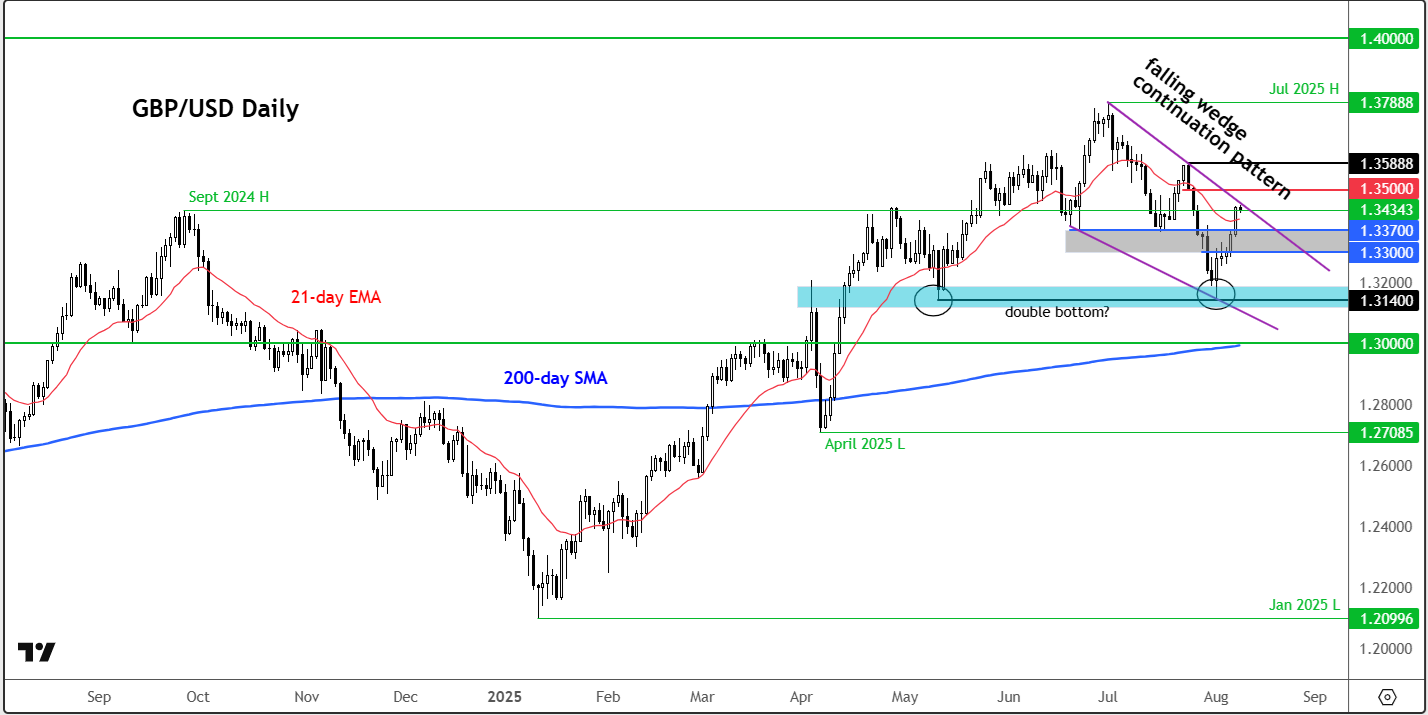
The BoE’s hawkish tone has tilted the GBP/USD forecast in a more bullish direction. With the US Federal Reserve expected to cut in September while the BoE adopts a more restrained approach, the rate differential could continue to support sterling.
From a technical perspective, the pair broke key resistance at 1.3370 on Thursday to deliver a clear hawkish signal. A double bottom formation around 1.3140 strengthens this outlook. A sustained break above the falling wedge resistance near the 1.3450–1.3500 zone would further validate the bullish bias. This area now serves as a critical resistance to monitor in the near term.
On the downside, short-term support is seen at 1.3370, followed by 1.3300. Key long-term support lies near 1.3000, aligning with the 200-day moving average.
-- Written by Fawad Razaqzada, Market Analyst
Follow Fawad on Twitter @Trader_F_R