
Gold has started the new week on the front-foot, although this comes on the back of a run of two consecutive weekly losses, making for a rather cautious outlook. Prices have lingered around the $4,000 mark in recent sessions, weighed down by a recovering dollar and a loss of prior momentum. The key question now is whether the market has already seen a peak—or if this two-week pullback is merely a pause before another leg higher. Much will depend on ongoing central bank demand and the direction of the US dollar. Still, this recent weakness was long overdue, so in many ways, it shouldn’t come as a surprise.
Gold’s fading momentum
In the past couple of weeks, bearish momentum in gold has become increasingly clear following its reversal from record, heavily overbought levels. Several key levels have been breached, most notably the psychological $4,000 barrier. The initial break below that level triggered a wave of technical selling and the unwinding of long positions. Yet, the subsequent recovery back above $4,000 – albeit without meaningful upside so far – is a mildly encouraging sign.
The real question is whether more downside is coming or if prices can now find a base around the $4K handle. The recent easing in US–China trade tensions is a negative factor for gold, while cooling inflation has given traders more reason to take profit. Adding to the headwinds, the Fed Chair’s comment that a December rate cut isn’t a foregone conclusion has dampened hopes of near-term policy easing. And with global equity indices recently setting fresh record highs, safe-haven demand for gold has naturally dimmed.
China’s gold demand cools—but remains resilient
Much of the strong central bank demand seen in Q3 was driven by heightened geopolitical tensions, elevated inflation, and global trade uncertainty, all of which boosted interest in safe-haven assets like gold. Several central banks, including the PBOC, have also been diversifying away from US dollar assets. However, persistently high prices this year may be limiting further large-scale purchases.
Indeed, recent data suggests some moderation in Chinese buying. Figures from Hong Kong showed that September’s net exports of gold to China dropped 17.6% month-on-month, hinting at softer demand from the People’s Bank of China. Yet, with imports still exceeding 22 tonnes, this likely reflects caution over elevated prices rather than a fundamental shift in policy. One month’s data hardly sets a trend, and with official PBOC numbers due soon, markets will get a clearer picture of China’s stance.
Can gold build a base at $4,000?

From a technical perspective, gold’s longer-term trend remains bullish. Despite the recent dip, calling a definitive top feels premature, especially since betting against the rally hasn’t paid off over the past year. If prices can stabilise above $4,000, that would reinforce the case that the long-term uptrend is still intact.
However, if gold fails to hold this level and slips decisively below it, then a short-term top may already be in place. That could open the door to further declines until prices become attractive again, or until sentiment shifts back towards risk aversion and safe-haven demand returns.
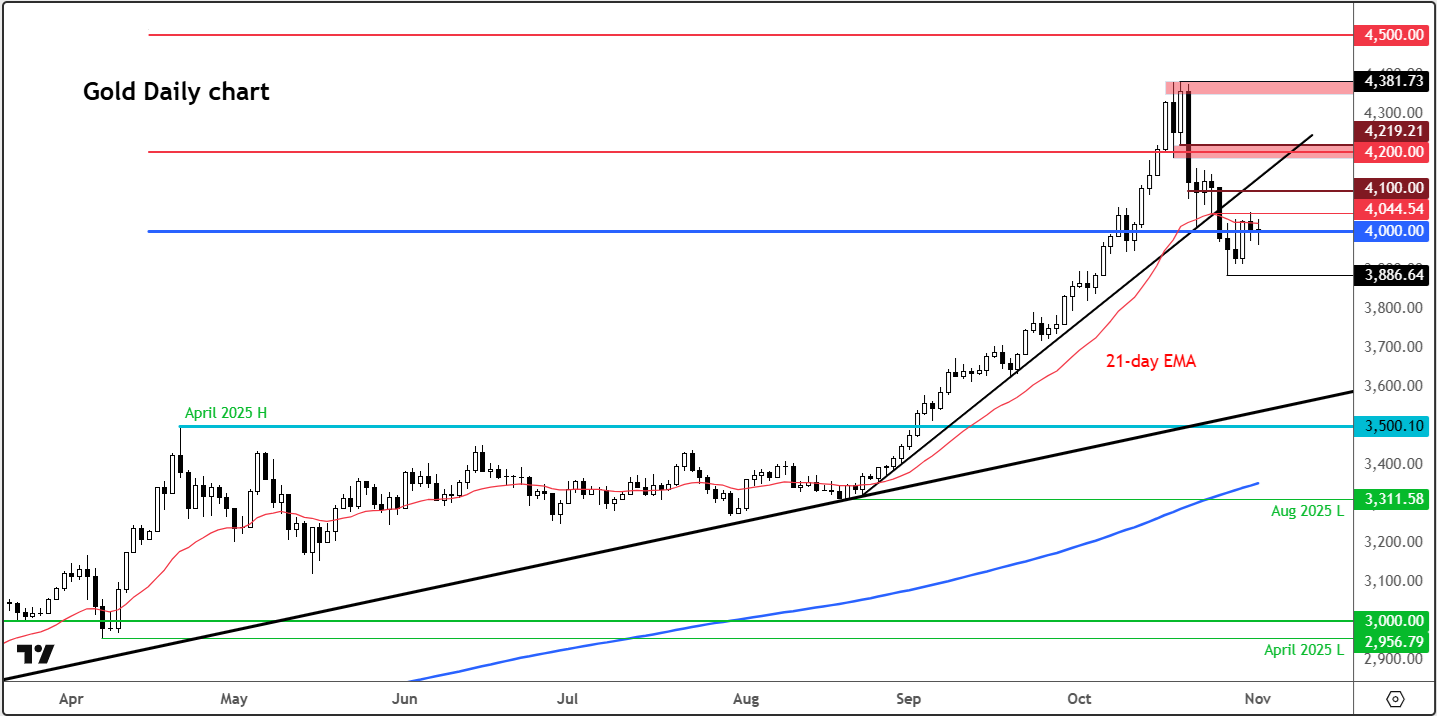
For now, short-term resistance stands around $4,045 on XAUUSD chart, followed by the underside of the broken trendline near $4,100. On the downside, initial support sits at $3,970, followed by last week’s low at $3,886. Below that, the next notable supports come in at the round numbers -- $3,800, $3,700, and ultimately the April high around $3,500, which now marks a key long-term floor.
-- Written by Fawad Razaqzada, Market Analyst
Follow Fawad on Twitter @Trader_F_R