
- Risks to crude oil forecast remains tilted to the upside as conflict enters third week with Strait of Hormuz the main focal point
- Gold tries to find a footing around $5K hurdle as equities bounce back and oil comes off highs
- Lots of central bank meetings this week – but will we hear anything significant?
Markets remain firmly on edge as the conflict in the Middle East continues, with oil prices keep on grinding higher. Though European equities and US futures firmed up a tad today as traders wondered whether there may be an end in sight in the conflict, sentiment remained cautious. Interestingly, US Treasury Secretary Scott Bessent told CNBC that the US is allowing Iranian oil tankers to transit the Strait of Hormuz “to supply the rest of the world.” But Iran can’t supply the whole world if it stops Gulf countries from exporting their oil though the Strait of Hormuz. For that reason, the risks to our crude oil forecast remains tilted to the upside. Gold’s outlook is muddled by conflicting forces as it probes key support around $5,000. Can it hold this key area of support this week?
What’s the latest from Middle East conflict?
US President Donald Trump said he had ordered a strike that wiped out every military target on Kharg Island—the key hub through which Iran exports almost all of its oil—though the island’s oil infrastructure was left intact, and the US is allowing Iranian oil tankers to move crude oil – for now. Trump also warned that NATO could face a very bleak future if US allies fail to help reopen the strategically vital Strait of Hormuz. He added that he expects China to assist in reopening the waterway ahead of his planned visit to Beijing. Meanwhile, reports suggest the administration may announce as early as this week a coalition to escort commercial shipping through the Strait of Hormuz, though officials are still debating whether such operations should begin before hostilities end or only once the situation stabilises. On the ground, the conflict continues to intensify, with Israel saying it has begun “limited and targeted” ground operations against the Iran-backed Hezbollah in southern Lebanon. Heavy bombing has been reported in Tehran, while Iran and Hezbollah have launched missiles towards Israel. Meanwhile, Saudi Arabia said it intercepted and shot down dozens of drones overnight, underscoring the growing regional dimension of the conflict and helping to keep risk sentiment firmly under pressure.
Can gold find renewed momentum amid oil volatility?
Gold began the week in much the same fashion as it ended the last one: under pressure. The precious metal slipped below the key $5,000 mark and extended the weakness that saw it lose nearly 3% last week. However, at the time of writing, gold was coming off its earlier lows to trade around this psychological hurdle again. With gold having fallen in the past three sessions, and down for the second week in a row, momentum has clearly been bearish for gold. Yet the latest drop hasn’t been as dramatic as the sharp sell-off seen towards the end of January. That suggests that perhaps traders are trying to buy the dip. For now, the metal appears to be caught between competing forces: heightened geopolitical tensions that normally support safe-haven assets, and a macro backdrop dominated by rising yields and a stronger dollar. A potential daily close below $5K would be a bearish development – but will haven flows prevent that this week?
Rising yields challenge gold’s resilience
The knock-on effects of the oil shock have been rippling through financial markets in the past couple of weeks. Higher energy prices have revived inflation concerns and pushed government bond yields upward as investors reassess the outlook for interest rates. Expectations for rate cuts have been pared back significantly, and the shift in policy expectations has strengthened the dollar further.
For gold, this creates a tricky backdrop. Rising yields are typically a headwind for non-yielding assets such as gold and silver. When interest rates climb, the opportunity cost of holding bullion increases, since the metal offers no income while still carrying storage costs.
Until recently, gold had managed to shrug off those headwinds with impressive resilience. However, over the past couple of weeks that relationship has broken down. Even with geopolitical tensions providing some safe-haven demand, macro forces have largely overshadowed that support.
Still, haven flows have prevented a more dramatic sell-off. The broader geopolitical backdrop continues to offer an underlying layer of support, helping to cushion the downside even as yields and the dollar move higher.
Technical gold forecast: A level-to-level market
From a technical standpoint, gold remains locked in a choppy consolidation phase. Volatility has increased, but price action is still largely defined by key levels rather than a clear directional trend.
Today’s move below the psychological $5,000 level is particularly noteworthy. That area had acted as support on multiple occasions in recent sessions, with buyers repeatedly stepping in to defend it. A decisive move below this level — especially if confirmed by daily closes beneath it — would represent a meaningful shift in the near-term technical picture. For now, though, it looks like traders are willing to defend that level.
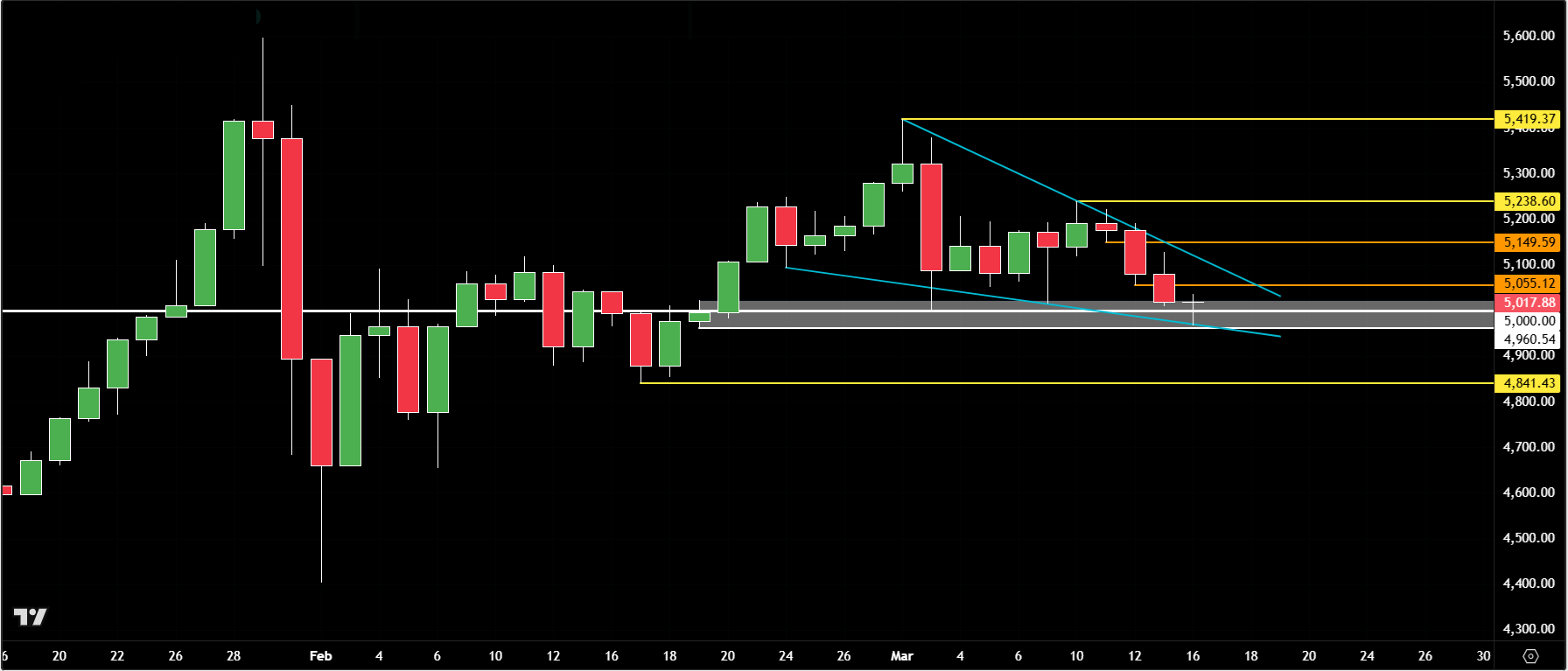
Should the decline continue, the next obvious support sits near $4,900 on XAUUSD. Beyond that, the focus would turn to $4,800, followed by a broader trendline region around $4,700.
On the upside, the broken $5,055 and $5,150 old support levels could act as a barrier. But if gold manages to climb out of what appears to be a falling wedge pattern, then that could re-ignited a more convincing recovery.
For now, however, the metal remains caught in powerful macro crosscurrents. If oil prices begin to stabilise and bond yields ease, gold could quickly regain upward momentum. At present, though, the balance of forces suggests that volatility — rather than a clear trend — is likely to dominate the near-term outlook.
Oil surge reshapes the market landscape
Much of the pressure on gold has come from the surge in energy prices. Crude oil has been the dominant driver across global markets, and today saw Brent extending its rally and pushing towards $105 a barrel after closing above $100 on Friday. The move higher comes as tensions in the Middle East intensify and tanker traffic through the Strait of Hormuz remains effectively halted. With oil prices on the ascendency, bond yields have pushed higher in recent days as traders scale back their previously dovish rate expectations, causing the US dollar to strengthen against currencies of energy-importing region. This has created a challenging environment for gold.
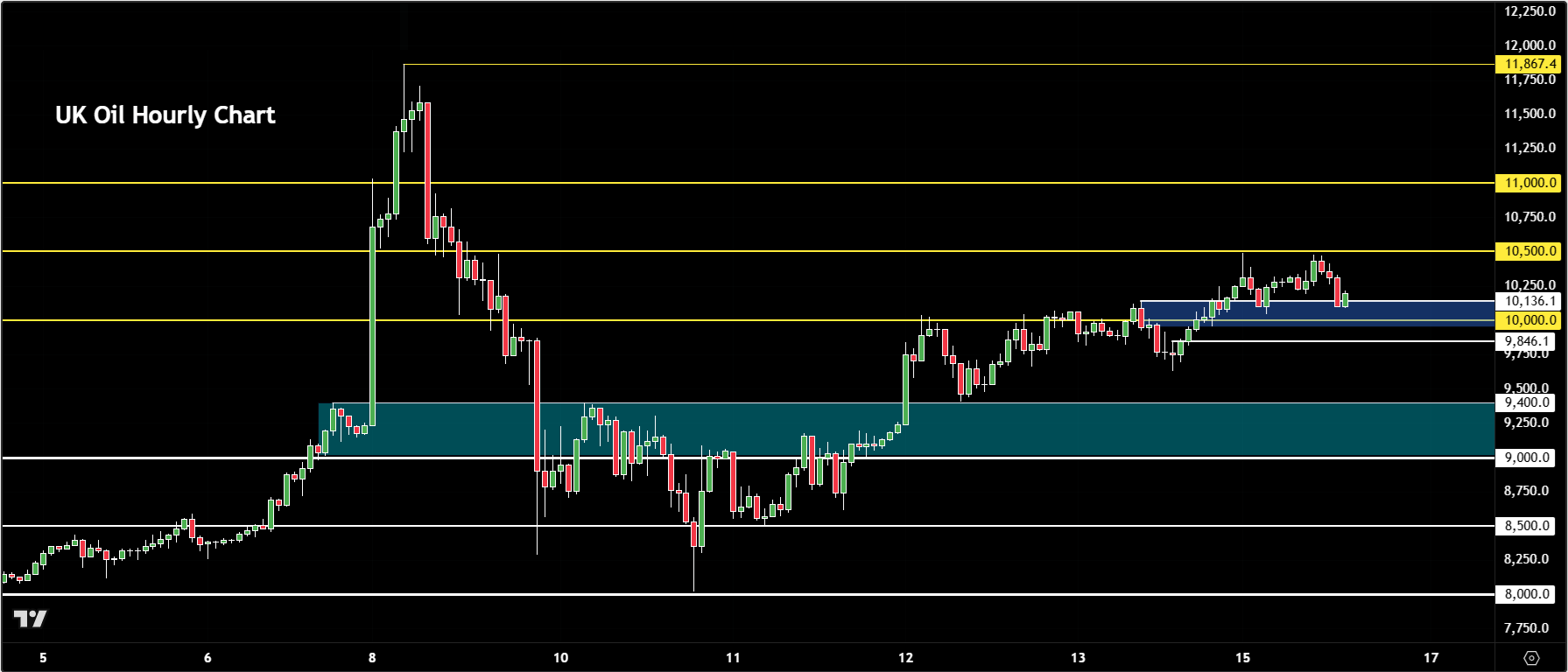
Oil prices did come off their earlier highs but remained supported. The volatility in energy markets is hardly surprising. Traders are still attempting to establish a fair value for crude under current geopolitical conditions. On the one hand, governments have responded with emergency reserve releases, while certain sanctions on Russian cargoes already at sea have been temporarily eased in an effort to stabilise supply.
Yet the scale of the disruption is difficult to ignore. The Strait of Hormuz is one of the world’s most critical energy chokepoints, normally carrying roughly 20% of global oil supply. Any prolonged interruption to tanker traffic immediately raises concerns about global energy availability, and those fears have driven oil prices sharply higher.
For as long as the higher highs and higher lows remain intact, we will maintain a bullish outlook on crude oil forecast.

-- Written by Fawad Razaqzada, Market Analyst
Follow Fawad on Twitter @Trader_F_R