
- Gold forecast starting to point to short-term correction
- Trade tensions and inflation uncertainty support safe-haven demand
- XAU/USD testing 2025 bullish trend line
After wrapping up a second consecutive weekly win, gold started this week with strength – but that proved short-lived as prices have since turned lower following the release of mixed inflation data. While the yellow metal hasn’t sold off significantly yet, there are increasing signs of a potential correction after it failed to reclaim the highs of earlier this year in the last couple of months. Still, the downside could be limited given renewed trade tensions, sparked by President Trump’s warning of potential 30% tariffs on the EU and Mexico. So, what’s driving the gold forecast and volatility right now? The US dollar. The greenback has stormed back to life, and this is putting some downward pressure on the XAU/USD and other dollar-denominated commodities.
More on that later, but first let’s talk technicals: gold is testing a major inflection point here…
Gold technical forecast: 2025 bullish trend line being tested
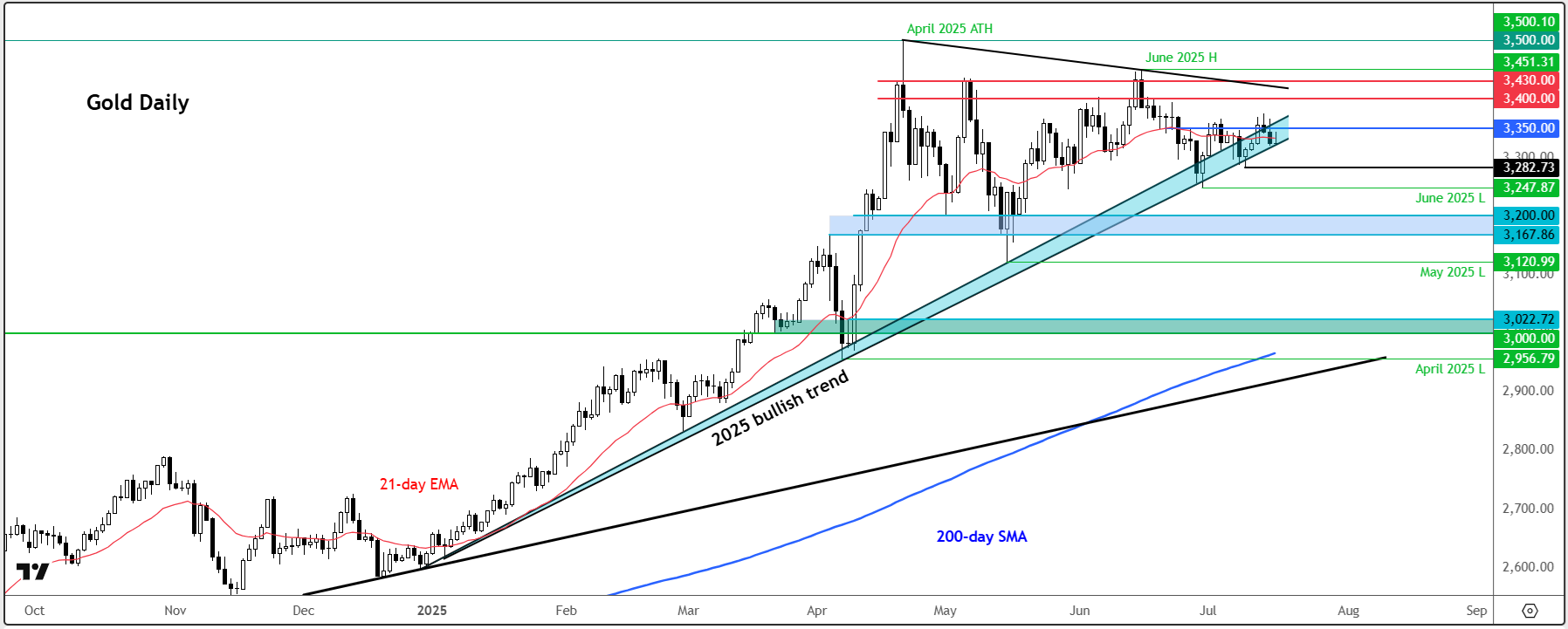
Technically, the long-term XAUUSD forecast remains constructive. But will the metal again respect its 2025 bullish trend line? A break of that trend line could unleash volatility.
Key support sits at $3,300-$3,320 area, which was being tested at the time of writing. A decisive drop below this area would be a bearish development.
On the upside, resistance is clustered around $3,350, $3,400 and $3,430. These levels need to get cleared, before the bulls can think about new highs again.
Tariff uncertainty means limited downside
Gold has now delivered gains in six of the past seven quarters, surging over 75% during that stretch. After briefly topping $3,500 in April, the metal entered a period of consolidation through Q2—perhaps a well-earned breather after its parabolic rise. But now, with the August 1 tariff deadline approaching and no major breakthroughs in trade talks, we’re back in familiar territory: risk-on markets wobbling a little, the dollar is finding support, and gold is stuck between these two forces.
If Trump follows through on his threats and trade tensions escalate, it’s not a stretch to imagine gold challenging—and potentially breaking—its record highs again. But in the near-term outlook, the strength of the US dollar could weigh on prices, causing it to dip into levels where dip-buyers will be interested in the metal once again. On the flip side, should we see meaningful trade agreements materialize, demand for gold could falter sharply. For now, the indecision is keeping gold’s volatility contained.
Longer-term gold forecast: Beware of rising dollar, yields
Looking out further, the gold forecast becomes more complicated. If tariffs kick in, inflation may accelerate. That could box the Fed into a corner—limiting its ability to cut rates. In turn, bond yields might climb even higher, weighing on both growth stocks and non-yielding assets like gold.
That’s assuming the US doesn’t suffer another credit rating downgrade—yet another wildcard in this story. It’s also worth noting that gold has been resilient, even as equity markets rebounded strongly from their spring lows. Were gold investors overpricing trade risks, or were stocks under-pricing them? Either way, the tug-of-war between optimism and caution remains a key feature of the second-half gold forecast.
As I have written in our H2 2025 gold forecast, the metal’s remarkable performance in the first half of 2025 is likely to transition into a phase of consolidation in the latter half of the year, as demand for safe-haven assets subsides. However, in the short-term, US trade dynamics and stock market volatility will continue to play a pivotal role in shaping gold forecast.
Meanwhile, the US dollar has shown signs of strength recently, buoyed by decent economic data and inflation concerns. Trump’s bold fiscal promises and tariff threats are stoking fears of more persistent inflation. While a rate cut in September could still be the case, sticky inflation could slow the pace of further easing. This matters because a stronger dollar could act as a headwind for gold.
-- Written by Fawad Razaqzada, Market Analyst
Follow Fawad on Twitter @Trader_F_R