

The week continues to unfold with a solid recovery in the gold market, as the metal has already gained more than 6.0% in the past two sessions. The renewed buying pressure reflects, in part, fresh tensions between the United States and Iran, which have supported a renewed demand for safe-haven assets. As risk sentiment regains relevance across markets, this buying pressure could remain a key driver for XAU/USD in the coming sessions.

Geopolitical tensions
Gold has seen a short-term increase in demand following a rise in geopolitical risk, driven by renewed tensions between the United States and Iran. The situation escalated after the U.S. shot down an Iranian drone that was reportedly perceived as a threat—an account later questioned by Iran—adding further uncertainty to an already fragile backdrop.
It is worth noting that both countries have experienced recent frictions, with a reinforced U.S. military presence in the region. While diplomatic talks remain ongoing, the conflict cannot be considered resolved, and a renewed escalation in the short term cannot be ruled out. This environment has been sufficient to revive the geopolitical risk premium and reinforce demand for defensive assets.
Within this context, gold has once again positioned itself as the ultimate safe-haven asset, benefiting not only from rising uncertainty but also from the potential covering of short positions held from previous sessions.
Historically, geopolitical events have acted as key catalysts for bullish moves in gold. In the current environment, markets remain alert to the possibility of a further escalation in the Middle East, which—if prolonged—could continue to support safe-haven flows and sustain buying pressure in XAU/USD.
Market confidence remains fragile
Beyond geopolitical tensions, market confidence indicators have also shown a consistent deterioration. The Fear and Greed Index currently stands near 43 points, slipping back into the “fear” zone, signaling a slowdown in overall market confidence.
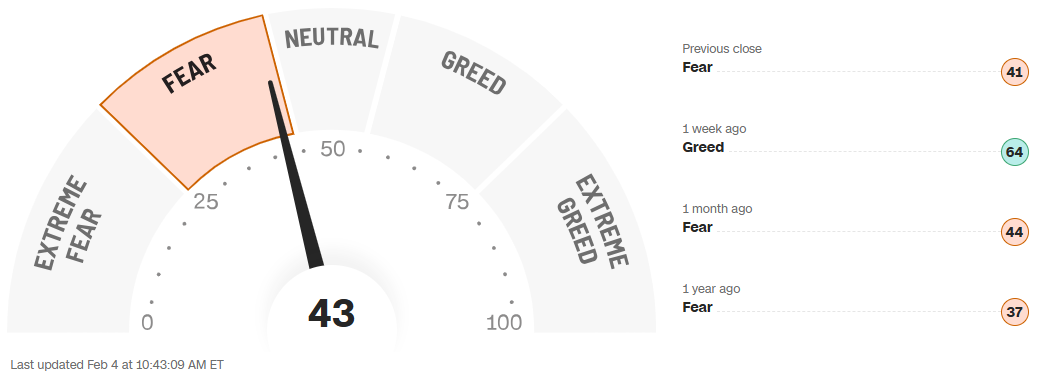
Source: CNN
This backdrop is particularly relevant, as gold tends to benefit when market confidence is not fully stable. As long as sentiment indicators fail to show a solid and sustained recovery, part of the market is likely to continue seeking defensive exposure, such as gold. As a result, this environment of persistent uncertainty could continue to support meaningful buying pressure in XAU/USD over the next few sessions.
Gold Technical Outlook
Source: StoneX, Tradingview
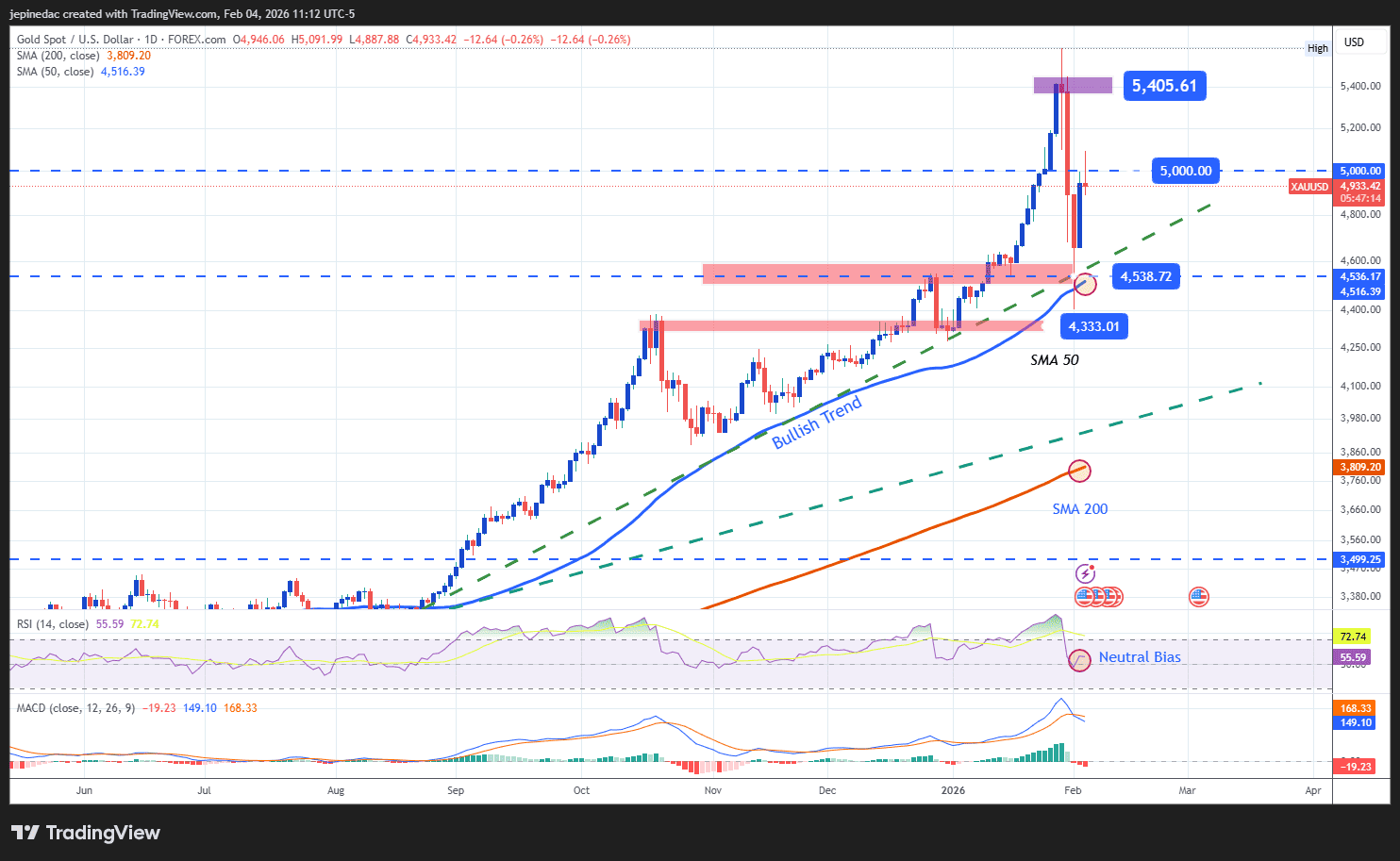
- Dominant bullish trend: Since late August of this year, gold has maintained a solid bullish trend, without experiencing downside corrections strong enough to threaten its technical structure. For now, this formation remains the dominant technical driver. However, rising volatility could lead to a phase of indecision, potentially giving way to a short-term sideways range as price searches for clearer direction.
- RSI: The RSI continues to hover near the 50 level, suggesting a balance between buying and selling forces. As long as the indicator remains in this zone, it may reinforce a short-term indecisive environment in gold prices.
- MACD: The MACD shows a similar setup, with the histogram hovering close to the zero line, indicating the absence of a dominant trend in short-term moving averages. This reinforces the view that market indecision is shaping recent gold price action.
Key levels to watch:
- $5,400 – Crucial resistance: A psychological level near record highs. A sustained move toward this zone could reactivate dominant buying pressure and allow the bullish trend to extend over the coming weeks.
- $5,000 – Nearby barrier: The main psychological resistance, which in recent sessions has generated a neutral price environment. As long as price fails to move decisively away from this area, a short-term sideways range could develop.
- $4,538 – Critical support: An area aligned with recent lows, the primary bullish trendline, and the 50-period simple moving average. A sustained break below this level would put the current bullish structure at risk and could open the door to a short-term bearish bias.
Written by Julian Pineda, CFA, CMT – Market Analyst
Follow him on: @julianpineda25