Gold closed the week flat after struggling for direction all week. On Friday, a strong US jobs report initially sent the metal lower, before dip buyers stepped in and later took profit ahead of the weekend. The US nonfarm payrolls report has thrown a bit of a curveball at the Federal Reserve after it easily beat expectations with a print of 254,000 jobs compared to the forecasted 140,000. The stronger data puts the Fed in a tough spot, as the narrative of a cooling economy got a lot more complicated. With the labour market still running strong, it’s no wonder Fed Chair Powell has already dismissed the idea of another 50-basis-point rate cut. Now, it’s all but certain: don’t expect any further aggressive rate cuts this year. The dollar surged on the back of this report, and gold, like other metals, saw an early dip. But as the dust settled, gold found its footing again and powered higher, riding the momentum alongside stock indices. Silver also saw a big move, nearly breaking the $33 barrier before easing off with gold by the close of play on Friday. But with geopolitical tensions simmering in the Middle East, the gold outlook is not completely bearish yet even if the metal remains severely overbought and the US dollar has just had one of its strongest weeks in months.

Gold outlook: what’s next for the Fed?
The Fed is now walking a tightrope. Inflation is still a concern, especially with crude oil rebounding sharply amid geopolitical concerns and China’s stimulus. Yet, they must be careful not to pump the brakes too hard on an economy that’s still showing resilience. The odds of a 50-basis-point rate cut are now off the table, and even if October’s jobs report shows some softening, it would take a significant slowdown to justify such an aggressive move.
So, what does this mean for the gold outlook? In the short term, gold’s price movements will likely continue to be reactive to the US dollar and Fed policy expectations. If the Fed stays cautious and maintains a steady course on rates, gold could come under some pressure in the week ahead. But with geopolitical risks adding uncertainty to the broader market, the potential downside could be limited.
Looking ahead: key data to watch
The week ahead brings some key data points that could shift the outlook further. The US CPI report, due Thursday, is expected to show inflation at 2.3% year-over-year, down from 2.5% in August. If inflation comes in softer than expected, it could add some dovish sentiment to the mix, giving gold another boost.
On Friday, the University of Michigan Consumer Sentiment data will offer insights into how consumers are feeling about the economy. With the Fed’s dual mandate of maximising employment and stabilising prices, sentiment indicators are increasingly important. A drop in consumer confidence could weigh on future economic activity, potentially influencing Fed policy and impacting gold.
Technical gold outlook: a bearish turn ahead?
 Source: TradingView.com
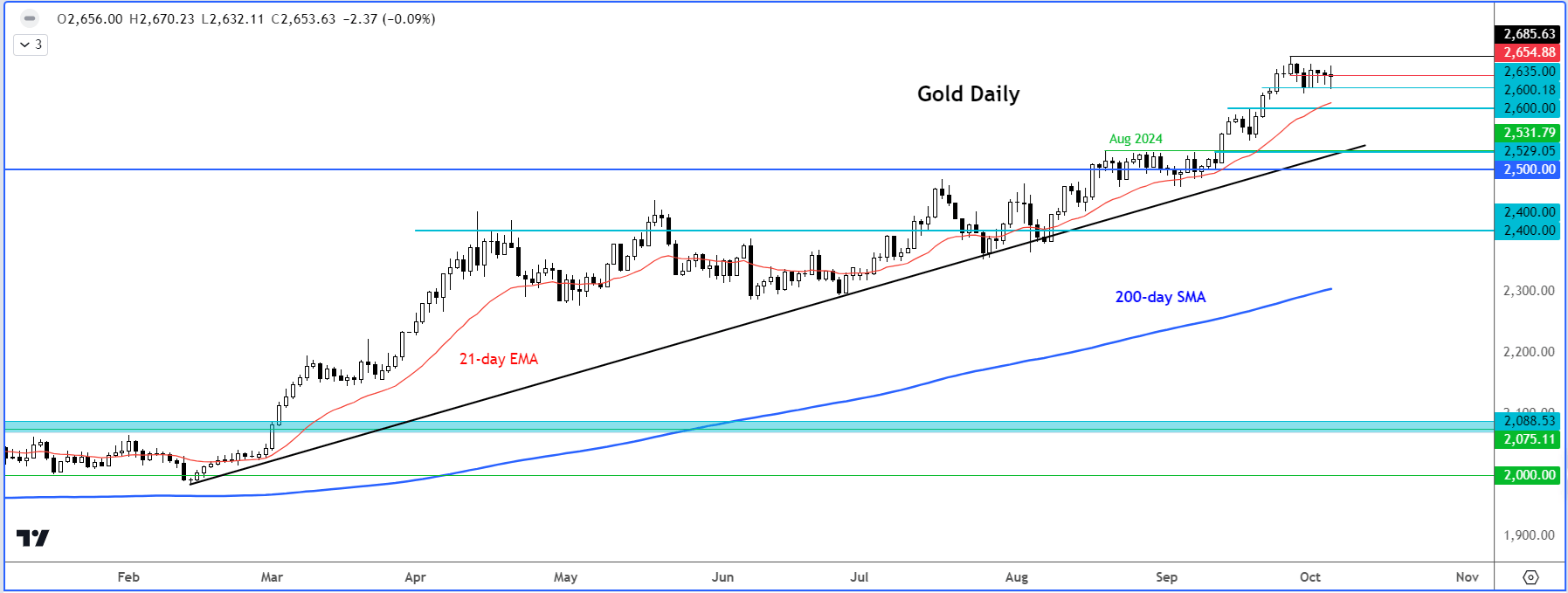
Gold has maintained a bullish technical outlook, but its price action this week might signal a shift as prices continue to remain at extreme overbought levels on higher time frames. We could be seeing the beginnings of a bearish reversal pattern on the gold chart, particularly if the dollar continues to strengthen. But before call the top, we need to see some confirmation that the rally has ended. Indeed, there are plenty of technical levels that could offer support on the dips. Among these, $2600 is a key short-term level to monitor closely in the event we break last week’s support around $2635. The 2024 bullish trend line comes ins around $2530, with the psychologically important $2500 level being the next potential support to watch.
-- Written by Fawad Razaqzada, Market Analyst
Follow Fawad on Twitter @Trader_F_R