
European markets gave up earlier gains and turned red as oil prices rose to the top of the recent range amid the deepening conflict in the Middle East. With the crude supply disrupted to key buyers, one of the biggest oil importers China has decided to suspend exports of diesel and gasoline to meet domestic needs. As the Iran conflict enters a sixth day and showed little sign of abating, it remains to be seen whether we will get any upside follow-through after the Nasdaq created a bullish reversal yesterday. Judging by signs coming out of Europe, one must be extra careful in these conditions.
Earlier today, risk sentiment had improved as investors were trying to price in the possibility of easing geopolitical tensions in the Middle East. Over the past day and a half, equity markets had staged a modest recovery, following some remarks from both the Iran and US side. This morning, Iran’s deputy foreign minister was quoted as saying that Iran could potentially abandon its nuclear programme if the United States offers a sufficiently attractive alternative deal. The comments were enough to trigger a quick, but ultimately a short-lived, reaction across financial markets.
Investors appear willing to respond to positive developments, but few are ready to assume that a definitive breakthrough is imminent.
Geopolitics still driving market direction
The broader geopolitical situation remains largely unchanged. The conflict is still ongoing, and there is no clear confirmation that meaningful de-escalation has begun. Yesterday, there was some hope for de-escalation after reports suggested that Iran may have indirectly sounded out the CIA regarding potential terms to end the conflict. Donald Trump also said that the US Navy would protect key shipping lanes in the Middle East and that Washington was prepared to support measures aimed at safeguarding the flow of global energy supplies.
In theory, such assurances should provide stability to markets that are sensitive to disruptions in oil supply. In practice, however, traders remain cautious. Geopolitical headlines can shift quickly, and market participants are well aware that negotiations during conflicts rarely follow a straight path.
For that reason, trading behaviour has reflected cautious optimism. Investors appear comfortable buying dips in equities, but they are equally quick to lock in profits when prices rebound. Given the uncertainty surrounding the situation and the number of parties involved, that cautious approach is understandable.
Nasdaq 100 Forecast: Technical picture mixed
From a technical perspective, the Nasdaq 100 has shown signs of stabilisation after experiencing some volatility earlier in the week. But with Europe coming under renewed pressure today, it may pay to be extremely nimble.
The index staged a strong rebound in the previous session, recovering the losses that had weighed on sentiment earlier in the week. Importantly, the index managed to close back above the 25,000 level, a psychologically significant threshold that many traders monitor closely. It was still holding above this level at the time of writing. Let’s see if that changes, though, given the situation with European markets and oil prices.
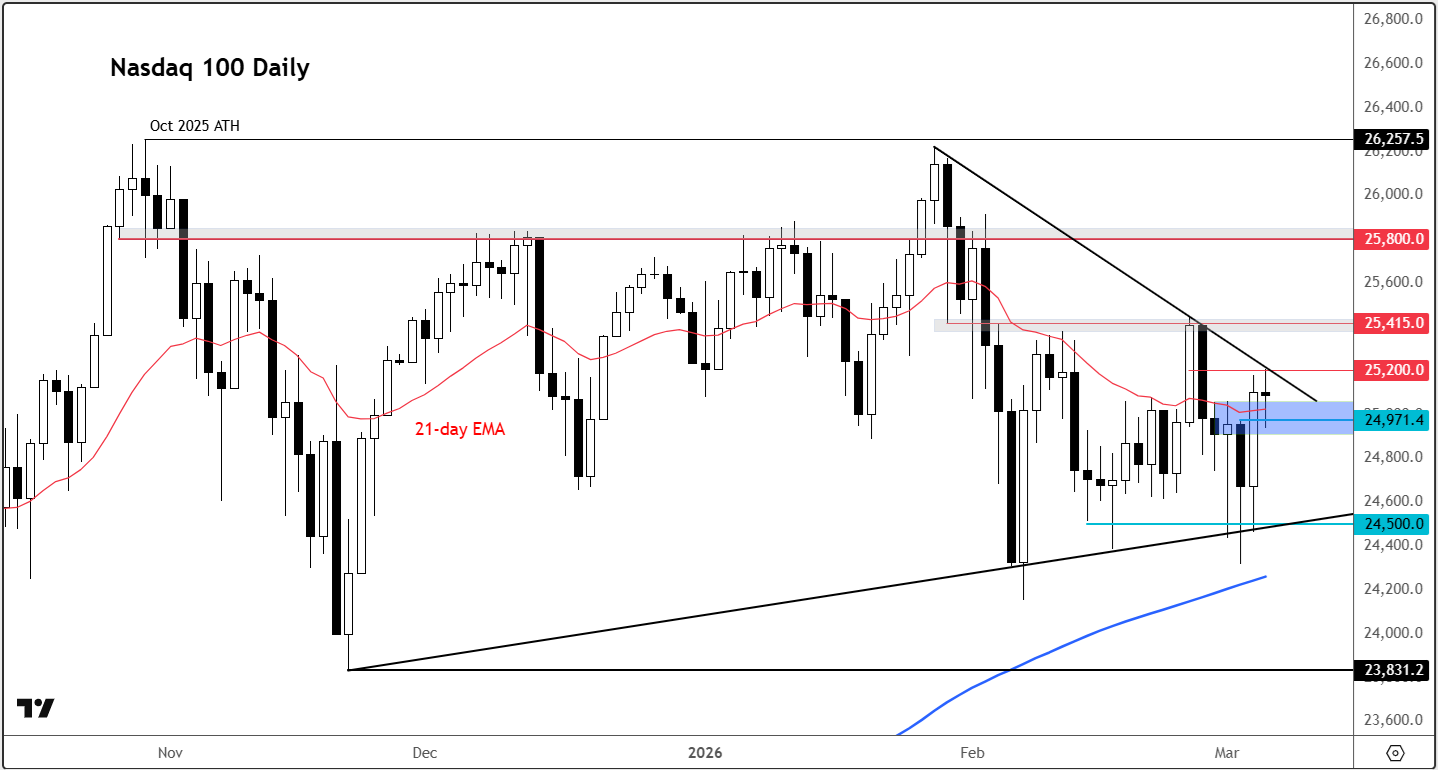
It is also worth remembering that the broader trend has been characterised by sideways trading in recent months. Since reaching highs towards the end of October, the index has struggled to push decisively higher, resulting in a choppy period for investors.
Part of that hesitation reflects concerns surrounding valuations in the technology sector. In addition, uncertainty about the long-term impact of artificial intelligence on various industries has created pockets of volatility among individual technology stocks.
Economic data ignored as focus remains on geopolitics
While geopolitical developments are currently dominating market attention, economic data has been pushed to backburner and currently play almost no role for the Nasdaq 100 forecast.
Today’s economic calendar has been relatively light compared with the previous session, when the ISM Services PMI came in much higher than expected (56.1, comfortably above expectations of 53.5) and marking a solid improvement from the previous month. Meanwhile, the ADP payrolls, showed that private-sector employment increased by 63,000 compared with forecasts of around 50,000.
Attention will now shift to Friday’s U.S. Nonfarm Payrolls, which remains the most closely watched labour market report. The outcome could influence expectations for Federal Reserve policy and therefore impact both the US dollar and equity markets. For now, however, geopolitics remains the dominant driver of sentiment. If tensions in the Middle East begin to ease and oil prices retreat, it could provide a boost to risk appetite and support a more constructive Nasdaq 100 forecast in the weeks ahead.

-- Written by Fawad Razaqzada, Market Analyst
Follow Fawad on Twitter @Trader_F_R