
Recent price action in silver has been particularly relevant, as over the last five trading sessions XAG/USD has posted a significant gain, accumulating an increase of more than 18% over this period.
Current buying pressure remains supported in part by the lower attractiveness of gold as a substitute metal, but also by expectations of growth in industrial demand for silver during 2026. This environment has allowed demand confidence to hold in the short term, and as long as silver continues to position itself as an attractive asset and industrial demand expectations remain strong, buying pressure could continue to be relevant in XAG/USD price action in the near term.

Demand expectations help support the market
In recent sessions, demand-related data for silver has become increasingly relevant. According to the World Silver Survey 2026 published by the Silver Institute, approximately 60% of silver demand comes from industries such as electronics, solar panels, electric vehicles, and semiconductors.
Therefore, unlike gold, which is primarily considered a safe-haven asset, silver demand is influenced not only by macroeconomic factors and market sentiment, but also by the performance of these industries.
At this stage, this characteristic has become more relevant, as sectors such as semiconductors and electric vehicles are expected to continue growing in the coming months. However, the May 13–15 meeting between the United States and China has also started to gain importance, as it represents a key opportunity to stabilize global trade after several months of tension.
It is important to consider that if this meeting leads to positive developments, it could improve global supply chain dynamics and, in turn, support the performance of key industries that rely on silver for industrial processes. This combination of factors has begun to reinforce confidence in silver demand in the coming months.
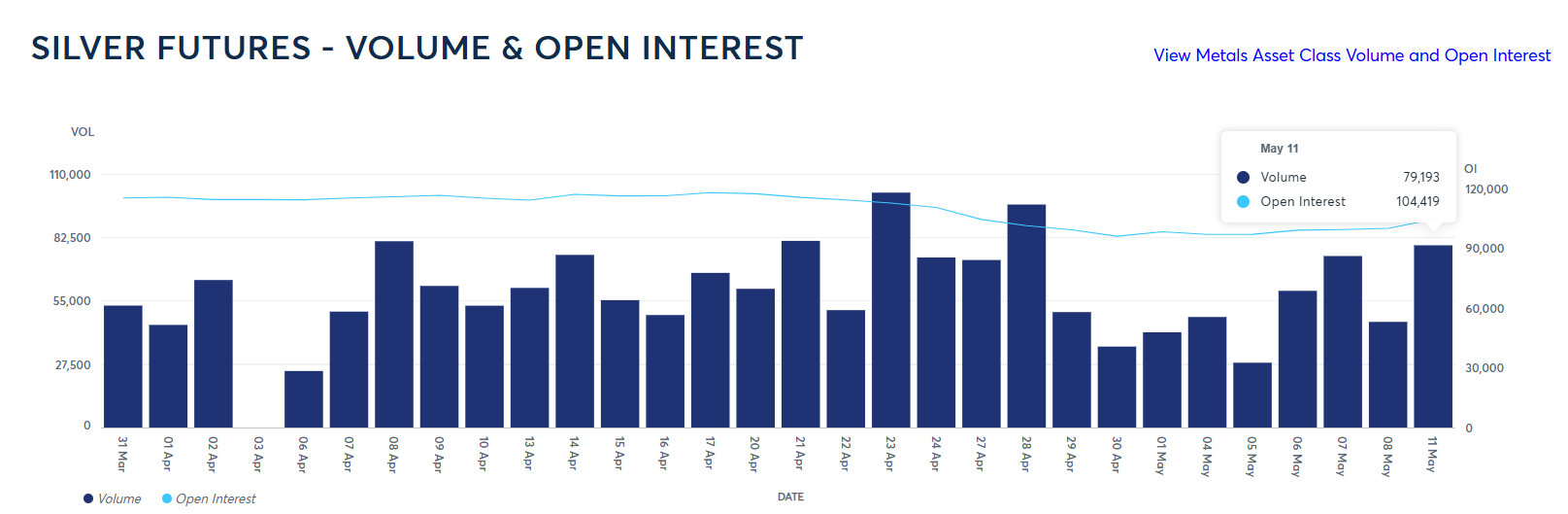
Taking all of this into account, this dynamic may be acting as an additional factor supporting silver demand, which had already begun to show improvement in recent weeks. Since the US–China meeting was first mentioned on May 6, silver futures volume has shown a consistent increase in the short term.
As of May 11, trading volume stands close to 80,000 contracts, reflecting an improvement compared to the early days of the month. This behavior suggests that market activity remains strong, as participants continue to monitor developments in global trade expectations.
As this increase in volume has been accompanied by rising prices, it may indicate that the entry of buying positions has started to stabilize in the short term.
Source: CMEGROUP
With all of this in mind, market optimism has become increasingly relevant as recent data points to improving demand expectations for silver. However, it is important to note that this scenario largely depends on positive outcomes from US–China negotiations.
Any signals pointing back to trade tensions could weaken current optimism and bring back a phase of indecision in the market.
Gold-to-silver ratio
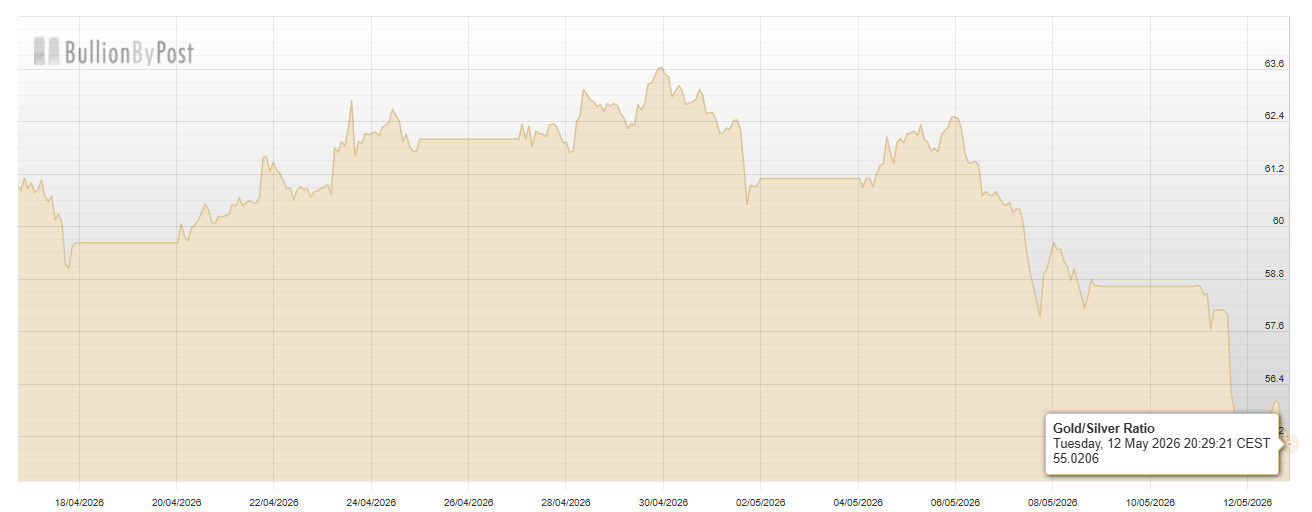
Another important factor within the metals market is the evolution of the gold-to-silver ratio, which has declined toward the 55 level in the short term, maintaining a consistent downward trend from levels near 62 seen in early May.
This implies that fewer ounces of silver are now needed to buy one ounce of gold, reflecting a stronger relative performance of silver compared to gold in recent sessions.
Source: Bullionbypost
The decline in the ratio suggests that the market may be viewing silver as a more attractive asset in the short term. Unlike gold, which is primarily driven by its safe-haven role, silver has an industrial component that makes it more sensitive to trade flows and expectations of production growth.
In this context, the market appears to be placing greater weight on this industrial component, which has supported silver’s price performance relative to other metals.
Therefore, if industrial demand expectations remain positive, silver could maintain its attractiveness in the short term and continue to show relative strength within the metals market.
Technical outlook for silver
Source: StoneX, Tradingview
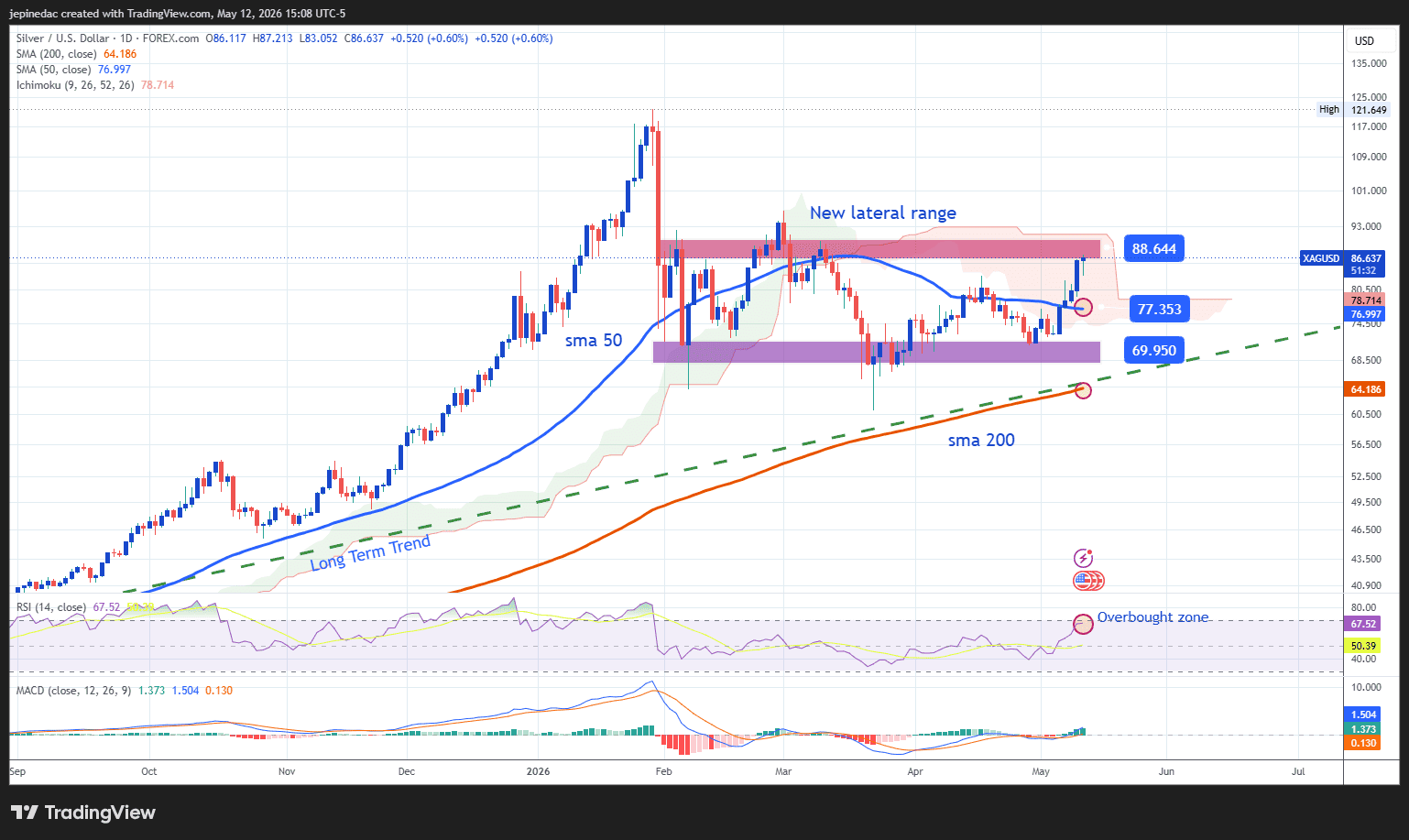
- A sideways range begins to gain relevance: Since early February, silver price action has been moving within a defined range between resistance near $88 per ounce and support around $70. As long as price continues to trade within these levels, it may remain difficult to establish a clear directional move, leaving this range as the dominant structure in the coming sessions.
- MACD: The MACD indicator shows a histogram attempting to move above the zero level, suggesting that short-term bullish momentum is beginning to gain relevance. This indicates that, for now, the buying bias maintains a certain level of dominance in price behavior.
- RSI: Despite this strength, the RSI is approaching 70 level, which signals overbought conditions. This may indicate an excess of buying pressure and could open the door to potential short-term corrections.
Key levels to watch:
- 88 USD – Key resistance: A major high zone aligned with the upper boundary of the current range. A move above this level could reinforce the bullish bias, challenge the sideways structure, and open the door to the formation of a more defined uptrend.
- 77 USD – Near-term barrier: A neutral zone aligned with the 50-period moving average. Price action near this level could continue to highlight a phase of indecision and maintain the relevance of the current range.
- 70 USD – Key support: A zone of recent lows that acts as the main downside barrier. A move toward this level could reactivate a bearish bias and lead to more dominant selling pressure in the short term.
Written by Julian Pineda, CFA, CMT – Market Analyst
Follow him on: @julianpineda25