



US Dollar Outlook: Bearish April Seasonality Meets Middle East Wildcard
US dollar seasonality points to April weakness, but Middle East tensions and oil risks could override the usual bearish bias.
Share this:
The US dollar enters April with a clear seasonal headwind, as historical data shows a strong tendency for weakness across FX majors. However, this year’s outlook is far from straightforward. Geopolitical tensions in the Middle East, elevated oil prices, and shifting expectations around US interest rates could easily override seasonal patterns. Traders must now weigh whether history repeats—or whether macro and geopolitical forces take control.
View related analysis:
View related analysis:
US Dollar April Outlook: Seasonality Turns Bearish as Middle East Risks Loom
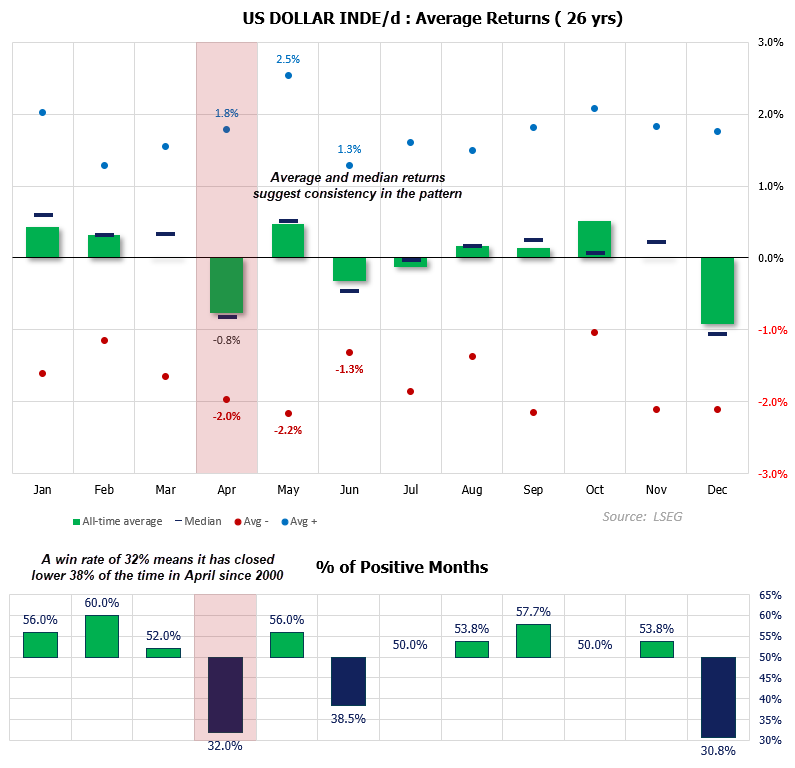
Using monthly data since the turn of the century shows the US dollar index has a slight bullish bias, with six months closing higher, four lower, and two flat. However, April stands out as a clear weak spot, with both average and median returns skewed to the downside.
Source: ICE, LSEG
April seasonality points to a weaker US dollar
- With a win rate of just 32%, the US dollar index has closed lower in April 68% of the time. It has also posted average returns of -0.77% and median returns of -0.8%.
- The close alignment between the mean and median suggests the data is relatively consistent and not distorted by outliers, making the 68% loss rate more compelling.
- Among those negative months, the US dollar has delivered an average loss of -2%, only slightly larger than the average gain of 1.8% during positive months.
Geopolitics to Dictate Whether Seasonality Plays Out
Whether the US dollar follows its seasonal tendency will largely depend on whether the war in the Middle East genuinely de-escalates. Seasonality reflects averages of past outcomes and can easily be overridden by major drivers such as geopolitical shocks or recessions. If the war drags on or the Strait of Hormuz remains closed, the US dollar could break higher and defy its seasonal pattern.
However, if the US withdraws and the Strait of Hormuz reopens, traders could shift their focus back to softer US employment data and reprice rate cuts, knowing a key inflationary pressure has been removed.
President Trump is set to address the nation on Wednesday night (early Thursday in Asia), so traders should be on guard for potential volatility—even if no concrete policy shift is delivered. If tensions de-escalate, incoming data such as ISM manufacturing, services, and NFP will carry far greater weight than they currently do.


US Dollar Index (DXY) Technical Analysis
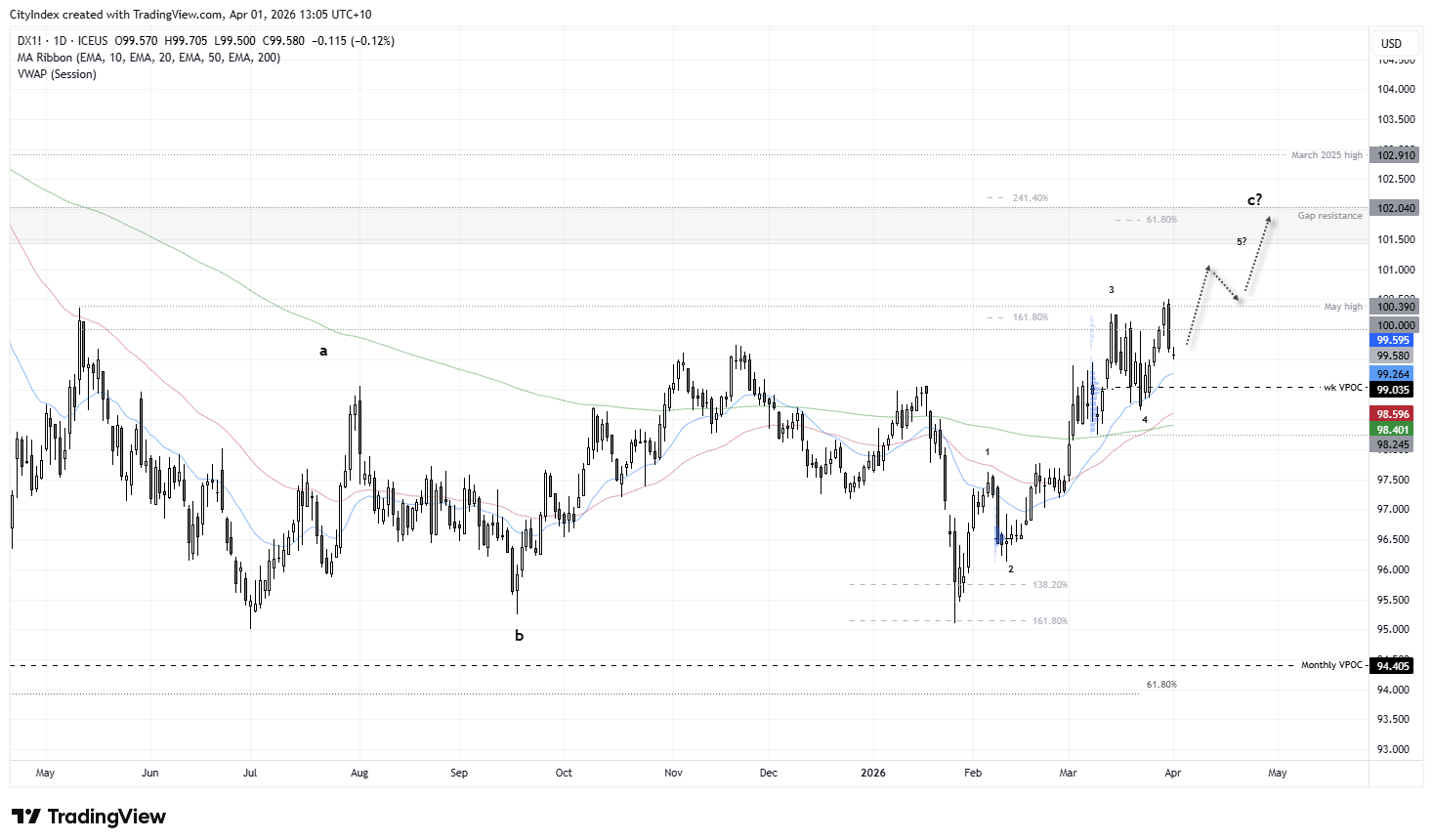
A bearish engulfing candle formed on Tuesday, seeing the US dollar retrace from its May high, in line with my near-term bias. For now, my bias remains bullish while prices hold above the 98.65 low, which I suspect marks the end of wave 4.
Bulls could therefore look for dips towards support and evidence of a swing low around the 20-day EMA (99.26) or the weekly VPOC near the 99 handle, in anticipation of a resumption of wave 5 towards 101.50 or gap resistance near 102.
As mentioned in yesterday’s report, I am ultimately looking for the completion of wave 5 and the larger wave C to mark a more meaningful top.
Source: ICE, TradingView
US Dollar Seasonality in April: FX Majors Performance (Since 2000)
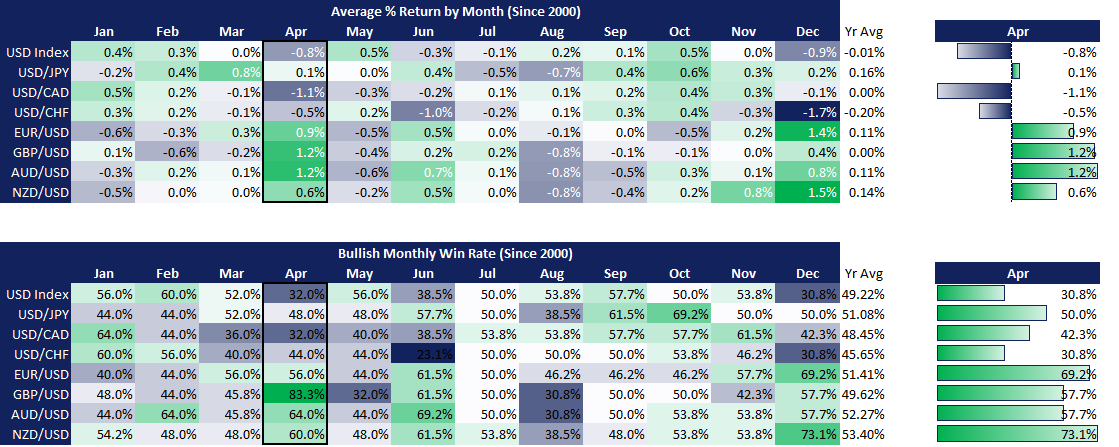
The bearish bias for the US dollar is clear when comparing its performance across FX majors, where it stands out as the weakest overall. Whether it follows that pattern again this year may hinge on what President Trump announces, alongside incoming headlines from the Middle East.
- US Dollar Index (DXY): Has closed lower 68% of the time (32% win rate), with average returns of -0.8%, making April one of the weakest months for the USD.
- EUR/USD: Rises 56% of the time with average gains of 0.9%, reinforcing a consistent seasonal bias for a softer US dollar.
- GBP/USD: One of the standout performers, climbing 83% of the time with average returns of 1.2%, highlighting strong and reliable upside seasonality.
- AUD/USD: Gains 64% of the time with average returns of 1.2%, combining a solid win rate with strong upside potential.
- NZD/USD: Advances 60% of the time with average gains of 0.6%, offering a steady but less explosive bullish profile.
- USD/JPY: Rises 48% of the time with average returns of 0.1%, effectively flat and highlighting mixed USD performance against the yen.
- USD/CAD: Falls 68% of the time (32% win rate) with average returns of -1.1%, making CAD one of the strongest currencies versus the USD in April.
- USD/CHF: Declines 56% of the time with average returns of -0.5%, pointing to modest but consistent franc outperformance.
Source: LSEG
View the full economic calendar
View the full economic calendar
-- Written by Matt Simpson
Follow Matt on Twitter @cLeverEdge
How to trade with City Index
You can trade with City Index by following these four easy steps:
- Open an account, or log in if you’re already a customer
• Open an account in the UK
• Open an account in Australia
• Open an account in Singapore
- Search for the market you want to trade in our award-winning platform
- Choose your position and size, and your stop and limit levels
- Place the trade
Related tags:


Open an account today
Experience award-winning platforms with fast and secure execution.
Economic calendar
Web Trader platform
Our sophisticated web-based platform is packed with features.
Related articles

US dollar outlook: Fed hike priced | FOREX Friday
A December Fed rate hike looks fully priced in, as the dollar stays below this week's highs despite strong US data, while gold, silver and the EUR/USD rebound. Fawad Razaqzada explains why next week's jobs report is the main event, and the Dollar Index levels to watch.


EUR/USD Recovers as Markets Fully Price in Fed Hike
EUR/USD outlook turns on Fed pricing, as the euro recovers while strong U.S. data fails to lift a dollar that has already priced in Fed tightening.

Silver Outlook: Improving risk appetite puts squeeze in play
Silver continues to amplify moves in gold, with unusually strong correlations with tech stocks offering another reason to monitor the recovery in risk appetite.

From time to time, StoneX Financial Pty Ltd (“we”, “our”) website may contain links to other sites and/or resources provided by third parties. These links and/or resources are provided for your information only and we have no control over the contents of those materials, and in no way endorse their content. Any analysis, opinion, commentary or research-based material on our website is for information and educational purposes only and is not, in any circumstances, intended to be an offer, recommendation or solicitation to buy or sell. You should always seek independent advice as to your suitability to speculate in any related markets and your ability to assume the associated risks, if you are at all unsure. No representation or warranty is made, express or implied, that the materials on our website are complete or accurate. We are not under any obligation to update any such material.
As such, we (and/or our associated companies) will not be responsible or liable for any loss or damage incurred by you or any third party arising out of, or in connection with, any use of the information on our website (other than with regards to any duty or liability that we are unable to limit or exclude by law or under the applicable regulatory system) and any such liability is hereby expressly disclaimed.