
With just one trading session left before the week comes to an end, the strength that has recently emerged around the Canadian dollar has once again become relevant. This can be observed in the recent performance of USD/CAD, which has declined nearly 0.3% over the last two trading sessions, a move that continues to highlight the relevance of the bearish bias within the pair's short-term behavior.
What stands out is that this selling pressure remained in place even after the monetary policy decisions from both the Federal Reserve and the Bank of Canada (BoC). This is largely because the Canadian central bank delivered a relatively more hawkish message, while the Federal Reserve maintained a more neutral tone. As a result, the U.S. dollar failed to develop a meaningful recovery in strength, while the Canadian dollar regained some relative appeal. For now, this divergence in expectations has become one of the main catalysts to monitor and, as long as it remains in place, the bearish bias around USD/CAD could continue to be relevant in the coming sessions.

What Happened with Central Banks?
Yesterday's session proved particularly important for the markets due to the policy decisions announced by both the Fed and the BoC. What is especially interesting is that the two institutions are beginning to show increasingly different signals regarding their monetary policy outlook.
While the Federal Reserve decided to leave interest rates unchanged at the 4.00% level, the Bank of Canada raised its benchmark rate to 2.50%. This situation suggests that, for now, the Canadian institution has started to adopt a relatively more aggressive stance than its U.S. counterpart, creating a divergence in economic and monetary policy expectations that may remain relevant over the coming months.
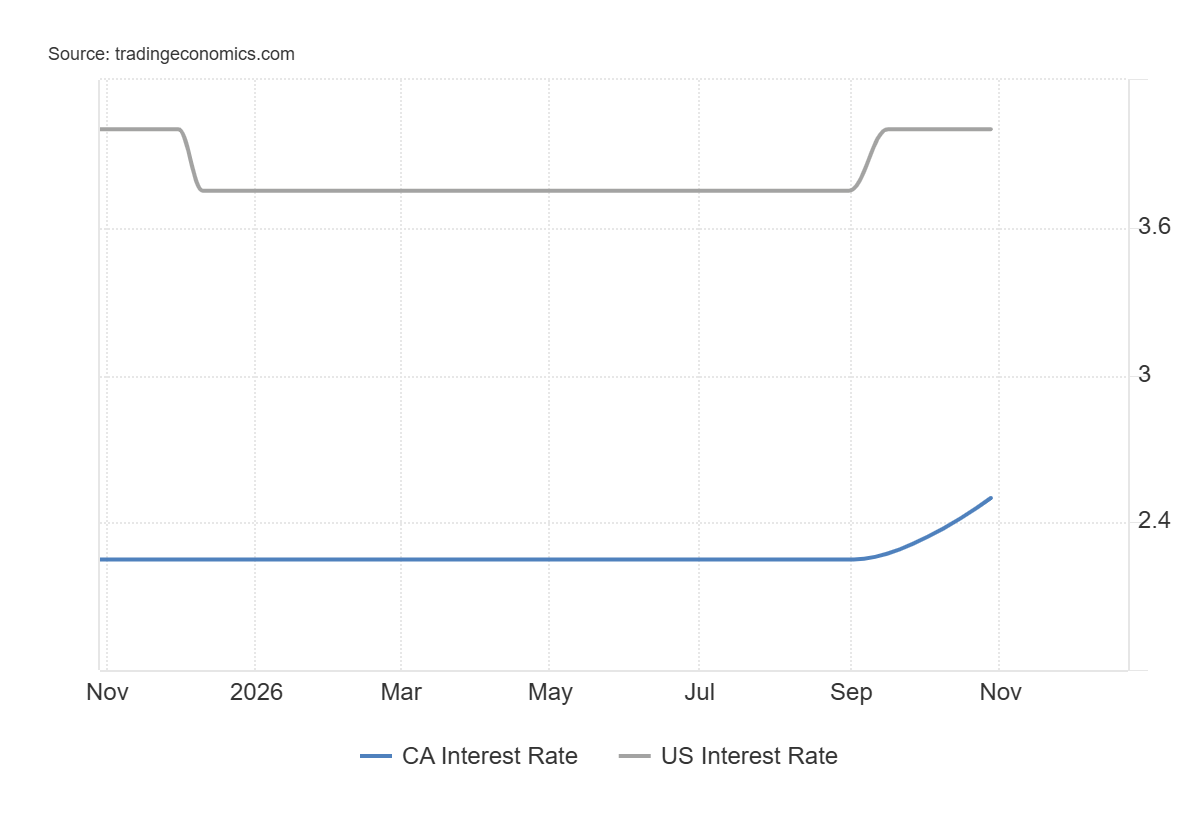
Source: TradingEconomics
It is also important to note that, following the Fed decision, the probability framework compiled by CME Group continues to assign more than 80% odds to one final rate increase during the December 9 meeting, potentially taking the benchmark rate to 4.25%.
However, the comments that followed the decision did not fully support this expectation. Most members of the central bank maintained a cautious stance and, although Warsh reiterated that inflation remains a concern, the broader message continued to emphasize the need for additional data before making further moves. This remains important because it does not reflect a clear urgency to continue an aggressive tightening cycle beyond a potential move in December.
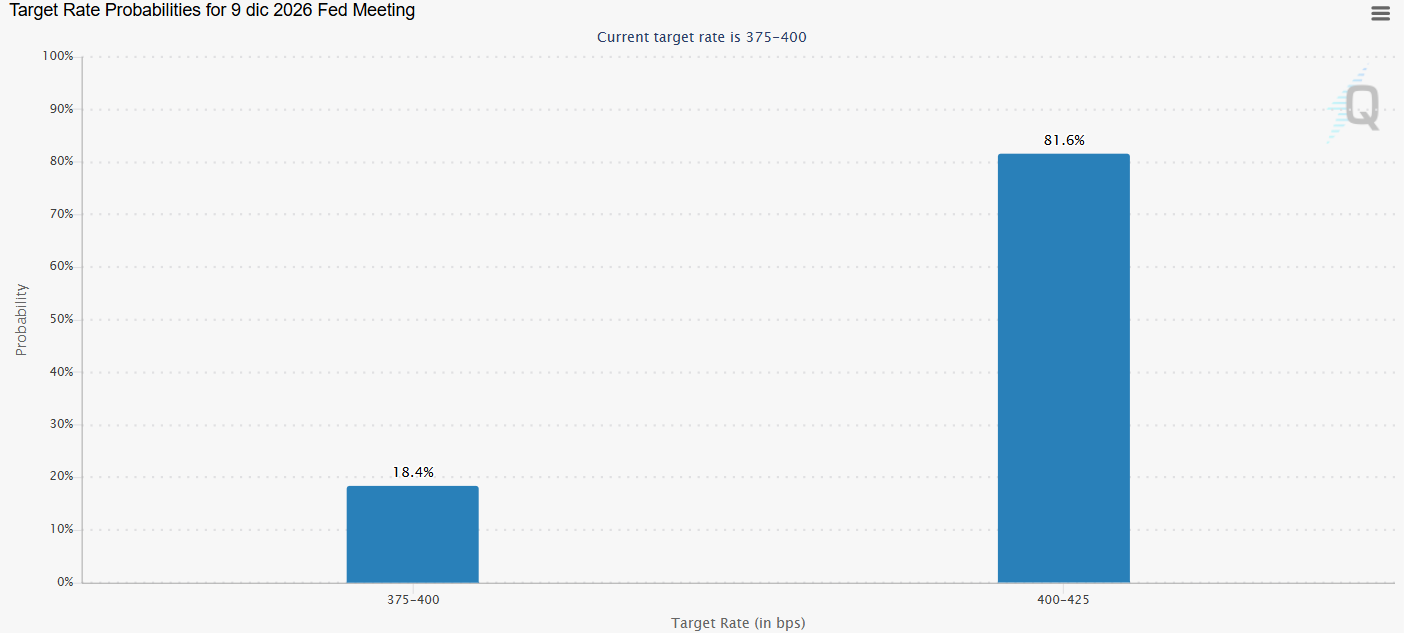
Source: CMEGROUP
Canada's situation was notably different. Following the rate hike, the central bank stated that inflation remains elevated and persistent, particularly due to energy-related price pressures. In addition, it revised its inflation outlook higher, projecting readings near 3.5% during 2026 and levels above 3.0% through much of next year.
This has reinforced the idea that the BoC remains open to additional rate increases if inflation fails to return consistently to its target range. Broadly speaking, comments suggesting less room for a flexible monetary policy indicate that the institution appears increasingly prepared for a higher-rate environment, particularly when compared to the cautious tone that continues to characterize the Federal Reserve. In fact, following the decision, markets began assigning more than 65% probability to another rate increase during the December meeting.
This divergence is particularly important because it represents a shift from the dynamic that dominated much of 2026. Until recently, it was the Federal Reserve that maintained the more restrictive stance, while the Bank of Canada remained comparatively cautious. Recent developments suggest that this picture may be changing and could gradually begin to narrow the interest-rate differential that had favored the United States.
This change is also becoming visible in fixed-income markets. While 10-year U.S. Treasury yields continue to follow a softer trajectory and have fallen back below the 5.00% area, equivalent Canadian bond yields have continued moving higher and are already approaching the 4.00% level.
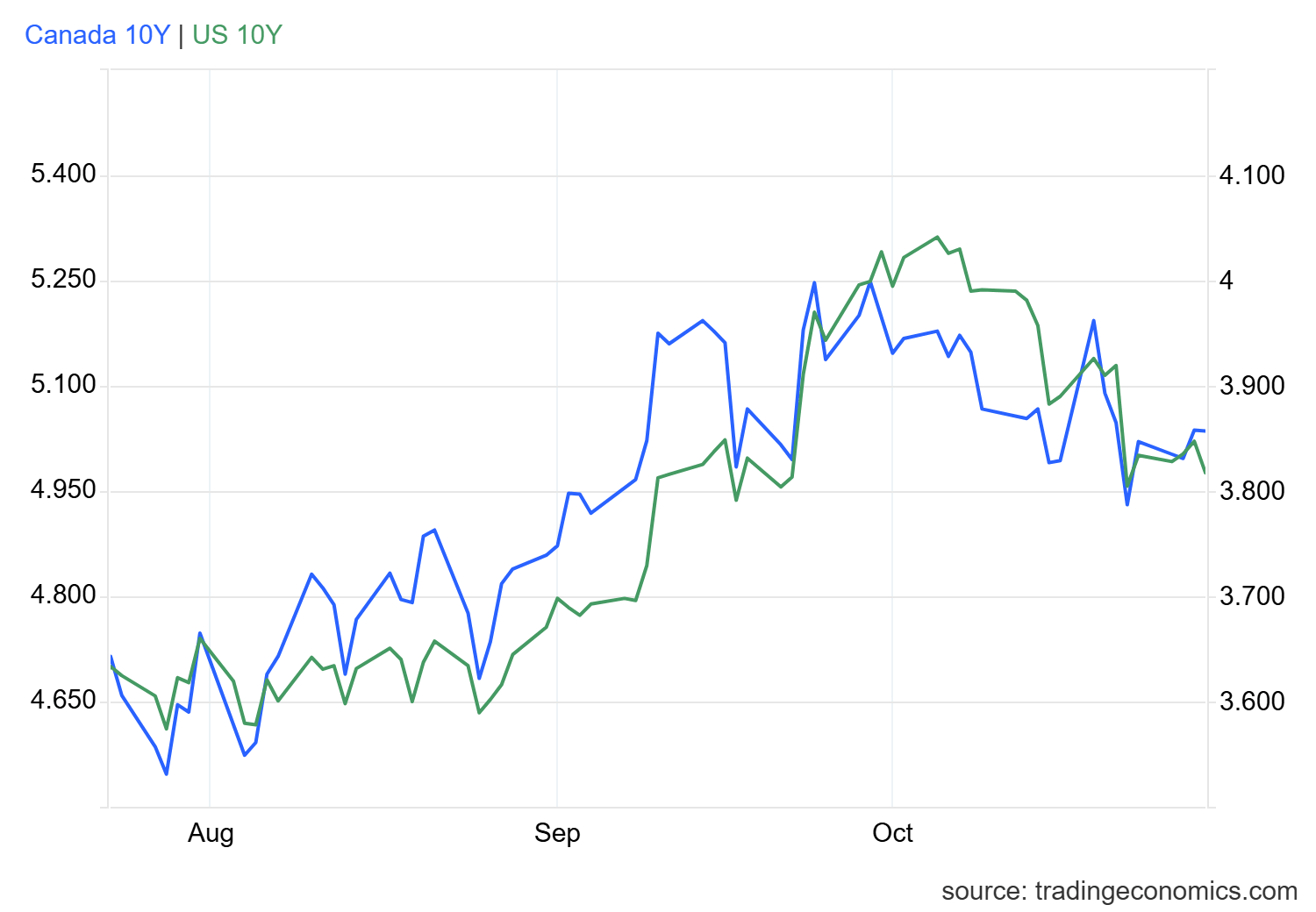
Source: TradingEconomics
This dynamic is important because it reflects a relative improvement in the attractiveness of Canadian dollar-denominated investments compared with U.S. dollar-denominated alternatives. On one side, Canada now has a central bank willing to maintain a more aggressive stance toward inflation and, on the other, a bond market that continues to offer increasingly attractive yields.
Under this scenario, if the Federal Reserve maintains a more cautious approach while the Bank of Canada remains focused on inflationary pressures, the interest-rate differential between the two countries could continue narrowing over time. As a result, the Canadian dollar may continue gaining relative attractiveness against the U.S. dollar, a situation that could translate into increasingly relevant selling pressure around USD/CAD in the weeks ahead.
USD/CAD Technical Forecast
Source: StoneX, Tradingview
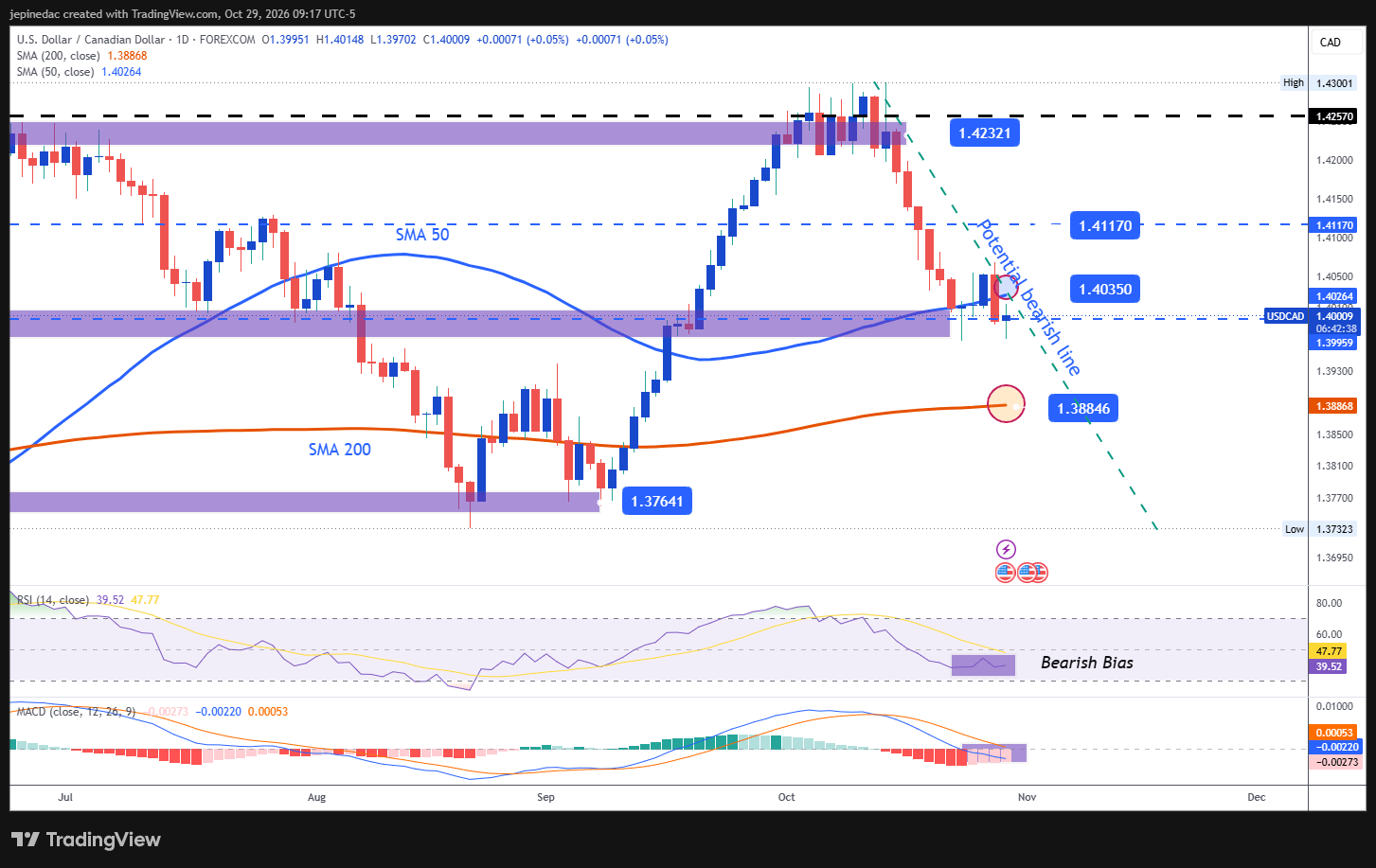
- A potential trendline is becoming increasingly relevant: Since mid-October, USD/CAD has developed a consistent pattern of lower highs, allowing a potential short-term bearish trendline to emerge. This structure is now beginning to establish itself as one of the most important technical references on the daily chart. As long as selling pressure remains dominant and price continues approaching important support levels, this bearish trend could gain further relevance in the weeks ahead.
- MACD: The MACD histogram continues to develop below the 0 neutral line, reflecting a bearish bias within short-term moving averages. As long as this dynamic remains in place, it could continue supporting a relatively consistent bearish bias across the chart.
- RSI: A similar situation can be observed in the RSI, whose line remains below the 50 neutral level. This reading suggests that selling momentum has gained relevance in recent sessions and continues to support the possibility that bearish pressure could remain important in the short term.
Key Levels:
- 1.41170 – Key Resistance: An area defined by highs observed in previous months that remains the most important upside barrier on the chart. Price movements returning toward this level could place the developing bearish trendline at risk and potentially favor a renewed phase of indecision or even the formation of a broader trading range in the weeks ahead.
- 1.40350 – Near-Term Barrier: A level that coincides with the 50-period simple moving average and could become the main reference to monitor in the event of short-term bullish corrections.
- 1.38846 – Critical Support: The last major support level on the daily chart and an area that coincides with the 200-period simple moving average. Oscillations that manage to consolidate near this level could reinforce the bearish bias and create room for a more consistent downtrend during the coming weeks.
Written by Julian Pineda, CFA, CMT – Market Analyst
Follow him on: @julianpineda25