



USD/CAD Analysis: Is the Canadian Dollar Running Out of Support?
A new trading week is underway, and the Canadian dollar continues to show signs of weakening momentum. This can be seen in recent USD/CAD price action, with the pair gaining nearly 0.7% over the last four trading sessions.
Share this:

A new trading week is underway, and the Canadian dollar continues to show signs of weakening momentum. This can be seen in recent USD/CAD price action, with the pair gaining nearly 0.7% over the last four trading sessions. Buying pressure around the pair has been supported primarily by two factors: expectations of a more aggressive Federal Reserve and an ongoing trade dispute that still shows few signs of resolution. Both developments appear to be weighing on the Canadian dollar's relative attractiveness and, as long as these conditions remain in place, buying pressure around USD/CAD could continue to play a relevant role in the sessions ahead.

Is the USD Becoming a Threat?
Since last week, expectations of a more aggressive Federal Reserve have continued to gain traction. This perception is largely driven by persistent inflationary pressures in the United States, a backdrop that could justify additional rate increases over the coming months. In fact, CME Group's probability tracker still assigns more than a 50% chance that interest rates will rise another 0.25% to the 4.25% area at the October 28 meeting.
The situation looks somewhat different at the Bank of Canada. Although policymakers continue to acknowledge inflation risks, there have not yet been equally strong signals pointing toward a more aggressive policy stance. Market expectations for the October 28 meeting remain broadly split between another rate hike and an unchanged decision, highlighting a greater degree of uncertainty surrounding the bank's next move. As a result, the Federal Reserve continues to stand out as the institution with the greatest potential to maintain a restrictive monetary policy over the coming months.
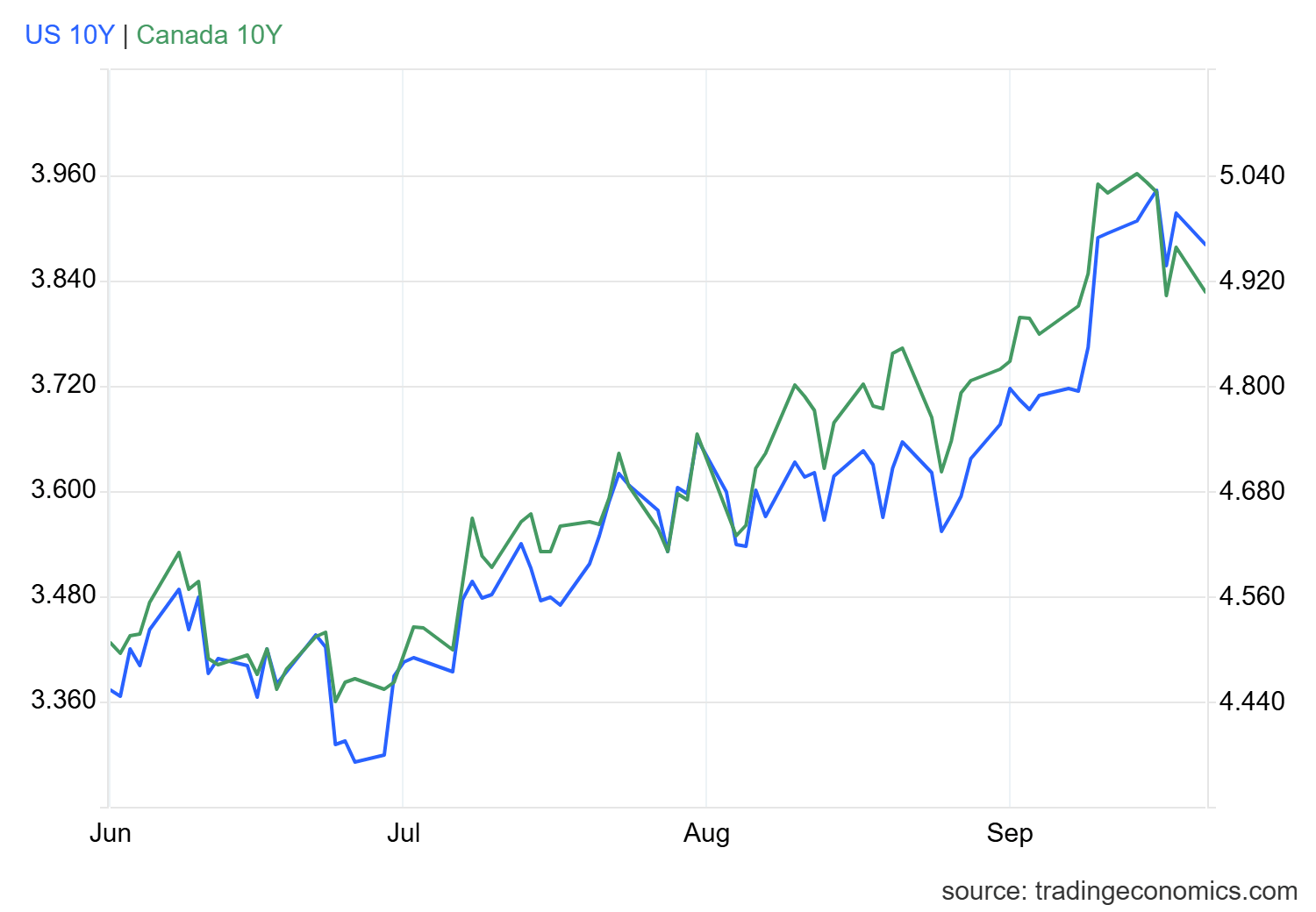
This divergence also has important implications for bond markets. Although 10-year bond yields in both countries have moved higher recently, the yield differential continues to favor the United States. While U.S. Treasury yields remain around the 5.00% area, Canadian bond yields continue to trade below 4.00%. This gap remains important because it supports the relative attractiveness of U.S. assets and could widen further if the Federal Reserve maintains a more aggressive stance than the Bank of Canada.
Source: TradingEconomics
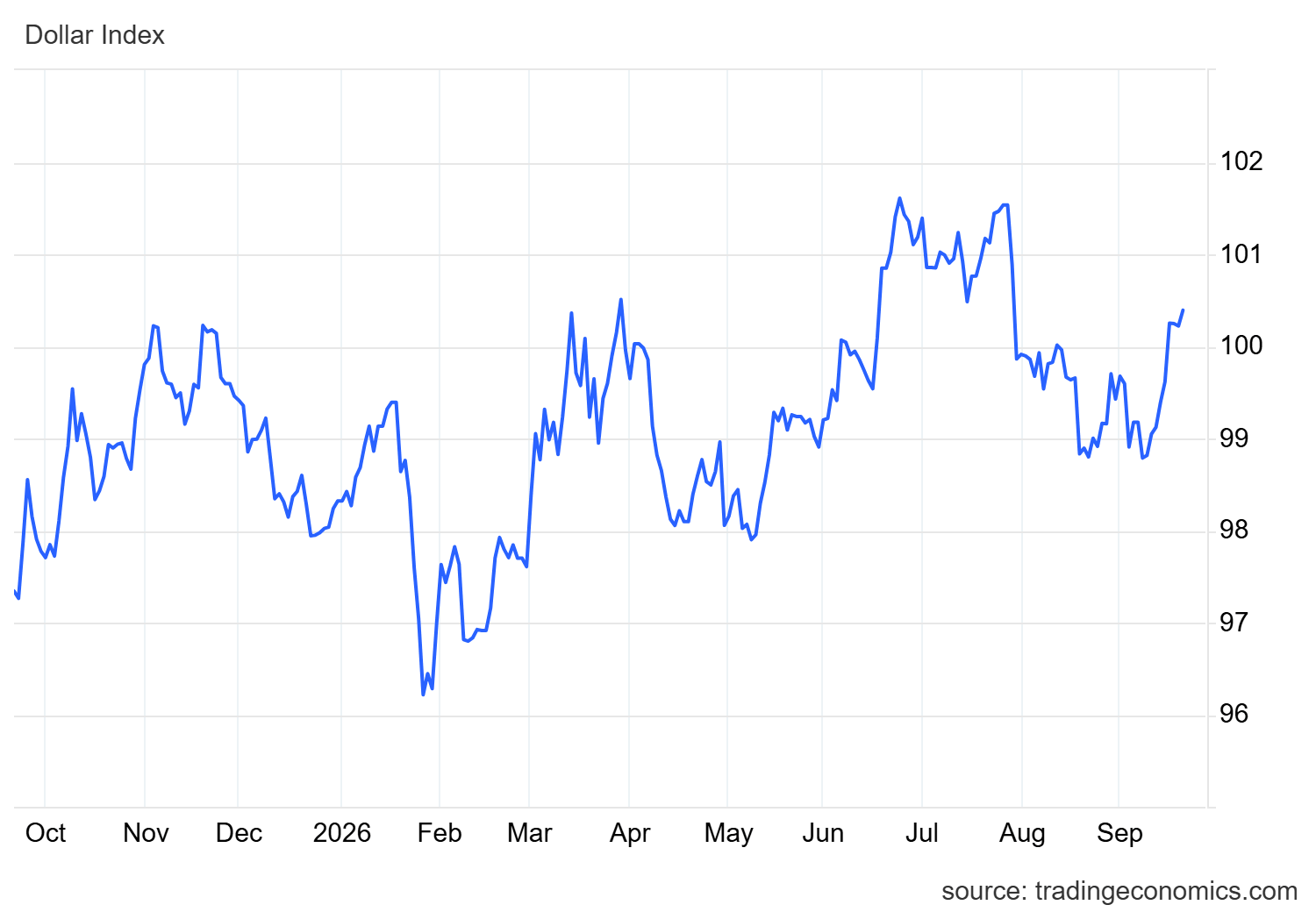
This advantage is already beginning to show up in the performance of the U.S. dollar. Recent movements in the DXY, the index that measures the dollar against its main rivals, continue to reflect strength above the 100-point level. This suggests that demand for the U.S. dollar remains well supported, backed both by the appeal of the bond market and expectations of a more restrictive monetary policy. As a consequence, the Canadian dollar continues to struggle to regain lost ground consistently.
Source: TradingEconomics
Taking all of this into account, the difference in outlook between the two central banks continues to favor the U.S. dollar. As long as markets continue to price in a more aggressive Federal Reserve than the Bank of Canada, capital flows may continue to favor USD-denominated assets and limit a stronger recovery in the Canadian dollar. Under this scenario, buying pressure around USD/CAD could remain relevant during the coming sessions.
Is There Still No Progress in the Trade Dispute?
Since September 15, when revised 50% tariffs on selected Canadian products came into effect, there have been no significant developments pointing toward a quick resolution of the trade conflict. In addition, beginning on September 29, the United States may start applying import restrictions on products from sectors such as automobiles and dairy. On the Canadian side, the countermeasures announced on September 8 remain in place, including tariffs ranging from 15% to 50% on U.S. goods. So far, both countries have maintained firm positions, and negotiations have failed to alter the overall direction of the dispute.
This situation remains highly relevant for the Canadian dollar because the currency has repeatedly shown weakness whenever trade tensions escalate. Moreover, the conflict directly affects an economy where more than 70% of exports are destined for the United States, creating uncertainty around future growth prospects. Until more meaningful diplomatic progress emerges, caution is likely to remain a dominant theme around the CAD and could continue supporting buying pressure in USD/CAD over the coming weeks.
USD/CAD Technical Forecast
Source: StoneX, Tradingview
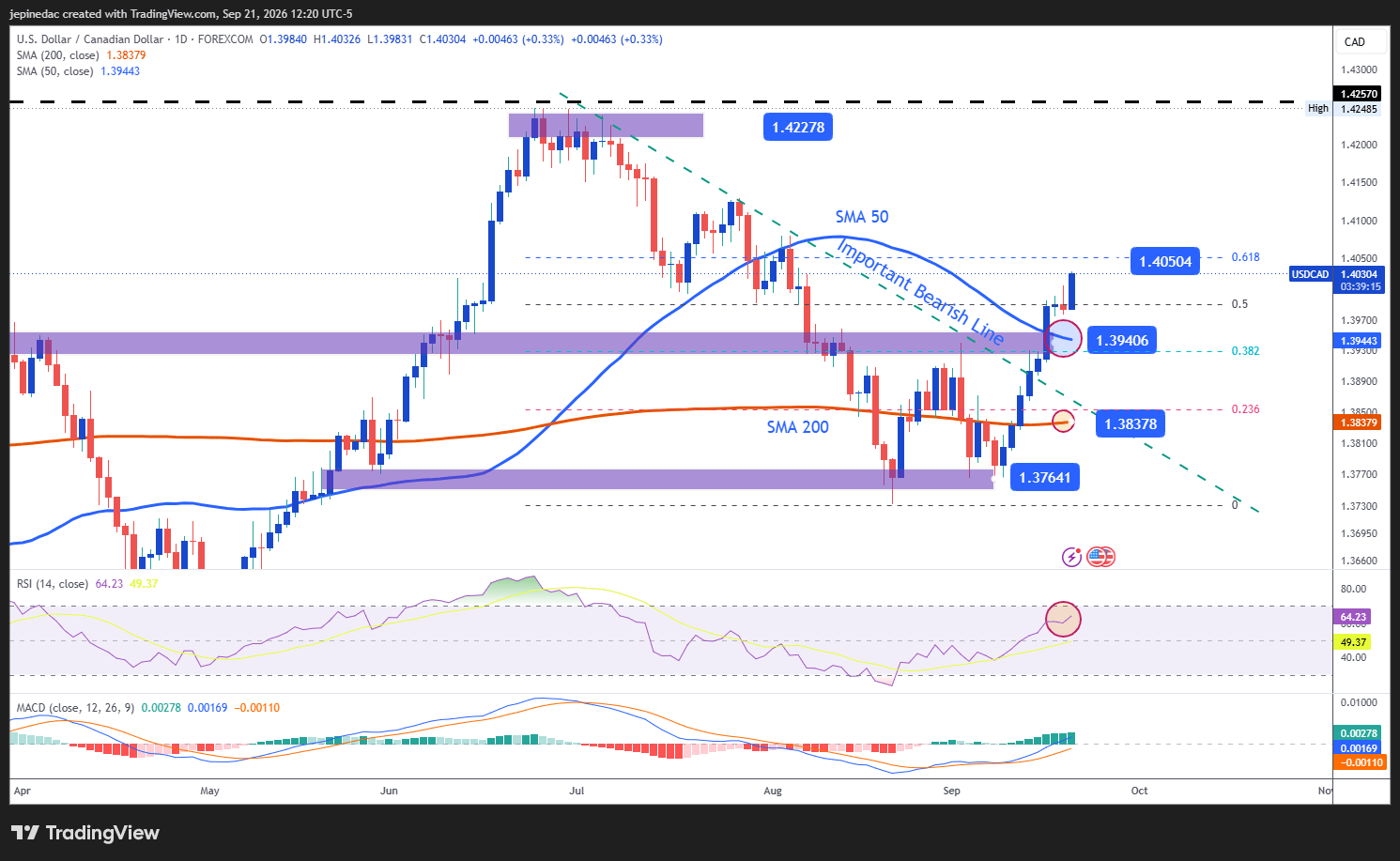
- Bullish momentum starts to emerge: Over recent months, USD/CAD had been developing a medium-term downtrend that became one of the chart's most important technical structures. However, the recent recovery has already generated a meaningful break above this trendline. If buying pressure remains in place over the coming sessions, a more established bullish structure could begin to emerge in the short term.
- RSI: The RSI remains above the 50 neutral level, a reading that reflects growing bullish momentum within the chart. As long as this dynamic remains intact, the bullish bias may continue strengthening over the coming sessions.
- MACD: A similar picture can be observed in the MACD, whose histogram continues to trade above the 0 neutral line. This reading suggests that short-term moving averages continue to favor bullish price action and supports the possibility that the current upward bias remains relevant.
Key Levels:
- 1.40504 – Key Resistance: The last major upside barrier on the chart, coinciding with the most relevant 61.8% Fibonacci retracement level. Price action that manages to consolidate above this area could signal stronger bullish control and open the door to a more developed upward structure in the weeks ahead.
- 1.39406 – Near-Term Barrier: A level that coincides with the 50-period moving average and the 38.2% Fibonacci retracement zone. It remains the most important reference to monitor in the event of short-term bearish corrections.
- 1.38378 – Critical Support: This level represents the most important downside barrier on the chart as it coincides with the 200-period moving average. A move back toward this area could undermine the credibility of the recent recovery, revive concerns about a lack of direction, and favor the development of a broader consolidation range.
Written by Julian Pineda, CFA, CMT – Market Analyst
Follow him on: @julianpineda25
Latest market news




Open an account today
Experience award-winning platforms with fast and secure execution.
Economic calendar
Web Trader platform
Our sophisticated web-based platform is packed with features.
Related articles
USD/CHF Outlook: Swiss Franc Surges as AI Trade Capitulates and SNB Bets Shift
USD/CHF weakens as the Swiss franc surges amid AI trade capitulation and shifting SNB rate bets, with further downside possible as December approaches.


EUR/USD forecast: Markets bounce off lows after damaging week
At the time of writing markets were bouncing back from their earlier lows as European investors were heading out, and US investors were starting to look forward to Thanksgiving.


US dollar outlook: DXY finds fresh support as risk aversion deepens
The dollar is finding fresh support as risk aversion drives investors out of emerging-market and commodity currencies. With tariff threats mounting and today's PCE data in focus, the 104.53 high and 104.60 resistance are back in play.
From time to time, StoneX Financial Pty Ltd (“we”, “our”) website may contain links to other sites and/or resources provided by third parties. These links and/or resources are provided for your information only and we have no control over the contents of those materials, and in no way endorse their content. Any analysis, opinion, commentary or research-based material on our website is for information and educational purposes only and is not, in any circumstances, intended to be an offer, recommendation or solicitation to buy or sell. You should always seek independent advice as to your suitability to speculate in any related markets and your ability to assume the associated risks, if you are at all unsure. No representation or warranty is made, express or implied, that the materials on our website are complete or accurate. We are not under any obligation to update any such material.
As such, we (and/or our associated companies) will not be responsible or liable for any loss or damage incurred by you or any third party arising out of, or in connection with, any use of the information on our website (other than with regards to any duty or liability that we are unable to limit or exclude by law or under the applicable regulatory system) and any such liability is hereby expressly disclaimed.