US yields fell for a second day and the US dollar index fell to a 3-day low as US employment data continued to deteriorate. US job openings hit a 3.5-year low, bolstering bets of a 50bp cut in November, which Fed funds futures are now implying with a 91.5% probability. They also see a 57.1% chance of 100bp cuts arriving by December.
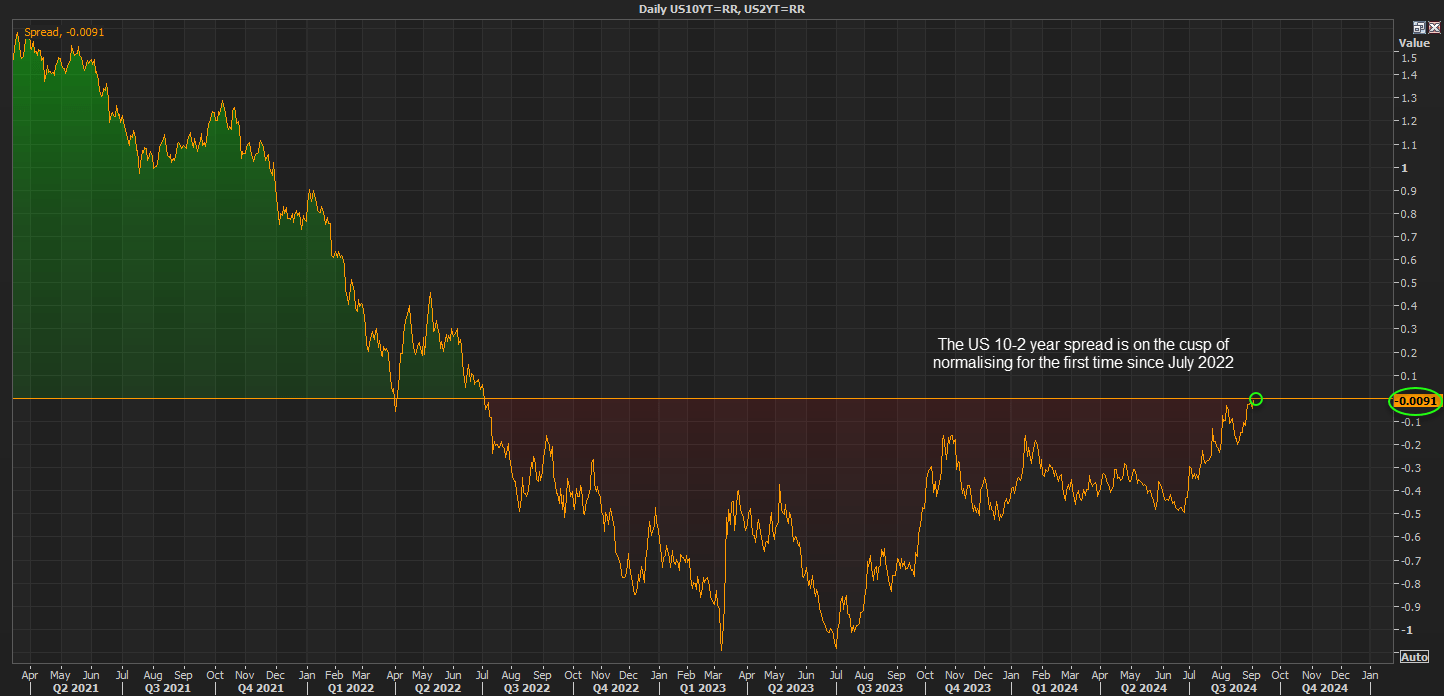
It seems more of a formality right now, but the US 10-2 year spread is on the verge of normalising for the first time since July 2022. And by ‘normalising’, I mean the 10-year yield will be higher than the 2-year. Which is what you would typically expect if you were lending your money to the government for a longer period of time. The soft-landing scenario appears to be at play for bond traders, and that could be supportive of the US stock market (and global stocks, for that matter) and spells further trouble for the US dollar.
As long as incoming employment data softens without completely falling over, bond traders are likely to have a favourable view on economic growth and the 10-2 could cross into positive territory and continue higher.
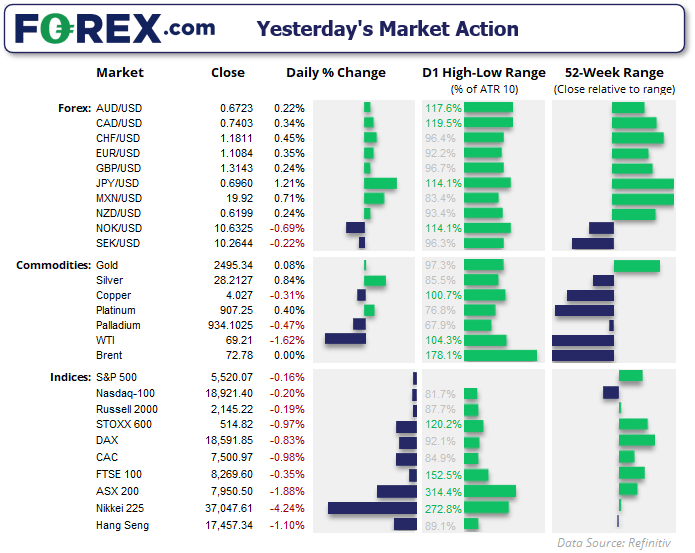
- The US 2-year yield saw a daily close below 3.8% for the first time since April 2023
- The US dollar was the weakest FX major, JPY was the strongest which was USD/JPY closed beneath 144 for the first time since last Tuesday (and second time since January)
- EUR/USD turned higher to form a bullish engulfing day, which finally saw momentum align with my bullish bias outlined at the start of the week (even if it had to make another minor low on the daily chart first)
- Gold futures continued to hold above 2500, forming another spike low above that key level to show demand in the area
- WTI crude oil was lower for a third day and fell to a 7-month low to reach the upper 60s.
The Bank of Canada (BOC) cut their cash rate by 25bp to 4.25%, marking their third consecutive cut. Governor Macklem said the central bank discussed different scenarios such as slowing the pace of cuts, or even opting for a 50bp cut. They’re optimistic of a soft landing, although there is a risk that shelter inflation could heat up - even if that is not their base case. Incoming data is to guide their future path of cuts.
Fed’s Bostic said the Fed should not remain restrictive for too long, and that a soft economic landing is within reach. However, the Fed must remain vigilant on inflation and he is not yet ready to declare victory on it, even though he thinks they remain in a favourable position.
US data: durable goods, factory orders, job openings, GDPnow, Fed’s beige books
Australian economy escaped a contraction in Q2, but its 0.2% q/q print is hardly anything to get excited about. This does little to please either bulls or bears, as sluggish growth does not exactly call for hikes yet neither does it call for imminent cuts. The Australia dollar’s lacklustre response was in proportion to the figures.
Events in focus (AEDT):
- 09:30 – JP wages, foreigner stocks and bonds purchases
- 11:30 – AU trade balance
- 13:05 – RBA governor Bullock speaks (The Costs of High Inflation – to The Anika Foundation, Sydney)
- 15:00 – SG retail sales
- 17:30 – DE construction PMI
- 18:30 – UK construction PMI
- 19:00 – EU retail sales
- 21:30 – US Challenger job cuts
- 22:15 – US ADP payrolls
- 22:30 – US jobless claims, nonfarm productivity, unit labour costs
- 23:45 – US services, composite PMI (final)
- 00:00 – US services PMI

USD/JPY technical analysis:
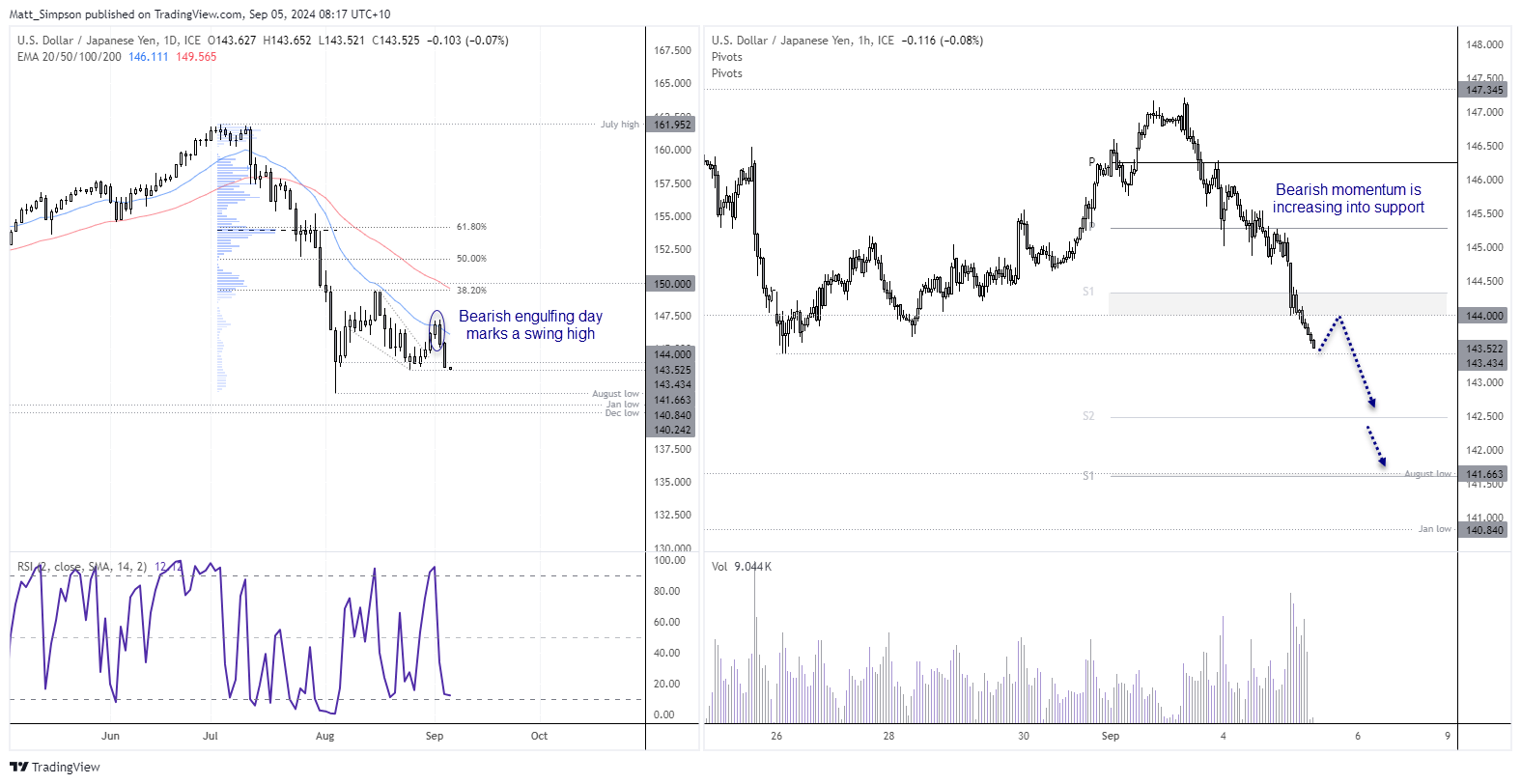
I am pleased to say USD/JPY rose beyond my initial 146 countertrend target outlined last week, but I think it is also safe to say that rally has stalled and we can scrap the falling-wedge target around 149. Momentum has clearly turned against the US dollar, with the return of hawkish BOJ comments clearly supporting the yen.
The daily chart shows prices closed at the low of the day, and just a touch above last week’s low. The 1-hour chart shows a strong bearish leg which ahs only increased in momentum has it approached the cycle lows. If we’re treated to a bounce, I’m not expecting it to be particularly large. But we could be looking at 142 sooner than later, particularly if today’s employment figures come in soft. And a weaker Ism services report could be the icing on the bearish cake.
View the full economic calendar
-- Written by Matt Simpson
Follow Matt on Twitter @cLeverEdge